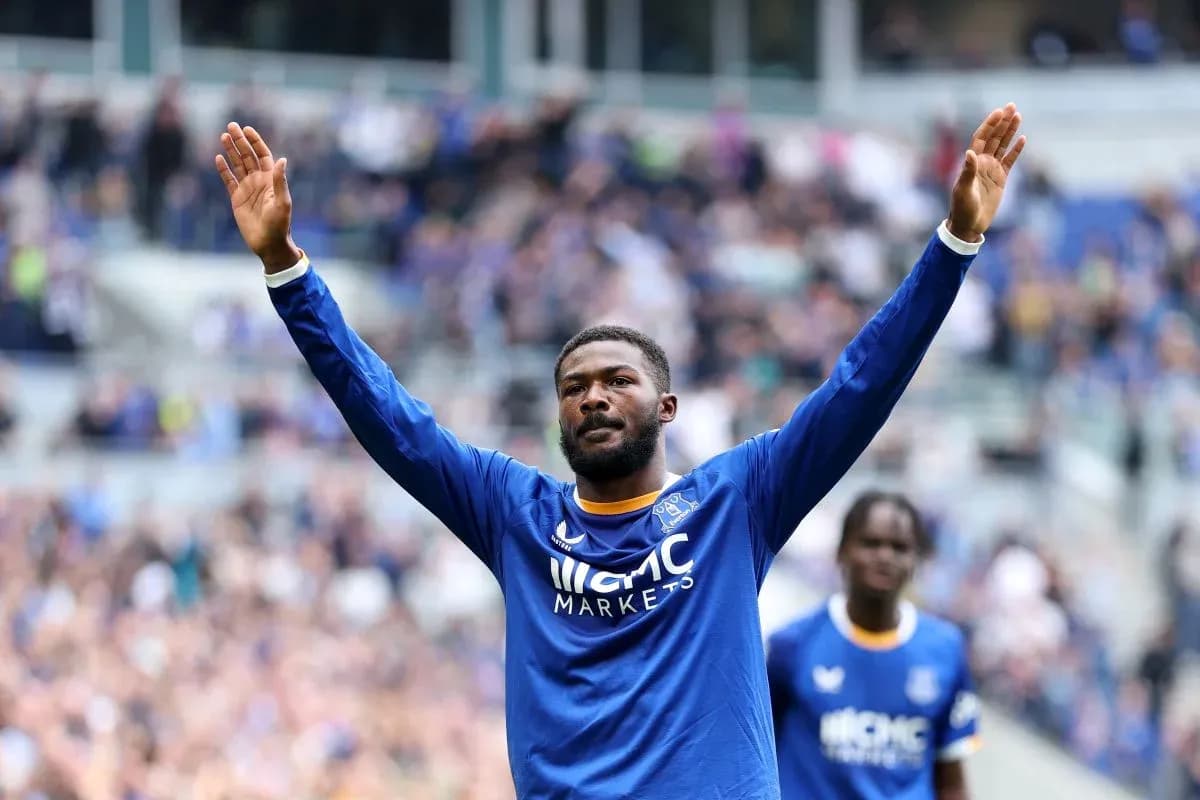
Everton and Manchester United Battle to 2-2 Draw at Hill Dickinson Stadium
Hill Dickinson Stadium hosted a meeting of two evolving identities, and the 2-2 draw between Everton and Manchester United felt less like a settled verdict and more like a tactical sketchbook left open on the table. Following this result, Everton sit 8th in the Premier League with 5 points from 3 matches, their overall goal difference at +2 (5 scored, 3 conceded). Manchester United, 11th with 4 points from 3 games, carry an overall goal difference of +1 (7 scored, 6 conceded). Both are unbeaten at key aspects of their plans, but neither is yet the finished article.
I. The Big Picture – Structures and Seasonal DNA
Both sides lined up in a 4-2-3-1, but the shared formation hid very different intentions.
Everton under Leighton Baines have quietly built a platform of control. At home this season, they have scored 4 goals and conceded 2 across 2 matches, averaging 2.0 goals for and 1.0 against at Hill Dickinson Stadium. They remain unbeaten overall (1 win, 2 draws, 0 defeats), with a clean sheet already banked and no game yet where they have failed to score. The structure is clear: a back four that holds its line, a double pivot to screen and recycle, and a band of three behind a lone forward that aims to break in numbers rather than through a single star.
United’s seasonal profile is more volatile. Overall they have 7 goals for and 6 against, averaging 2.3 goals scored and 2.0 conceded per match. At Old Trafford they have been explosive, scoring 5 and conceding 2 in a single home outing, but on their travels the picture is far less comfortable: 2 away goals scored, 4 conceded across 2 matches, with one away defeat already on the board. Michael Carrick has kept faith with 4-2-3-1 in all three league fixtures, but the balance between Bruno Fernandes’ creative licence and the defensive cover behind him remains a live question.
II. Tactical Voids – Absences and Discipline
The absentees shaped the tone of this contest even before kick-off. Everton were without C. Norgaard, whose injury removed a potential controlling presence at the base of midfield. In his absence, H. Armstrong and J. Garner had to shoulder more responsibility in the double pivot, both in screening the back four and in progressing the ball under pressure.
United’s casualty list was heavier and more structurally significant. C. Baleba, A. Diallo, T. Heaton, M. Ugarte and M. de Ligt all missed out. The absence of Ugarte and de Ligt, in particular, forced Carrick into a more delicate balancing act: Lisandro Martinez and Harry Maguire anchored the defence, but without Ugarte’s ball-winning presence, the protection in front of them had to come from K. Mainoo and the positional discipline of the full-backs.
Disciplinary trends this season hinted at the emotional temperature. Everton’s yellow cards are spread almost evenly across the match, with 20.00% of their cautions coming in each of the 0-15, 31-45, 46-60, 61-75 and 91-105 minute windows. That pattern speaks to a team that fouls in moments of transition rather than in extended periods of panic. United, by contrast, cluster their bookings late: 40.00% of their yellows arrive between 76-90 minutes, with another 20.00% in the 31-45 window and 20.00% in 91-105. This is a side that can fray under scoreboard or physical pressure as the game stretches.
III. Key Matchups – Hunter vs Shield, and the Engine Room
The marquee duel was always going to be Bruno Fernandes against Everton’s central shield. Bruno arrives as one of the league’s early standouts: in total this campaign he has 3 goals and 1 assist from 3 appearances, with 9 shots (4 on target), 203 completed passes at 84% accuracy, and 8 key passes. He is United’s primary chance creator and their most reliable scorer, including from the spot – United’s penalty record this season is perfect, with 1 penalty taken and 1 scored, none missed.
Everton’s response was structural rather than individual. J. Tarkowski and J. Branthwaite formed a compact central pairing, with V. Mykolenko and M. Rohl tucking in intelligently to narrow the channels Bruno loves to exploit. Ahead of them, J. Garner and H. Armstrong were tasked with closing his passing lanes rather than diving into reckless challenges – a sensible approach for a side whose card profile shows no red cards and a measured spread of yellows.
Out wide, the duel between B. Mbeumo and Everton’s left side was another decisive front. Mbeumo has started the season as a high-impact wide threat for United: 2 goals in total, 7 shots (4 on target), 5 key passes and 3 interceptions, combining final-third incision with hard running without the ball. His willingness to attack the inside channel tested Mykolenko’s positioning and demanded support from K. Dewsbury-Hall tracking back from the left of Everton’s three.
For Everton, creativity was more distributed. B. Johnson, who has already collected a yellow card this season and committed 4 fouls, offers vertical threat and aggression in the attacking band. His duels (12 total, 3 won) and defensive contribution (2 tackles, 1 block, 2 interceptions) underline why Baines trusts him in high-intensity fixtures like this, even if his end product is still catching up.
From the bench, H. Hackney loomed as Everton’s subtle playmaking option. With 1 assist in total this season, 3 key passes and 89% passing accuracy, he represents a calmer tempo-setter who can help Everton manage games in the final half-hour – particularly valuable against a United side whose discipline deteriorates late.
At centre-forward, T. Barry and M. Cunha operated as contrasting spearheads. Barry worked primarily as a channel-runner and first presser, linking with T. George and Dewsbury-Hall, while Cunha’s role was to pin Tarkowski and Branthwaite, freeing Bruno and M. Rashford to attack the spaces around him.
IV. Statistical Prognosis – Where the Game Tilted
Everton’s season-long numbers paint a picture of controlled growth. Overall they average 1.7 goals for and 1.0 against per match, with no defeats and only one clean sheet needed to keep their overall goal difference positive. At home they have been particularly secure: 4 goals scored, 2 conceded, and a biggest home win of 2-0. They do not rely on penalties – none awarded, none missed – and they have not yet failed to score in any fixture.
United, by contrast, are more boom-or-bust. Their biggest win is a 5-2 home result, their heaviest defeat a 2-0 away loss. On their travels they average 1.0 goal scored and 2.0 conceded, a fragile platform for a side with top-four ambitions. The absence of any clean sheet in total so far underscores the defensive work still to be done, especially when the game becomes stretched in the final quarter-hour – precisely when their yellow-card rate spikes.
Following this 2-2 draw, the statistical currents suggest two truths. Everton look like a side whose floor is rising: unbeaten, structurally consistent, and increasingly comfortable in this 4-2-3-1. United, meanwhile, remain dependent on the individual brilliance of Bruno Fernandes and the cutting edge of Mbeumo, but their away defensive profile and late-game discipline continue to drag their ceiling down.
If xG could be overlaid on this narrative, it would likely show Everton’s chances coming from well-constructed moves and sustained pressure at home, while United’s spikes would correlate with Bruno’s shot volume and Mbeumo’s breaks. The draw feels like a fair reflection of where both squads stand: Everton as an emerging collective, United as a dangerous but still unbalanced contender whose season will hinge on whether their defensive solidity can ever match their attacking flair.