Feyenoord Win Amidst Chaos: Flares and Injuries at Kooi Stadion
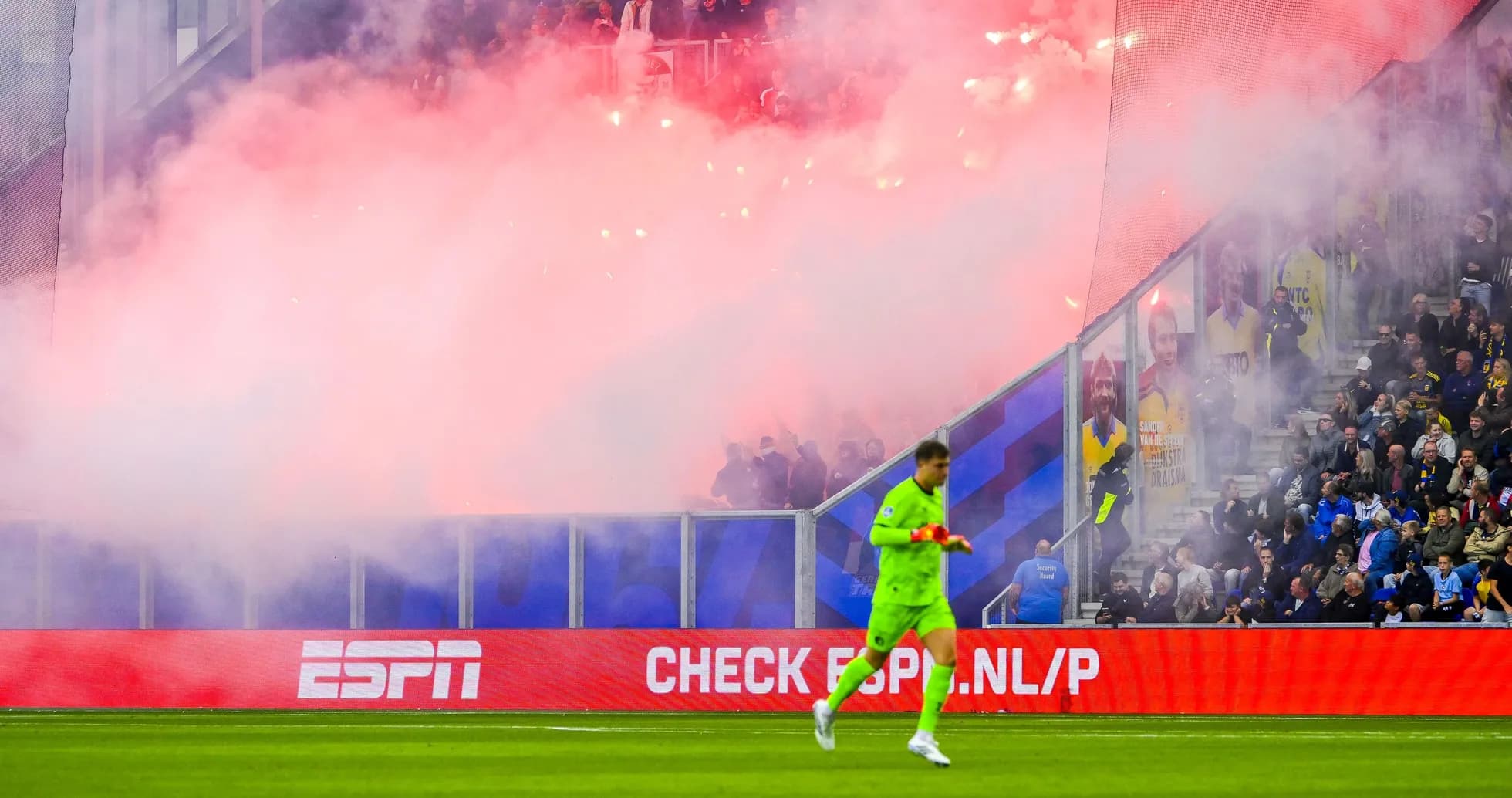
The scoreboard read 5-2 to Feyenoord, but the numbers felt almost irrelevant in Leeuwarden. What lingered instead were the images: a wall of red smoke, fireworks streaking across the Kooi Stadion, and players sprinting for the tunnel as explosions cracked near the pitch.
The Eredivisie, once again, was dragged into a familiar and deeply troubling conversation.
Match Stopped as Away End Erupts
The trouble started early. In the 12th minute, with the game still settling into rhythm, the away section holding Feyenoord supporters ignited a barrage of red flares. Fireworks followed, not just onto the pitch, but towards Cambuur fans in the home stands.
Smoke quickly swallowed large parts of the stadium. Referee and players had no choice. The match was halted, and both teams were led off the field as detonations rang out close to the playing surface.
One blast landed frighteningly close to Feyenoord goalkeeper Tjark Ernst, detonating just metres from him. It was a stark reminder that this was not just spectacle; it was a situation inches away from serious harm to those on the grass as well as in the seats.
Play eventually resumed after roughly 10 minutes. The damage in the stands, though, was already done.
Cambuur Confirm Injuries in the Stands
In the aftermath, Cambuur laid out the grim reality. The club confirmed that five home supporters had been injured in the incident. Their medical update detailed "burns, hearing damage and eye injuries" after fireworks were fired directly into sections packed with Cambuur fans.
For a club only recently back in the Eredivisie after three seasons away, this was supposed to be another measure of progress on the pitch. Instead, the conversation turned to safety, vulnerability and how such scenes were allowed to unfold in the first place.
Feyenoord Win, but Leave with Heavy Conscience
On the field, Feyenoord did what title contenders are expected to do: they scored five, controlled the contest and left with three points. Inside the club, though, there was no appetite for celebration.
Head coach Giovanni van Bronckhorst moved quickly after the final whistle, offering apologies to Cambuur’s leadership on behalf of Feyenoord. The Rotterdam club then issued a formal statement, stressing it "firmly distances itself from the unacceptable events" and promising internal action.
Feyenoord announced that they will request and review all available camera footage to identify those responsible for what they described as life‑threatening behaviour. The club wants names, faces and consequences.
General manager Robert Eenhoorn cut a visibly shaken figure as he spoke post-match. The scoreline, he made clear, was an afterthought.
"I cannot be happy," he admitted. "Frustration prevails too much for that. This problem obviously does not only affect Feyenoord and is unfortunately something we have been unable to put a stop to for decades. We will therefore have to sit down again with all stakeholders, clubs, the KNVB and the authorities to look for a solution together."
Cambuur and City Authorities Demand Answers
Cambuur’s response carried the anger of a club whose own supporters had been put in direct danger. The board promised a full investigation in cooperation with local police and government officials.
Their statement left no room for ambiguity: "It should be clear that setting off and firing fireworks is completely unacceptable and has no place in a football stadium whatsoever."
Leeuwarden’s mayor, Foort van Oosten, stepped in as well. He condemned the events in the strongest terms and vowed to find out how such a large quantity of pyrotechnics was smuggled into the Kooi Stadion in the first place.
Security checks, stewarding, and search procedures at Eredivisie grounds now sit under a harsh spotlight. This was not an isolated eruption. Dutch football has been wrestling with escalating fan disorder, from repeated flare incidents to last season’s high‑profile abandonment of Ajax vs Groningen after similar pyrotechnic chaos.
KNVB Under Fire Over Protocols
One question cut through the noise: why did the game continue?
Under current KNVB regulations, a match must be abandoned if a player or match official is struck by an object. When the injured are supporters, the rules become far less defined.
That grey area is now at the centre of a storm. Five fans were confirmed injured, yet the game restarted and ran to its conclusion. For many, including officials within the Dutch football association itself, that sat badly.
Jan Bluyssen, the KNVB’s manager of professional football competition affairs, did not try to gloss over the issue. Speaking to Dutch news agency ANP, he admitted the optics were troubling. "That doesn't feel right," he said.
The governing body now faces growing pressure to toughen its stance. Clubs whose fans cause bodily harm to others are expected to face stricter penalties, and the KNVB has confirmed it will revisit its disorder protocols to ensure supporter safety is placed above the need to finish a fixture at all costs.
The fireworks in Leeuwarden have gone out. The smoke has cleared. But with anger simmering in boardrooms, city halls and supporter groups across the country, Dutch football now has to decide: does it finally draw a hard line, or wait for the next explosion to land even closer?