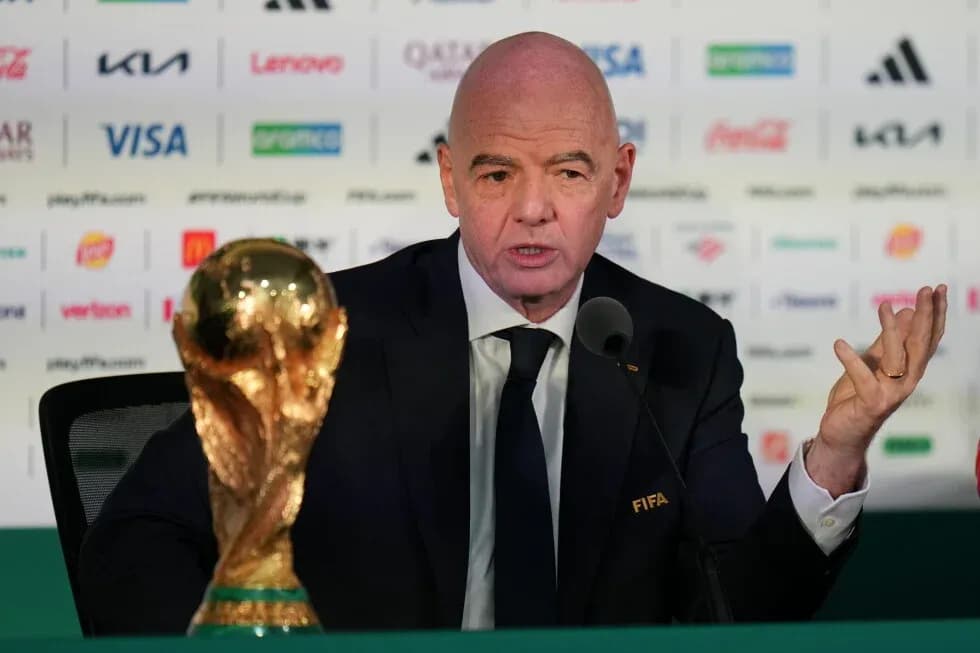
FIFA's $20 Million Proposal: Infantino's Controversial Plan
GENEVA — Gianni Infantino has put world football on the clock.
In a letter that landed like a grenade in inboxes across the globe, the FIFA president on Wednesday gave all 211 member federations until Sept. 19 to sign up to a one-off $20 million payout, tied to a radical plan to sell a stake in the World Cup and other flagship competitions to private investors.
At the heart of it: a proposed $20 billion FIFA subsidiary, with 20% owned by outside backers, fronted by Thrive Capital — the investment firm of Joshua Kushner, brother of Jared Kushner. The new vehicle would run FIFA’s competitions and events for 12 years, including World Cups and Club World Cups.
Infantino calls it a “singular and unique funding opportunity.” Large parts of the football world call it something else entirely.
UEFA leads the backlash
The fury in Europe was immediate and visceral. UEFA, blindsided and incensed, moved to convene an emergency online meeting of its 55 member associations, likely on Thursday, and issued a stinging statement.
“The World Cup is not FIFA’s to sell,” was the core message from Infantino’s former colleagues in Nyon, who say they learned of the proposal the same way as everyone else: through the media.
UEFA warned that the rushed deadline and the pressure tactics “say everything you need to know about this plan,” accusing FIFA of using the sport “to enrich themselves and their friends.” The threat that always lurks in the background surfaced again: Europe could consider boycotting FIFA competitions, just as UEFA-led resistance helped kill Infantino’s attempt in 2021 to turn the men’s World Cup into a biennial event.
The influential European Football Clubs group, which co-manages the Champions League with UEFA, echoed the anger, saying it too had been kept in the dark until the story broke publicly.
The sense of exclusion was not limited to Europe.
Global confederations bristle
Across the world, continental bodies lined up to question both the substance and the process.
CONCACAF, representing North and Central America and the Caribbean, said it was “deeply concerned by the lack of due process.” The Asian Football Confederation, based in Kuala Lumpur, said it was “disappointed that a matter of such significance entered the public domain before the AFC family had been afforded the opportunity to examine and discuss it.”
The complaint is consistent: a project that could reshape the global game for more than a decade has been pushed forward with speed and secrecy, with major stakeholders feeling railroaded rather than consulted.
Behind the anger lies a deeper fear. If FIFA’s new subsidiary controls the most lucrative competitions and is partly owned by private investors, the pressure to stage more World Cups, more Club World Cups, and to add more teams will only intensify. That would threaten the calendar space, prestige, and commercial power of confederation-run tournaments such as the Champions League, European Championship, and Copa America.
Sports governance expert Antoine Duval summed up the concern in stark terms, warning that inviting in private equity could “incentivize FIFA to further commodify the World Cup,” from more commercial breaks to aggressive dynamic pricing, all in pursuit of revenue.
The money on the table
Infantino’s pitch to the 211 member federations is simple and brutally clear.
Approve the creation of the new FIFA Forward Enterprise subsidiary and each federation is promised $20 million from the commercial cycle tied to the 2030 men’s World Cup. That money, he wrote, will come as part of a broader deal that could eventually bring in “a pool of diverse international investors,” with Thrive as the anchor investor and J.P. Morgan leading the process.
Reject the plan, and the offer drops back to the previously promised $10 million over the next four years.
Over 12 years, the cash gap is stark: about $86 million per federation under the private equity scheme, compared with roughly $36 million if they say no and stick with the existing funding model.
For dozens of smaller or less developed federations — many of which rely heavily on FIFA money, rarely qualify for World Cups, and have players who seldom reach the elite club level — that difference is seismic. In FIFA’s one-member, one-vote system, those nations can easily outvote the sport’s superpowers on the field.
Infantino knows this. It helped elect him in 2016 and carried him through unopposed reelections in 2019 and 2023, built on promises of more money flowing directly to national associations.
Now, he is asking those same voters to back his most audacious project yet.
A pattern of power plays
The private equity proposal is not an isolated idea. It fits a clear pattern in Infantino’s 11-year presidency: big, often secretive, revenue-chasing projects that leave traditional power brokers feeling sidelined.
In 2018, he tried to push through a $25 billion private equity deal for new and expanded men’s competitions. UEFA pushed back and the plan stalled. He created a FIFA Peace Prize and awarded it to then-U.S. President Donald Trump at the World Cup draw. He welcomed Trump’s intervention in the eligibility saga that cleared United States forward Folarin Balogun to play at the World Cup.
Now, he is trying to bolt Joshua Kushner’s Thrive Capital onto the heart of world football’s commercial engine for 12 years.
The sense that Infantino is increasingly acting like a chief executive of a global entertainment company, rather than the elected head of a not-for-profit sports body based in Switzerland, has never been stronger.
Political fire in Britain
Resistance has not been limited to football’s own institutions. In Britain, the backlash quickly turned political.
Prime Minister Andy Burnham, a longtime football fan whose government is backing a joint bid by England, Scotland, Wales, and Ireland to host the 2035 Women’s World Cup, came out swinging in a video message.
“Football does not belong to investors,” he said. “Once you have sold a piece of (the World Cup), you have sold out. Football belongs to the fans. It always has, and it always will.”
British lawmakers have form here. Political pressure, including threats of legislation from then-Prime Minister Boris Johnson, played a crucial role in crushing the breakaway European Super League in 2021 — a project that challenged UEFA’s Champions League and which Infantino had discreetly supported. J.P. Morgan was also a central player in that doomed venture.
The echoes are impossible to ignore.
Infantino’s future on the line?
Until this week, Infantino looked to be cruising toward a fourth and final term as FIFA president, running unopposed through 2031. His alliance with many smaller federations, fueled by funding promises, seemed unshakeable.
Now, the mood is shifting.
By pushing a deal that has enraged UEFA, alarmed other confederations, and dragged in political leaders, Infantino has stirred discontent beyond the usual critics in Europe. With almost four months left before the Nov. 18 deadline for presidential candidates to enter the race, the door is suddenly open — at least in theory — for a challenge.
There is another twist. Some in the game have long suspected that Infantino’s ultimate ambition stretches beyond the FIFA presidency itself. A long-term CEO or commissioner-style role at a powerful, semi-independent FIFA subsidiary — such as the proposed FIFA Forward Enterprise — would fit that ambition perfectly, even after his presidential term limit expires.
The election is set for March 18 in Rabat, Morocco, a key Infantino ally and co-host of the 2030 World Cup. By then, the sport may have decided whether to sell a slice of its crown jewel to Wall Street-backed investors — or to draw a hard line on who really owns the World Cup.
The clock to Sept. 19 is ticking. The next move belongs to the 211 federations who must decide if the promise of cash today is worth the price of control tomorrow.