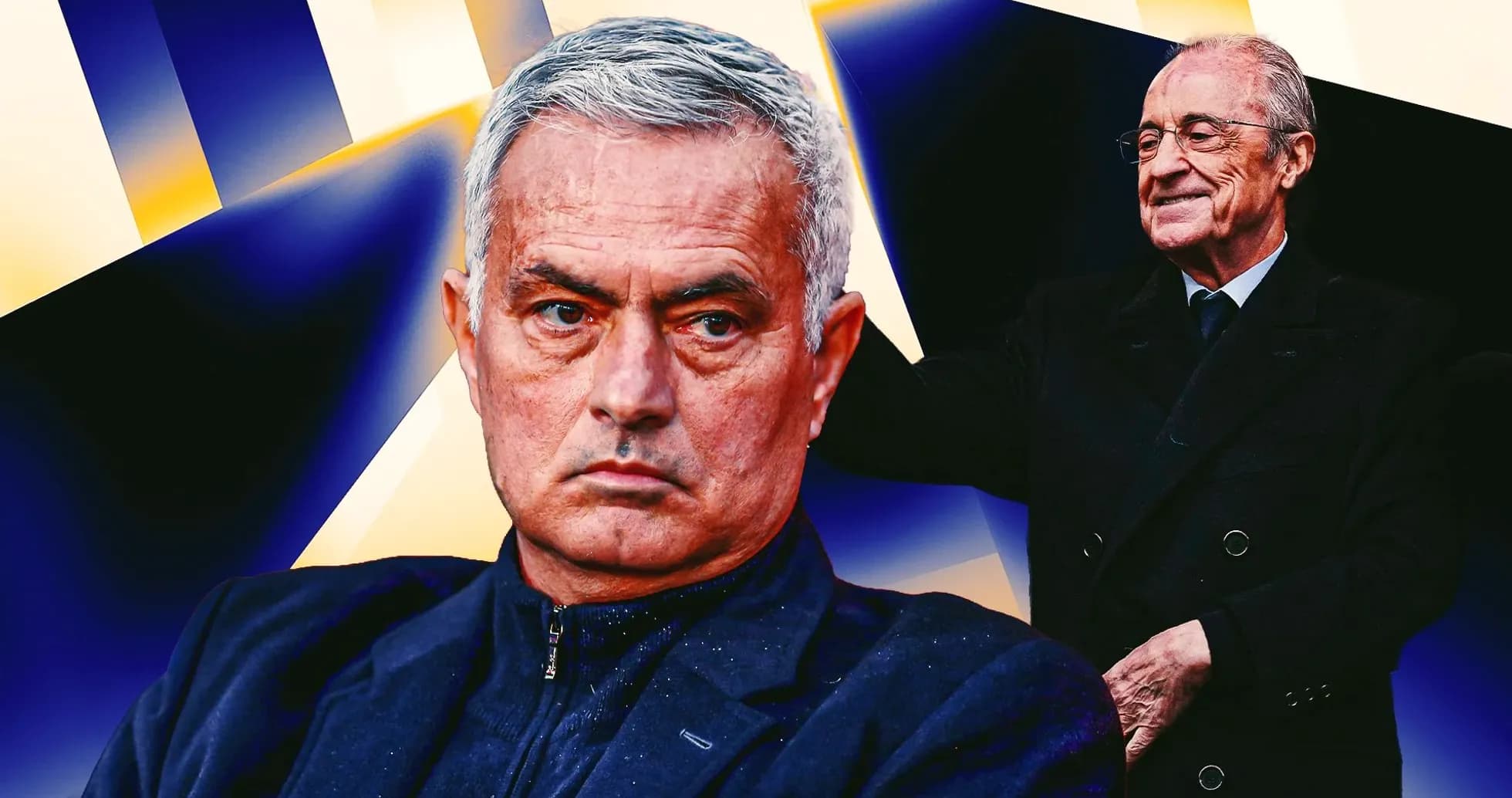
Florentino Pérez's Mourinho Dilemma: A Return to the Past?
Florentino Pérez is staring at the past and trying to convince himself it still looks like the future.
He sees echoes of 2010 everywhere. Real Madrid, once again, are trudging towards a second straight season without a major trophy – a catastrophe by Bernabéu standards. Barcelona are back on top, driven by another diminutive, left-footed genius. The parallels are neat. Seductive, even.
So Pérez reaches for the same answer he clutched at back then: José Mourinho.
The problem is that the Mourinho of 2024 is not the Mourinho of 2010. Not even close.
A myth colliding with reality
Mourinho still generates headlines, still thrives on conflict, still revels in the theatre of chaos. But the trophies stopped coming a long time ago. He has not won a league title in 11 years. His last piece of silverware, of any kind, is the 2022 Europa Conference League. For a two-time Champions League winner, that is not a line on the CV. It is a verdict.
Pérez will argue that none of this matters. That what Madrid need now is not a tactical visionary but a personality big enough to dominate a dressing room packed with egos and Ballon d'Or contenders. In his eyes, Mourinho remains that figure: a commanding presence, a natural lightning rod, a man who can look Kylian Mbappé and the rest in the eye and make them listen.
Sergio Ramos once captured that internal Bernabéu logic perfectly: “At Real, managing the dressing room is more important than the coach’s tactical knowledge.” That sentence still shapes Pérez’s thinking.
But Mourinho is not Ancelotti. He is not Zidane. He is the antithesis of the calm, unifying, ego-soothing figures who delivered Madrid’s modern Champions League dynasty. Where they absorbed pressure, he multiplies it. Where they soothed, he scorched.
And everyone in Madrid has already seen how that story ends.
The first divorce
Mourinho loves to remind anyone who will listen that he is one of the few Madrid coaches who “left on his own terms”. Pérez has always backed that version. “Nobody’s been sacked, it’s a mutual agreement,” the president insisted in 2013. “We’ve decided to bring our relationship to an end.”
The reality was far uglier. Less than a year after signing a contract extension to 2016, Mourinho’s position had become untenable.
By January 2013, the situation was so toxic that Pérez took the extraordinary step of calling a press conference just to deny a MARCA report that senior players – including Iker Casillas and Ramos – had threatened to walk unless Mourinho was removed. Officially, the president stood by his coach. Unofficially, everyone could see the dressing room had already slipped from Mourinho’s grasp.
The very tools that had brought him glory at Porto, Chelsea and Inter turned against him in Madrid. The siege mentality, the permanent state of war with the outside world, the climate of suspicion and grievance – it all eventually seeped into the squad itself. The players stopped feeling protected by the barricades. They felt trapped behind them.
When Casillas was dropped to the bench in 2012-13, he stayed quiet in public. Pepe did not. The defender openly criticised Mourinho’s treatment of the club legend. Mourinho hit back by suggesting Pepe was merely bitter because a teenage Raphaël Varane had taken his place.
Ramos, meanwhile, reportedly mocked Mourinho’s footballing ability behind closed doors. When Ancelotti arrived in June 2013, Ramos delivered a line that cut to the heart of the matter: “You can tell he was a top player.”
The message was clear. The players wanted a coach they could relate to, not a general barking orders from a bunker.
Who really built the dynasty?
Pérez and Mourinho have long pushed the idea that the Portuguese laid the foundations for Madrid’s later Champions League dominance. According to Mourinho, Pérez even pleaded with him in 2013: “Don’t leave now. You’ve done the hard part and the good part is yet to come.”
Ramos never bought it. When asked about Mourinho’s supposed role in Madrid’s four Champions League titles between 2014 and 2018, he was blunt: “I don’t think he had anything to do with it. On the contrary, in fact…”
That may go too far. Mourinho did help harden Madrid in big games, did force the club to confront Barcelona’s supremacy. But the notion that he was the architect of La Décima and everything that followed has always felt like a convenient myth.
What is undeniable is how dramatically the atmosphere changed once Ancelotti walked through the door. The constant firefights ceased. The dressing room relaxed. The football flourished. Madrid stopped fighting everyone and started winning almost everything.
That is the contrast Pérez is now ignoring.
A club in upheaval, a president out of ideas
Madrid today are not a stable, smoothly functioning machine in need of a minor jolt. They are coming off a season of turbulence. Xabi Alonso was supposed to be the long-term project, the moderniser, the fresh voice. Instead, he was ruthlessly discarded just over six months into the job, replaced by rookie coach Álvaro Arbeloa.
The message from the boardroom was brutal and unmistakable: patience is a luxury this president no longer believes in.
In that context, Mourinho’s name rising back to the top of Pérez’s wish-list says less about the coach and more about the president. It screams of a man running out of ideas, clinging to an old solution because he cannot see a new one.
Not everyone inside the club is on board. Reports suggest parts of the board are wary, to put it mildly. They remember the scorched earth. They remember the factions. They remember how hard it was to clean up the mess last time.
But Pérez still rules the Bernabéu. His long-standing conviction that Madrid need a leader more than a tactician has only been strengthened by the failure of the Alonso experiment under José Ángel Sánchez’s watch. From his perspective, the conclusion is simple: give the stars a strongman and let their talent do the rest.
Football outside his bubble tells a different story. Watch Paris Saint-Germain and Bayern Munich tear into each other at Parc des Princes in the Champions League. The speed, the pressing, the fluidity, the attacking ambition. The game has sprinted away from Mourinho’s default settings.
Pérez, though, is acting as if time has stood still.
A fractured dressing room waiting to happen
Even inside the current squad, the idea of a Mourinho return is far from universally appealing.
Mbappé may have liked an Instagram post linking the Portuguese to the Madrid job. That is one data point. Another is Vinícius Júnior, who was effectively blamed by Mourinho for provoking the shameful racist abuse he suffered in Lisbon this season, in a Champions League play-off against Mourinho’s Benfica that had to be suspended.
How does that dynamic play out if the same man walks into the Valdebebas dressing room as his boss?
This is the risk Madrid are flirting with: importing a coach whose power base relies on division into a squad that has already lived through enough drama for one season. A coach whose intensity burns bright, then burns everything around it.
Back in 2015, the idea of bringing Mourinho back to Madrid already felt like a terrible miscalculation. The club had moved forward; he had not. Now, nearly a decade later, with his last league title fading into the distant past and the sport’s tactical and emotional landscape transformed, the prospect is even more jarring.
If Pérez really believes Mourinho is still the answer, the more uncomfortable question hangs over the Bernabéu: what does that say about the man asking it?