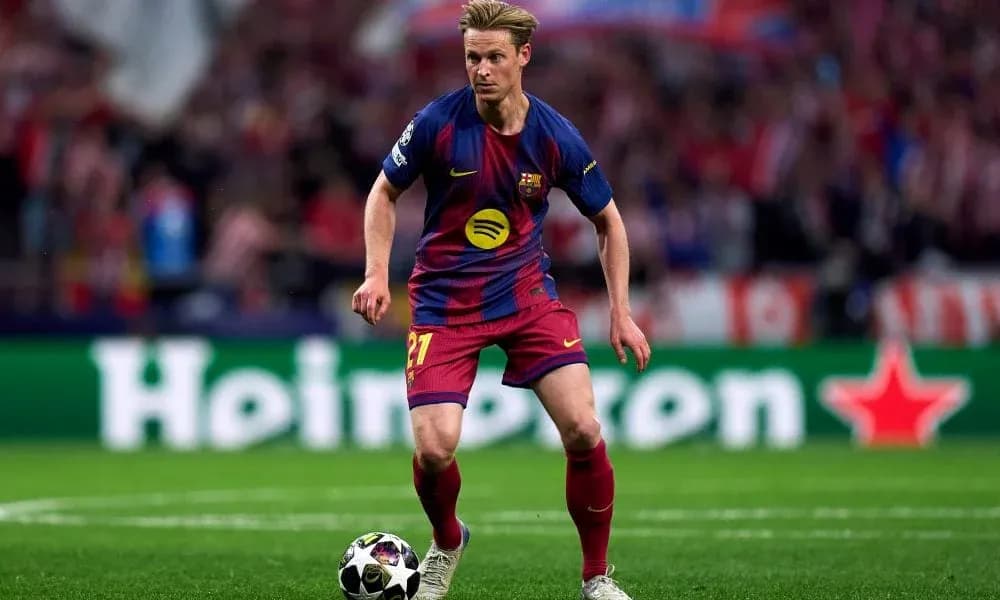
Frenkie de Jong's Future at Barcelona: Final Season Ahead?
Frenkie de Jong’s future at Barcelona is back under the microscope, with one leading Dutch voice convinced the midfielder is heading into his final season at the club.
Valentijn Driessen, speaking on De Telegraaf’s podcast, painted a stark picture of De Jong’s situation at Barça, where injury problems and the arrival of Rodri threaten to reshape the hierarchy in Hansi Flick’s midfield.
“He has been injured a lot; they already tried to get rid of him before, and now they bring Rodri,” Driessen said, adding that while he does not expect Barcelona to push De Jong out while he is sidelined, he believes “he’s in his last season at Barça.”
Rodri’s arrival shifts the midfield landscape
Barcelona’s move for Rodri has changed the tone of the conversation around De Jong. The club have added one of the most accomplished midfielders in world football, a player expected to become a cornerstone of Flick’s project and a guaranteed starter in the heart of the team.
De Jong, by contrast, is trying to fight his way back from yet another injury and into a side that suddenly looks far more crowded in his zone of the pitch.
The Dutchman has always been clear about his dream: to stay at Barcelona for the rest of his career. Driessen is blunt about the chances of that happening.
“He wanted to stay at Barcelona until the end of his career, but that’s a privilege granted to very few players,” he said. In his view, De Jong is not the type of player “you’d think would remain a first-team regular at Barcelona until he’s 35. In short, he won’t see out the end of his career there.”
For Driessen, Rodri’s signing does not automatically trigger a transfer for De Jong, especially while he is recovering. The threat is subtler. Once everyone is fit, the competition could quietly erode the Dutchman’s status and minutes.
He even questions whether there is room for both of them in Flick’s preferred XI.
“You always have to perform to keep playing. If an excellent player comes in who plays in your position, I can’t imagine those two playing together,” he argued.
A tactical crossroads for De Jong
That leads to the key issue: adaptation. De Jong has built his reputation on controlling games from deeper areas, carrying the ball through pressure and knitting together different phases of play. He likes to see the whole pitch in front of him, not chase it near the penalty area.
To coexist with Rodri, Driessen believes De Jong would have to push higher up the pitch, take more risks, and become more of an attacking presence. He is not convinced that switch suits him.
“He might be able to try, but he needs to be more attacking, and that’s usually the point of criticism: that he lacks that. He’s never managed it,” Driessen said.
The question now hangs over Flick. Does the new Barcelona coach see a way to pair two elite midfielders who both prefer to operate from the base of play? Or does he view Rodri as the fixed point and De Jong as the one who must bend?
Barcelona’s midfield is already packed with players who can interpret different roles and zones. Once De Jong returns, the system Flick chooses will decide whether the Dutchman remains central to the project or becomes a luxury piece in a squad that suddenly has less room for sentiment.
Rodri’s arrival does not guarantee De Jong’s exit. It does something more ruthless: it forces a decision on what kind of midfielder De Jong wants to be in the final prime years of his career – and whether that evolution happens in Barcelona or somewhere else.