The Future of Football: AI and Data Revolution
The future of football isn’t arriving with a bang. It’s slipping in through side doors, buried in spreadsheets, MRI scans and four quick photos on a phone.
Clubs will tell you they still trust their eyes. But the arms race has shifted. Every marginal gain now has a processor behind it.
From Arsenal blog to AI war rooms
Ask Micky Bracha how that happened and he’ll take you back to his living room, not a boardroom.
A devoted Arsenal fan, he started as so many modern analysts do: with a blog and an opinion. He watched the Gunners obsessively, mixed the eye test with whatever data he could find, and began flagging players he thought big clubs were missing. The audience grew. Scouts started reading.
Then his day job in tech got busy. He didn’t have time to churn out long, detailed posts. So he built himself a shortcut.
He trained an AI model to spit out the skeleton of his articles. He layered his own insight on top. Somewhere in that blend of code and intuition, he began to uncover players who weren’t yet on everyone’s radar.
“I started to get inbox requests from professional scouts and at clubs asking me, 'How do I know about that on a player?’” Bracha recalled. His answer stunned them: “It's just ChatGPT.”
If that was enough to impress people paid to spot talent, he wondered, what exactly were clubs using?
The answer, he discovered, was chaos.
Drowning in data
Football’s data revolution didn’t arrive neatly packaged. Wyscout helped drag the sport into the numbers era in the early 2010s, but rivals quickly piled in. Now, there are too many dashboards, too many metrics, too many ways to slice the same performance.
“In the past 10 years, this industry has moved from complete scarcity to data overload,” Bracha said. “There are so many different data providers.”
Clubs had numbers. What they didn’t have was coherence.
So Bracha built Marquee, a company that effectively acts as an outsourced analytics department. It hoovers up information from scattered platforms, strips away the noise and presents clubs with something usable.
“If we automate a lot of these glorified spreadsheet processes, and the different platforms that are scattered and cannot be consolidated into one place, we do it for them,” he explained. “Marquee is an analytical department that works for the club.”
This isn’t Football Manager dressed up in corporate language. Marquee sells tailored scouting profiles, designed around a club’s tactical model and recruitment needs. The platform doesn’t just ask who’s good; it asks who fits.
Some Premier League sides already lean on it. Barcelona and MLS outfit Chicago Fire have publicly backed it. Clubs can ignore the recommendations if they like, but the service has clearly earned a seat at the table.
And yet, this is only one front in football’s AI experiment.
When the machine spots fatigue before the player does
Last year, FC Cincinnati faced Nashville SC in MLS. Deep into the game, center-back Matt Miazga began to tire. Five minutes before he asked to come off, the club’s tech stack had already flagged something was wrong.
An “irregular movement pattern” flashed up.
The system doesn’t operate in real time, so nobody rushed to the touchline waving a printout. They didn’t force him to play through pain. But the machine had seen the dip before the human did.
The bigger question, though, isn’t about the moment of injury. It’s about what happens next.
How quickly can he come back? When is he truly ready? And how do you even measure that?
For Springbok Analytics, that’s the puzzle.
Cracking football’s most stubborn injury
Ask any medical department for their worst headache and you’ll hear the same word: hamstrings.
A 2020 NIH study found hamstrings account for 12 percent of all professional soccer injuries. The re-injury rate? Somewhere between four and 68 percent. That’s not a margin of error; that’s a guessing game.
Hamstring problems usually show up under fatigue, often late in halves. Clubs have thrown every new gadget and test at the problem. The trend line still points the wrong way.
“We’ve got all the new technology that exists every which way, all the new ways of testing people… how much force can you produce? What does running look like? Hamstring injuries have not gone down. They've gone up,” said Matt Brown, Analytics Director at Springbok Analytics.
Brown believes the core issue is how the game handles data around injuries. Diagnosing a tear is simple. Quantifying what’s happening inside the muscle over months of rehab is not.
“You want to scan a player at the time of injury, two months later, six months later, to track atrophy and see if you're getting the stimulus and the changes that you're going after with muscle,” he said.
Springbok grew out of the University of Virginia, where researchers built ultra-precise MRI tools for children with cerebral palsy. They created 3D models to help surgeons calculate tendon lengthening procedures. When that worked, the tech made the jump to sport.
The NBA signed on in 2023. MLS chose Springbok for its Innovation Lab this year.
Traditional MRIs are, as Brown puts it, “thousands and thousands of slices of [two-dimensional gray images].” Doctors stack them, interpret them and mentally build a 3D picture. It’s slow, specialist work.
Springbok’s AI does the heavy lifting.
“We can now pre-process those images using AI,” Brown said. “We process through them, create the muscle boundaries, and we can give a very finalized, beautiful 3D digital twin.”
They don’t treat the injury. They don’t promise to prevent the next one. What they do is slash the time it takes to turn scans into hard numbers, from about a week to hours.
“We are the support system in that we can make imaging from an MRI way more impactful and actionable,” Brown said. “We are providing you the measurements. But you're trained in this. You've done 10 years of this. You have your own thesis.”
The doctor still makes the call. The AI just hands over the clearest possible picture.
Four photos, 10 seconds, a glimpse of the future
If Springbok lives in the medical suite, Fit:Match walks straight onto the training pitch.
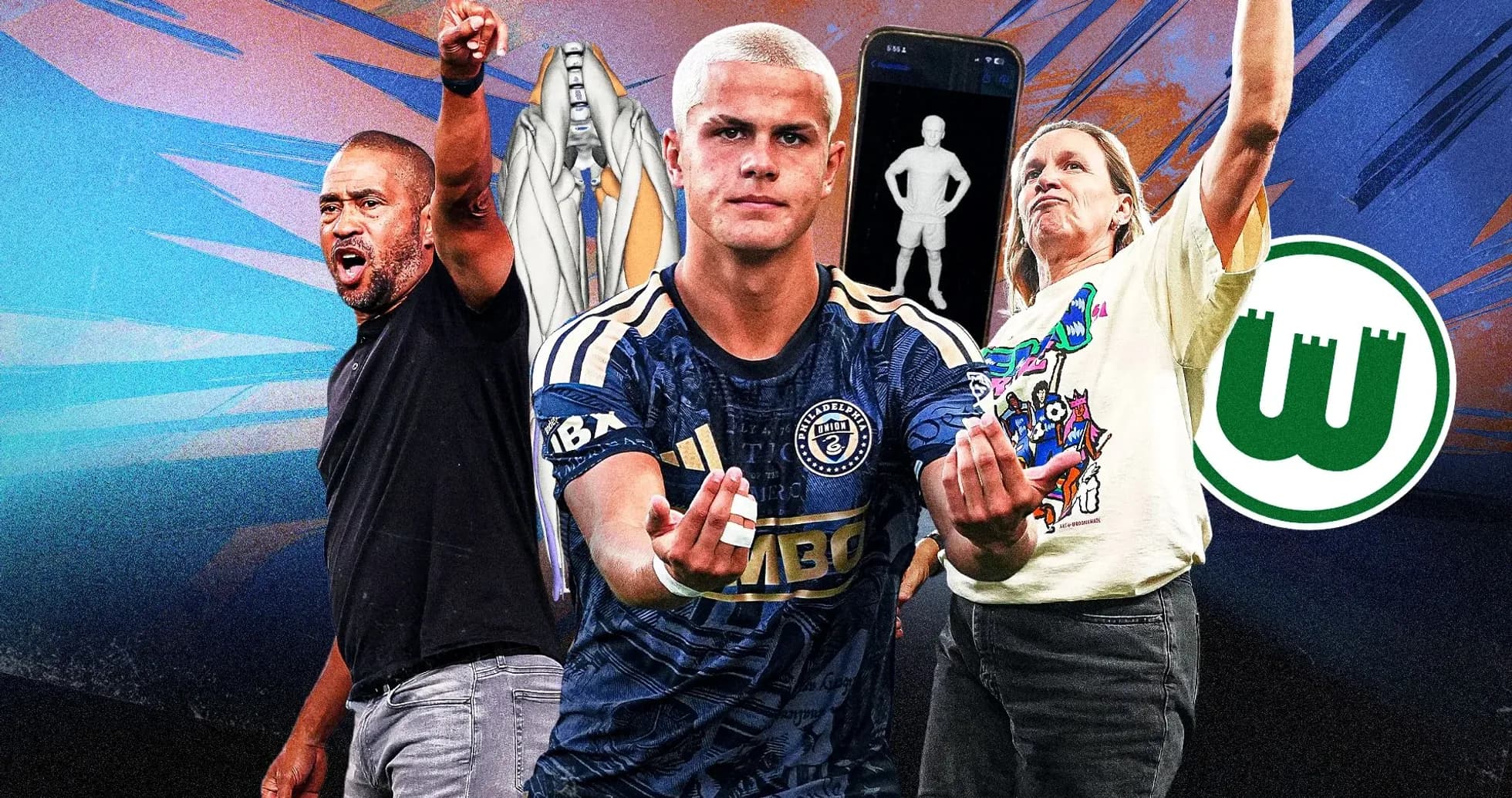
At the Philadelphia Union academy, staff wrestle with the same questions every day. What level can a kid handle? How much first-team exposure is safe for a teenager like Cavan Sullivan? Is his body ready for the jump his talent demands?
Traditionally, the answers come from strength tests, growth charts and gut feel. It’s slow and imperfect.
Fit:Match claims it can compress that process into 10 seconds and a smartphone.
Here’s how it works: a coach or parent takes four photos of a player from different angles. The phone then calculates height, body mass, wingspan and a host of other measurements. From there, the system projects likely height, growth maturation and a basic snapshot of what full physical development might look like.
Founder Haniff Brown half-jokingly calls it “ChatGPT for soccer.” A process that usually drags across multiple appointments is boiled down to a 30-second output.
Brown didn’t start in sport. He came from fashion, where he used instant body scans to help shoppers buy clothes that actually fit.
“How can we allow [a user] to upload a body profile of himself so that he doesn't have to buy four shirts and return the three that don't fit? You'll just buy one and boom,” he said.
Hospitals noticed. Healthcare companies called. Then, in 2024, a European club asked Fit:Match to scan its academy.
Brown saw a new lane.
He knew one thing from the outset: it had to be fast.
“I was very clear from the start that it had to take no more than 15 seconds,” he said. “Coaches don't like assessments that take too long. They want the kids going back, doing their drills. The longer and more complicated the assessment is, the less likely they are to use it.”
The club bought in. Others followed. One major problem quickly surfaced: inconsistency. Two coaches could measure the same player and get different results from the same basic tests.
“What we saw was one coach would, for the same player, measure and get one result, and from the same team, another coach would measure that same player and come up with a different result,” Brown said.
Fit:Match strips that human variance away. Four photos, 30 seconds of processing, and a standardized profile appears. Clubs use it. So do families.
“When parents register their children to go into an academy, they can actually upload their photos,” Brown explained. “It generates their digital twin, and then on the back end, we tell MLS all these stats on that player.”
That helps clubs place kids in the right age groups and levels, rather than simply rewarding the biggest 14-year-olds.
“A player who is a 14-year-old but an early developer is far different from a player who's 14 and a late developer,” Brown said. “Now MLS can scientifically tell that, and then make better pathways for those late developers so that they don't drop out of the ecosystem.”
The technology sounds transformative. It also carries obvious ethical weight.
The human cost of smarter machines
Projecting the physical future of a teenager is a delicate business. Doing it with algorithms raises hard questions.
“The first step was getting people comfortable,” Brown said.
Marquee ran into the same wall. The product might be built on code, but the relationship is human. Clubs don’t want to feel like they’re being replaced by a machine.
“It's more about them, to be fair, to kind of feel comfortable with everything that we do together,” Bracha said. “And then once we create some successful stories together, we will definitely publish it.”
Behind all of this sits an uncomfortable reality: AI can make certain jobs redundant. Bracha doesn’t dance around that.
“From an ROI perspective, it will always be faster, quicker, righter to go to us because we've already built something, and we're investing a lot to improve it. It's your only expense,” he said. “One of the largest expenses in football clubs today is salaries. So do they want to hire more to build such a thing or just buy externally? It's like the AI’s most common question nowadays: build or buy? In this case, I think buy.”
But buying in doesn’t guarantee success.
Wolfsburg’s warning – and Seattle’s back five
Wolfsburg were one of Europe’s early AI flag-bearers. The club boasted that its systems saved around €1 million per year in admin and injury-prevention work. On the pitch, though, results sagged. As performances dipped, the PR push around AI turned into an easy punchline.
The club hasn’t backed away. Sevilla now use IBM WatsonX to help manage their data. The tech is too embedded, too promising, to abandon.
Elsewhere, some coaches have gone hands-on with more public tools. Some just dabble. One admitted to playing with ChatGPT to explore matchups and formations.
Others leaned in harder.
Seattle Reign head coach Laura Harvey made headlines in October 2025 when she revealed she’d asked ChatGPT a simple, blunt question: “What formation should you play to beat NWSL teams?”
For two of the league’s then-14 sides, the model suggested a back five. Harvey didn’t just shrug and move on. She took the idea to her staff. The Reign adopted a five-defender system and finished fifth, climbing eight places from the previous season.
Did ChatGPT transform Seattle Reign? Of course not. Coaches still coached. Players still executed. But an AI prompt nudged a tactical shift that worked.
For those arguing in AI’s corner, that’s enough. It doesn’t need to call the shots. It just needs to offer something useful.
There are plenty of dead ends, too — models binned, outputs ignored, ideas that never make it onto a tactics board. That might be the real point. This isn’t about replacing football people. It’s about handing them one more tool in a sport where the margins keep shrinking.
As one voice in the game put it, stripping away the theory and the tech-speak: “We’re all looking for any advantage we can get.”