Germany's World Cup Preparations: Key Performances and Questions
Kai Havertz walked off with a goal to his name, Florian Wirtz with a performance that felt like a statement. The Germany camp, though, leaves this international window with more questions than answers – and a national coach who seems to be fighting on several fronts at once.
Wirtz lights it up, Havertz still searching
The attacking structure around Havertz and Wirtz worked. At times, it crackled.
Nominally, Julian Nagelsmann stationed Wirtz on the left in Switzerland, with Serge Gnabry operating as a number 10. On the pitch, it became something else entirely: Wirtz drifting into pockets, Gnabry darting into the box with short, sharp runs that dragged defenders away. The second goal against Switzerland captured the idea perfectly – Gnabry’s movement tore open lanes, Wirtz stepped into the space and dictated.
In that game, Wirtz produced what was arguably his best performance in a Germany shirt. He was involved in all four goals, scoring twice with the kind of clean, confident finishing that separates form players from merely talented ones. His sense of timing, his feel for tempo – it all clicked.
Havertz, by contrast, ran into an old enemy. Composure.
The 26-year-old again found himself with clear chances and again left too many of them unconverted. One goal, from the penalty spot, was a poor return for the volume of opportunities. At the European Championship he had also scored only from the spot, twice, despite being a nailed-on starter. The pattern is becoming hard to ignore.
Nagelsmann, though, is not blinking. Havertz remains a guaranteed starter. The only open question is where. If Jamal Musiala shakes off his recent injury issues and returns to full sharpness, he is likely to lead the line alone or, as against Ghana, shift out to the right. That would turn the spotlight on a straight duel: Gnabry or Nick Woltemade.
Woltemade’s profile, Undav’s problem
Up front, the hierarchy is clear – and still slightly fragile.
Despite a dip in form at crisis-hit Newcastle United, Woltemade remains Nagelsmann’s first-choice option if he goes with a classic centre-forward. Against Ghana, the tall striker impressed as a target man, linking play, occupying defenders, offering something no one else in the squad quite has. He did not score, but his profile gives Germany a different attacking dimension.
Deniz Undav, by contrast, leaves camp as both a winner and a loser.
On the one hand, he did exactly what was asked of him. Sent on as the “finisher” in front of a home crowd, “Everybody’s Darling” delivered the 2-1 winner against Ghana. The role description fits the data: 16 of his 23 goals for VfB Stuttgart this season have come in the second half. Nagelsmann’s argument – that Undav’s qualities bite hardest against tiring legs – is backed up by the numbers.
On the other hand, Undav chose his moment to push back. Speaking to ARD after the match, he voiced his desire for more minutes, implicitly questioning the “role discussions” Nagelsmann has been hammering home for months. It was a misstep.
Nagelsmann had made it clear he only wanted players who accept their roles without complaint. Undav did say he “accepted” the situation, but the coach did not appreciate the public nudge. At the subsequent press conference, Nagelsmann bristled and responded with a barbed line: Undav, he said, was putting himself under pressure with his comments – and it would be “fine” by him if the striker started scoring fewer goals as a result, “if he’s happy with that.”
Behind the rhetoric sits a simple truth: until his goal, Undav barely featured. Thirteen touches, little involvement. Nagelsmann said as much – he “didn’t think his performance was good until the goal” – before immediately adding the punchline that defines Undav’s appeal: “that’s why he’s a top striker – because he’s there when the ball falls.”
Nagelsmann then wondered aloud whether Undav would have “scored like that if he’d been running around for 70 minutes beforehand,” and again underlined the label: this is a super-sub, a specialist to decide games from the bench. The debate will not disappear quickly. The coach, though, sounds tired of it already: “Deniz Undav has been the topic of conversation for seven days now.”
Sané under scrutiny, Karl kicks the door
The scrutiny on Leroy Sané felt different, more political, more loaded.
His selection after a stuttering spell at Galatasaray Istanbul raised eyebrows across Germany. Nagelsmann himself had publicly demanded more end product from Sané when he left the Bundesliga. Instead, the winger has not even been a regular starter in Turkey in recent weeks. That made his place in the squad – and then in the starting XI against Switzerland – a flashpoint.
Sané did little to silence the doubters in that game. While the magic unfolded around him, he remained almost invisible, winning just one of his many dribbles. The old electricity never really appeared.
Nagelsmann still refused to “drop” him. His justification was straightforward: Germany do not have many genuine one-on-one players, especially in advanced areas. He named Lennart Karl and Jamie Leweling as direct competition and sent a clear message: “Leroy knows what’s required – and he has to show it.”
Against Ghana, he did. Coming on from the bench, Sané produced the kind of sharp, intelligent contribution Germany need from him, setting up Undav’s winner with a clever assist. Nagelsmann acknowledged the improvement.
Karl, meanwhile, used his cameos in both matches to force his way into the conversation. His dribbling was fearless, his impact immediate. The teenager drew what sounded like the highest possible praise from Nagelsmann, who said that of all the young players called up over time, Karl had made the best impression. Undav went even further, invoking Franck Ribéry and raving about Karl’s “cunning at such a young age.” This no longer feels like a mere taste of senior football. The World Cup suitcase can quietly be pulled out of the cupboard.
Leweling, injured and unavailable, still looks a near-certainty for the squad. His ability to play on both wings and change a game from the bench gives him a similar “spark” profile.
Chris Führich, by contrast, did not seize his moment against Ghana. Kevin Schade did not get a moment at all.
Schade on the pitch – but only in training
Schade’s situation sums up the brutal margins in this squad.
Nagelsmann brought the Brentford winger in to “get a taste” of the national team and adjust to the environment. That decision left Karim Adeyemi and Maximilian Beier out in the cold, even when Leweling dropped out. The coach was blunt with all three: at most one, maybe two, of these counter-attacking forwards would go to the World Cup. Schade’s advantage, Nagelsmann said, was that he could show his qualities now. The others had enjoyed that advantage earlier.
In the end, Schade showed them only in training. He did not play a single minute, which leaves his supposed advantage open to interpretation – and gives Adeyemi and Beier little reason to feel aggrieved.
Beier, in particular, stands to profit. In top form at BVB, he has already impressed as a super-sub there. His tireless work without the ball and his pressing intensity make him arguably the best fit for Nagelsmann’s preferred style on both sides of the game. Adeyemi is in a weaker position: he has lost his starting place under Niko Kovac and has not done enough from the bench to force his way back.
Brown’s rise, Raum’s warning
At left-back, a quiet shift might be underway.
Nathaniel Brown, starting against Ghana, delivered a performance that will not have gone unnoticed. He interpreted the role very differently to David Raum, drifting more centrally in possession, mirroring the hybrid positions he has taken at Eintracht Frankfurt under Albert Riera as a makeshift defensive midfielder or attacking midfielder.
Brown gave the attacking players the platform to roam. Defensively, he had everything under control, even though he faced arguably Ghana’s most dangerous player in Antoine Semenyo, Manchester City’s winter signing. Brown repeatedly won crucial duels in the few counter-attacking moments the visitors created.
Raum, by contrast, remains a weapon going forward but continues to show defensive frailty. In the 1-2 defeat to Switzerland, he allowed Silvan Widmer to cross too easily for Breel Embolo’s goal. He later redeemed himself with a vital intervention on Johan Manzambi, preventing a possible 3-2, but the pattern persists.
For now, Raum is likely to keep his starting spot. If Brown maintains this level, the dynamic could change as the World Cup progresses. The irony is obvious: at the home European Championship, Raum himself arrived as Plan B and took the place of Maximilian Mittelstädt. For the Stuttgart defender, the door is now firmly closed after his omission.
Midfield battles and special roles
The same “door half-open” feeling hangs over Angelo Stiller.
His chances hinge on the fitness of Aleksandar Pavlovic and, above all, Felix Nmecha. Pavlovic is already back in training; for Nmecha, it is a race against time. Stiller, called up late, started both friendlies and did a solid job. Nothing more. He confirmed Nagelsmann’s assessment: Pavlovic is ahead in the pecking order. Nmecha’s absence remains his only realistic route onto the plane.
Pascal Groß is different. The Brighton man enjoys a kind of protected status as the link player and Nagelsmann’s “right-hand man” on the pitch. His display against Ghana was underwhelming, but the trust remains. That spelled bad news for Anton Stach, who did not get another chance after a positive cameo against Switzerland, where he helped secure the 4-3 win and set up the decisive goal. Stach’s profile – a defensive midfielder who can shield against counters and do the dirty work for Joshua Kimmich – looks useful on paper. Nagelsmann clearly has other ideas.
Those ideas lead straight to Leon Goretzka.
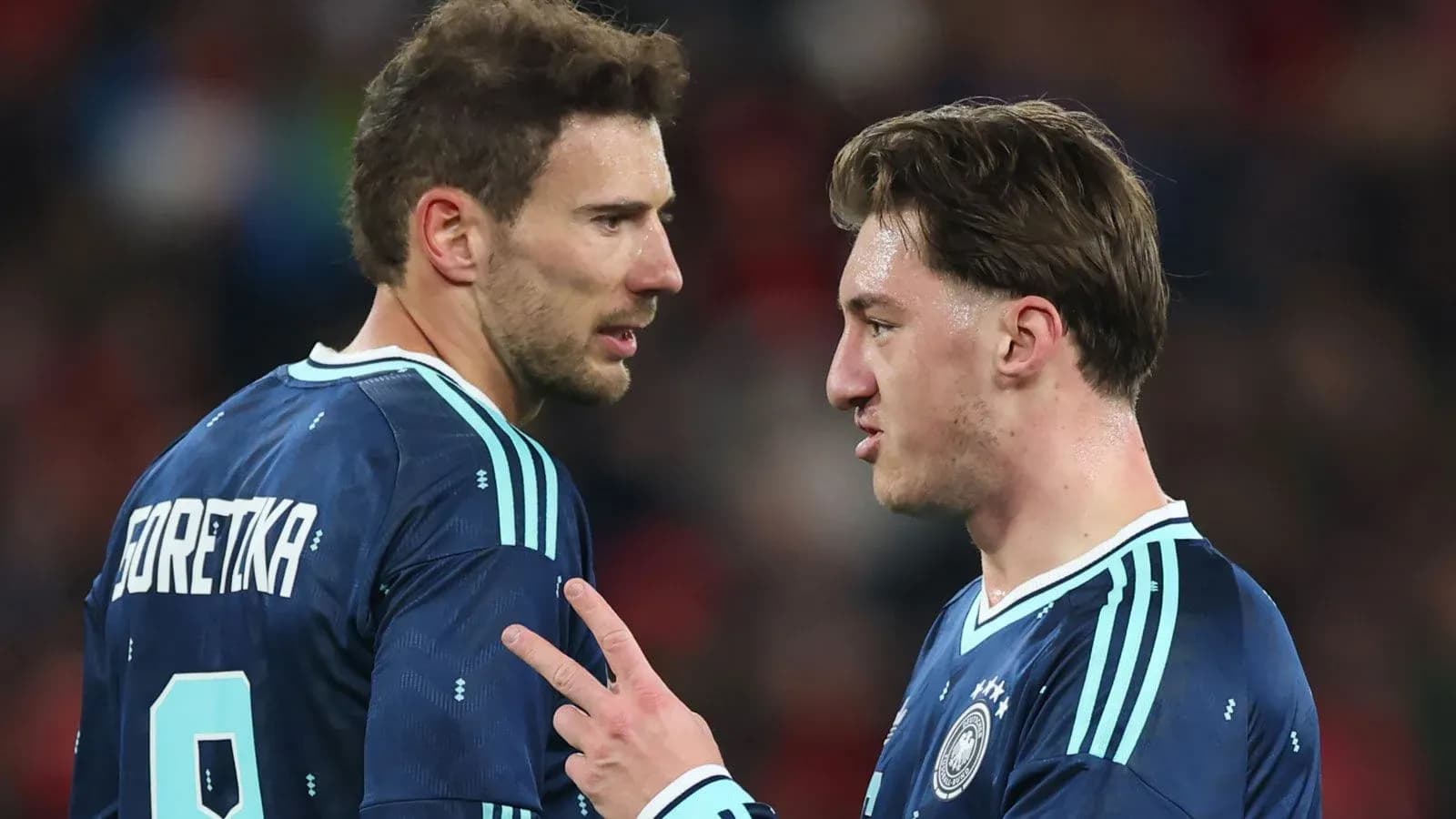
He did not dazzle, but he fits the template the coach wants alongside Pavlovic or Nmecha. As Nagelsmann explained to kicker before the game, Goretzka acts as a line-breaker on the front line, a free radical whose runs pin opponents back and open passing lanes. In the closing stages against Ghana, that role became visible in the move that led to the winner: Goretzka found Sané, Sané found Undav.
With Kimmich drifting between right-back and central midfield, Germany can afford Goretzka’s higher starting position in games where they dominate the ball. The captain still saw plenty of it, using his distribution and game intelligence much as he does at Bayern. Defensively, he was decent, though he left too much space behind him at times and shared some blame for the first goal conceded against Switzerland.
Nagelsmann’s options at right-back, though, are thin. Kimmich’s understudy, Josha Vagnoman, struggled badly on his return after three years away, especially on the tackle before Ghana’s equaliser. That single moment may have reopened the door for Benjamin Henrichs or Ridle Baku to return.
Schlotterbeck, Tah – and the Rüdiger question
At centre-back, the coach’s mind is made up.
Whatever the noise, Nico Schlotterbeck and Jonathan Tah will go into the World Cup as the first-choice pairing. Not even Schlotterbeck’s two mistakes against Switzerland have changed that. Nagelsmann had already promised him a starting spot in kicker and doubled down with firm backing after the game.
There is a tactical reason for that conviction. Schlotterbeck is the only left-footed centre-back in the squad. In Nagelsmann’s ball-oriented system, that profile is non-negotiable. His ability to play progressive, space-opening passes from the back is central to how Germany build attacks.
Defensively, his individual quality in open space and one-on-one situations remains high. Tah benefits from that, particularly in transitions, where he can sometimes react a fraction too slowly. Against Switzerland, Tah was too passive on two of the goals conceded, but his overall position in the hierarchy is secure.
Antonio Rüdiger sits behind him. The Bayern defender did not look convincing in one key moment against Ghana and needed Schlotterbeck’s intervention to prevent an earlier equaliser. Even so, he remains the first replacement – as long as he avoids further controversies at Real Madrid that might complicate his standing.
Waldemar Anton, meanwhile, can be almost certain of his World Cup ticket despite not playing a single minute. Like Groß, the Dortmund defender is a valued squad member, a player trusted to see out narrow leads and bring stability. His call-up also rewards a strong season at BVB. Nagelsmann hinted strongly after the final whistle that “Waldi” is “very likely” to be in the squad, praising his intensity in training and his attitude despite limited playing time.
Malick Thiaw, the fourth outfield player not to feature alongside Anton, Schade and goalkeeper Finn Dahmen, remains a doubtful candidate for the final squad.
Nagelsmann’s tightrope
Above all of this stands Nagelsmann himself, a coach whose football ideas are often sharp and progressive, whose communication keeps pulling him into storms.
His handling of Undav has been clumsy at times, the tone unnecessarily harsh. His public U-turn on Sané and the contradictions between various interviews – including the kicker piece – have become a recurring theme of his tenure. Each word is weighed, then thrown back at him.
Yet many of his sporting calls have been vindicated. The decision to bring in Alfred Schreuder and to give set-piece coach Mads Buttgereit more freedom has paid off instantly: two rehearsed routines, two goals against Switzerland, from Tah and Wirtz.
The question is whether Nagelsmann’s long, often convoluted explanations help or hinder him. The Undav saga alone threatens to follow the DFB team all the way to the World Cup kickoff. If Germany deliver at the tournament, the noise will fade into the background. If they stumble, every line, every barb, every role discussion will be replayed and dissected.
For now, the football looks promising in flashes, the hierarchy is hardening – and the margin for error, on and off the pitch, is shrinking by the day.