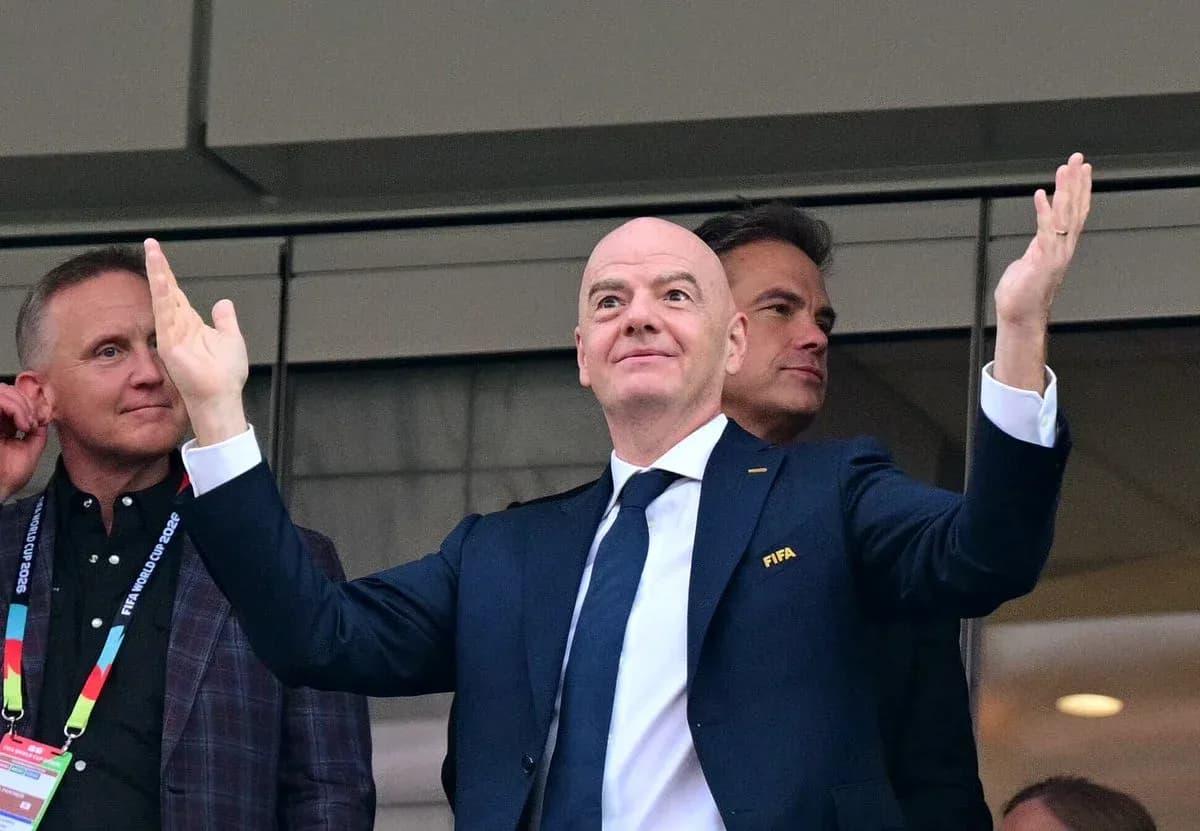
Gianni Infantino's $4.2bn FIFA Plan Collapses
Gianni Infantino walked into this week as the all-powerful president of a $15 billion World Cup machine. He ends it forced into a spectacular retreat, his flagship financial project scrapped and his authority openly shredded across world football.
Late on Friday night, FIFA finally hit the brakes.
“Having listened carefully to all the views,” Infantino said in a statement, “it has become clear that the project has created divisions… that are no longer in the interest of the objective set out in the first place… As a result, this proposal will not proceed.”
The climbdown was as abrupt as it was complete. The plan that was supposed to define his next term has instead exposed its fragility.
A $4.2bn vision that detonated the room
The idea, unveiled on Tuesday, was bold and blunt.
FIFA wanted to create a new private entity, FIFA Forward Enterprises (FFE), to run its blue-riband events – World Cups, Club World Cups and other major tournaments. A 21 per cent minority stake in this new vehicle would be sold to outside investors, led by Joshua Kushner’s venture capital firm Thrive, in a deal worth $4.2 billion.
That money, FIFA argued, would cascade straight back to the 211 member associations through a new funding stream branded the FIFA Fast-Forward Programme (FFFP). Development funding over the next four years would, on FIFA’s numbers, smash through the $10 billion barrier.
The sales pitch went further. Even those who voted against the FFE plan, FIFA confirmed, would still be rewarded if the proposal passed: $20 million each in the 2027-30 cycle, rising to $22 million in 2031-34 and $24 million in 2035-38, regardless of whether any FFE stake was actually sold.
But if a federation backed the project? Then the cheque for 2027-30 would double to $40 million. The financial incentive was stark. The political message even starker.
UEFA’s boycott threat lights the fuse
FIFA misread the room.
UEFA, representing Europe’s 55 national associations, did not just bristle. It threatened open revolt. All 55 members, it said, would boycott FIFA competitions – including World Cups – if the project went ahead in its current form.
That was not a routine protest. It was a direct challenge to FIFA’s control of the world game.
Concacaf, the North and Central American confederation, quickly aligned itself with UEFA. The Asian Football Confederation (AFC) then followed, publicly declaring solidarity with both. Between them, those three confederations account for 137 of FIFA’s 211 member associations – a clear majority before any vote had even been called.
CONMEBOL, South America’s confederation, stopped short of outright rejection but made its position clear enough: financial and commercial decisions, it said, must serve football’s interests and never eclipse its essence.
The pressure built in hours, not weeks.
FIFA digs in – then buckles
On Friday morning in Europe, FIFA tried to hold the line.
In a statement, it insisted “nobody is selling football” and stressed that it “acknowledges and respects feedback and concern aired in public,” while at the same time vowing to press on and “reaffirming its commitment to an open and democratic consultation.”
It sounded like a classic FIFA manoeuvre: acknowledge the noise, continue the march.
Then the walls inside Zurich started to move.
First came Carlos Cordeiro. Once a close adviser to Infantino, he resigned from his role and torched the proposal on his way out, branding it “a bad deal for FIFA’s Member Associations, a bad deal for football, and a bad deal for the long-term future of the game.”
Soon after, FIFA’s chief operating officer Kevin Lamour spoke to The Associated Press and delivered an even more damaging blow. Staff, he said, had been “deceived” by Infantino. He described the project as “the project of one person” and urged “football political leaders to ask themselves the right questions and make the right decisions.”
Lamour admitted he might lose his job for speaking out, but said he would sleep better for having done so.
Once your own lieutenants start firing live rounds in public, the battle has changed. A debate over commercial structure had become a fight for survival.
By Friday night, the investors were still technically in place. Thrive had not pulled out. It no longer mattered. FIFA leadership pulled the plug via Infantino’s late statement. The project was dead.
Power, trust and a president suddenly exposed
The speed of the reversal was stunning. So was the damage.
Within 72 hours, Infantino had been opposed by three major confederations, threatened with a boycott of his flagship competitions, and undermined by senior figures inside his own organisation. The man who had been expected to stand unopposed in March 2027 now looks anything but untouchable.
His position had appeared secure. Many federations had already filed letters backing him for another term. The World Cup in Qatar delivered record revenues. The men’s World Cup this summer brought in $15 billion. On paper, the numbers were his shield.
This week cut through that armour.
UEFA and Concacaf discussed his future in their own meetings on Thursday, with The Athletic reporting that his leadership was openly questioned. Lise Klaveness, president of the Norwegian Football Federation, did not mince her words when speaking to VG.
“My clear impression at the moment is that he has lost a great deal of trust,” she said. “We didn’t vote for him last time, and we’ve been sceptical about this. There are many good things about FIFA, but if you take a lax approach to governance principles and rules, you quickly lose trust.”
Trust, not revenue, is now the currency that matters most for Infantino.
The numbers game turns political
The arithmetic behind the project underlined how far he was prepared to push.
To advance, the FFE proposal needed a majority of the 211 member associations and approval from the 37-strong FIFA Council, which includes Infantino and the eight vice presidents. With UEFA, Concacaf and the AFC on record against the plan, he was suddenly staring at the prospect of being outvoted on his own signature policy.
The financial sweeteners – the promise of tens of millions to every association, even dissenters – could not mask the unease about effectively parcelling off a slice of FIFA’s commercial engine to private capital.
“Not only must this project not go ahead,” Lamour said, “but the time has now come for football political leaders to ask themselves the right questions and make the right decisions.”
Those questions now land squarely at Infantino’s door.
A humbling – and a fight looming on the horizon
This week will linger over FIFA for a long time. For Infantino, it is more than a lost deal. It is a public humbling.
He began it as a president seemingly cruising towards re-election, armed with record revenues and a sprawling calendar of tournaments. He ends it with his judgement questioned, his governance challenged, and his inner circle fractured.
The vultures, as one senior figure put it, are circling.
Nominations for the 2027 FIFA presidential election must be submitted by November. Until a few days ago, that deadline felt like a formality. Now it feels like an invitation.
Who steps forward – and how many follow – will tell football everything about whether this was a one-off rebellion or the start of a genuine power shift at the top of the world game.