Guardiola’s Warning to Manchester City’s New Leadership
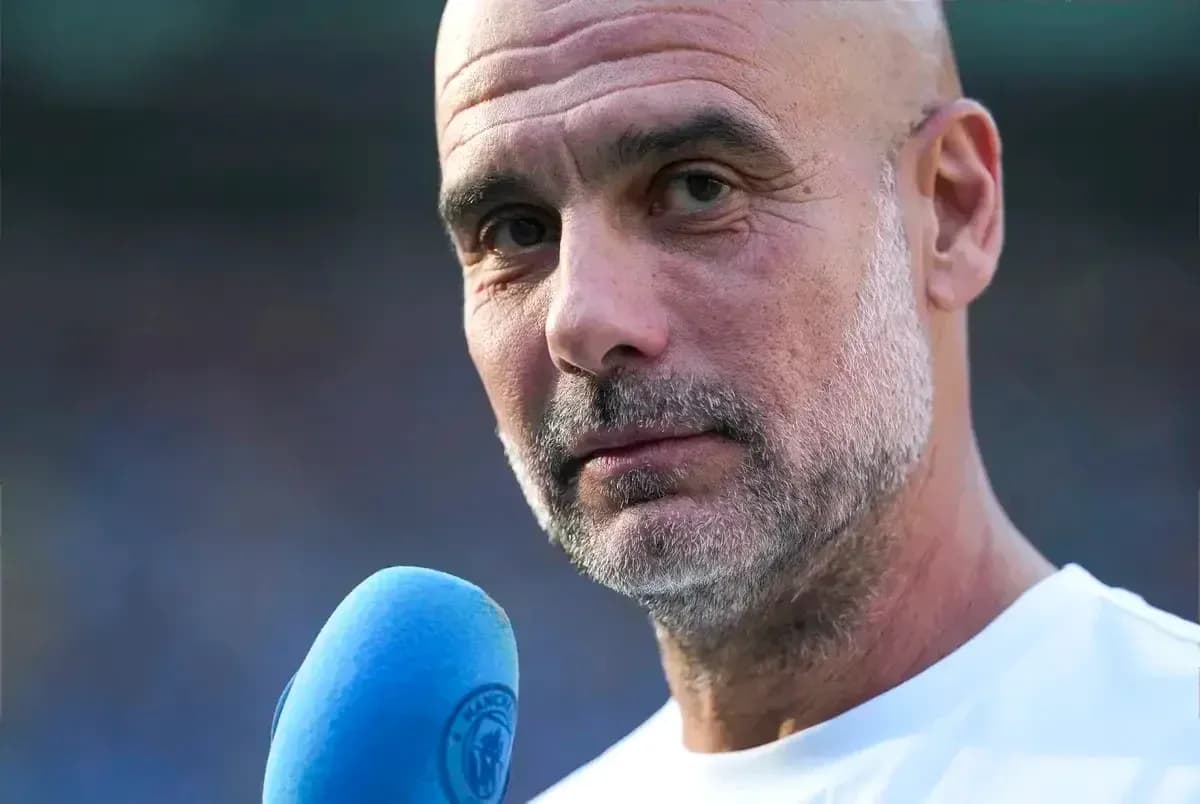
Pep Guardiola has never been one for gentle euphemisms. Even in retirement, he prefers the hard truth.
And this time, the message is aimed straight at Manchester City’s new power axis: sporting director Hugo Viana and head coach Enzo Maresca.
Guardiola’s Warning From the Summit
After a decade at the Etihad – four straight Premier League titles, three FA Cups, a first Champions League, an era that bent English football around his ideas – Guardiola has earned the right to speak bluntly about what comes next.
In a new interview with OKX, he lifted the curtain on one of the great illusions of modern squad-building: the notion that a club can simply assemble a young group and sit back for “three or four years” while it matures together.
“I spoke many times with the Manchester City sporting director(s) (former) Txiki Begiristain and (current) Hugo Viana,” Guardiola said. “And said, ‘Now we have a young team for the next three or four years!’
“It’s not true. You don’t know why, but it doesn’t work. A lot of players, young players, don’t play and say, ‘I want to leave! I’m here in cold Manchester, not playing, I want to leave!’ And you have to replace those guys.”
That line – “cold Manchester, not playing” – lands with particular force. It captures the reality behind the glossy project presentations and long-term plans. Talented youngsters don’t sign up to be training-ground ornaments. They want minutes. When they don’t get them, they move.
The Fragile Dream of a “Young Core”
Guardiola’s words cut against one of the most seductive ideas in recruitment: the dream of building a young core that grows together, season after season. On paper, it looks perfect. On the pitch, under the pressure of elite competition, it often falls apart.
At City, the tension is obvious. The club is trying to refresh an ageing core while staying at the top of the Premier League and Europe. Maresca has just walked into his first pre-season. Viana is steering one of the most ambitious rebuilds of the club’s modern era. Around them, a cluster of players are already pushing for moves, frustrated by the prospect of another year on the fringes.
Guardiola knows that dynamic all too well. His decade in Manchester was littered with similar battles: big reputations, bigger ambitions, and only 11 starting places. His comments now read as both confession and warning. He’s acknowledging how hard it was to keep everyone happy – and spelling out the problem his successors are inheriting.
Recruitment as a Collective Responsibility
For Guardiola, the solution doesn’t lie in one genius signing or a single visionary director. It lies in the machinery of the club working in ruthless harmony.
“The big task,” he said, “is how the club, organisation, sporting director, manager, CEO, hierarchy recruit the right players you need – everyone makes mistakes, but make as few as possible. That’s the key point.”
No hiding place there. He namechecks Begiristain and Viana, but widens the frame to include the CEO, the manager, the entire hierarchy. Recruitment, in his view, is not a one-man job or a convenient scapegoat. It’s a shared responsibility, and when it goes wrong, the whole structure feels it.
That philosophy has underpinned City’s dominance over the last decade. They did make mistakes – every club does – but they limited the damage, corrected quickly, and rarely chased short-term fixes at the expense of long-term balance.
Young Talent, Hard Choices
Right now, Viana is living inside the dilemma Guardiola describes.
City’s squad is stacked with ability, but opportunity is finite. For younger players, the calculation is brutal: stay and fight for sporadic minutes in a trophy-chasing side, or leave for regular football and a clearer path to development.
Guardiola’s warning about players “agitating for moves” is not theoretical. It mirrors the noise around the Etihad this summer, as Maresca works through his first full assessment of the group ahead of the 2026-27 campaign. Every conversation about a loan, a sale, or a contract extension carries a knock-on effect for squad harmony and long-term planning.
Keeping those players engaged in a city where the weather is unforgiving and the competition even harsher is part of Viana’s daily reality. Some will be persuaded to stay with promises and pathways. Others will go. Each departure forces a reaction, each arrival must be right.
Anderson as a Test Case
On the incoming side, Guardiola’s mantra – “make as few mistakes as possible” – is already being tested.
The headline move of the summer so far is the club-record £116 million deal for Elliot Anderson from Nottingham Forest. That fee alone guarantees scrutiny. But inside City, the signing is being framed not as a panic buy or a response to a single exit, but as the product of long-term tracking and detailed planning.
This is exactly the sort of transfer Guardiola is talking about: a carefully profiled player, targeted over time, brought in to fit a defined role rather than to plug a hole. If Anderson flourishes, it will be held up as proof that the recruitment machine still hums as efficiently without Guardiola in the dugout. If he struggles, the questions will land squarely on Viana’s desk.
A Blueprint, Not a Farewell
Guardiola’s comments are not a nostalgic look back at what he built. They read more like a blueprint handed over at the end of a job: here is what worked, here is what nearly broke us, here is where you cannot afford to get it wrong.
The message is simple, but unforgiving. Young squads don’t stay together just because you want them to. Players don’t wait forever. And in a club built to win every season, recruitment errors are not just expensive – they are existential.
For Maresca and Viana, the challenge is clear. Keep enough young talent happy in “cold Manchester” to refresh a serial-winning side, while making as few mistakes as possible in the market.
Guardiola has left them the trophies and the template. Now they have to prove they can live with the standard he set.