Hannibal Mejbri: From La Banane to World Cup Hope
The boy named for a general who crossed the Alps now carries a nation’s hopes across a very different mountain range.
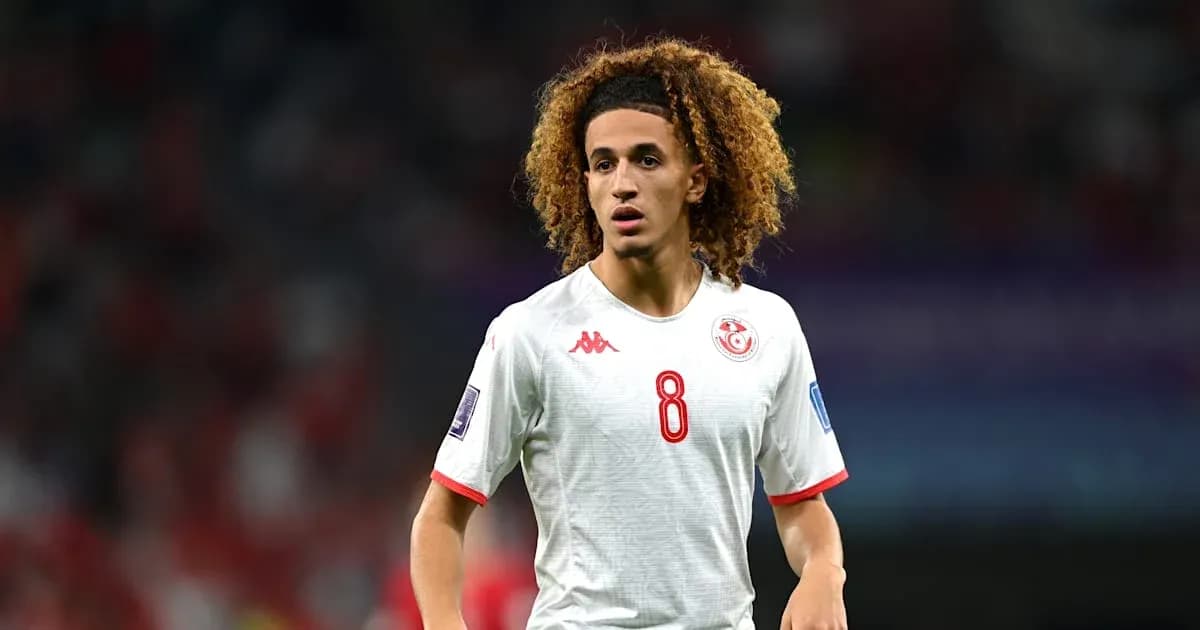
Hannibal Mejbri, 23 years old and already the beating heart of Tunisia’s midfield, leads the Eagles of Carthage into the 2026 FIFA World Cup with a mission his country has never completed: escape the group stage and push deeper into football’s biggest tournament than any Tunisian side before.
For a team whose nickname reaches back to one of antiquity’s great powers, the symmetry is hard to ignore. The original Hannibal Barca once marched war elephants towards Rome. This Hannibal, born in Paris and raised between tower blocks and concrete pitches, marches into stadiums with a mane of big, blond curls and a game built on bite, imagination, and defiance.
From La Banane to the world
Mejbri’s story begins in Paris’ 20th arrondissement, a dense, working-class slice of the capital where football stitches together a patchwork of cultures. Tunisians, Algerians, Moroccans, Senegalese, Malians – for kids in these streets, the ball is the common language and the quickest route to being seen.
In the middle of it all stands La Banane, a curved block of flats whose nickname says everything about the area’s ability to turn the ordinary into something memorable. That was the backdrop. The training ground was wherever the pavement left enough space for a ball.
“Instead of going straight up to my house, I used to stay out and play football until night fell,” Mejbri recalls in the series World at Their Feet, which tracks emerging stars on the road to the 2026 World Cup. No grand plan. No carefully drawn roadmap. Just a kid who wanted to stay outside a little longer.
“I was a normal boy, there was no master plan. I had my friends, I was focused on my life as a kid,” he says.
Yet even among the crowds of La Banane, he stood out. Childhood friend Hubert Mbuyi remembers the image as clearly as the talent.
“He had a unique style, with big hair, big blonde hair. So everyone knew him and had a lot of expectations for him,” Mbuyi says. “Where you could find a pitch and a ball, you will find Hannibal.”
The look made him recognisable. The hunger made him impossible to ignore.
Paris, Monaco, Manchester: a fast climb
Paris FC spotted him early. Mejbri joined their academy at six and stayed for nearly seven years, learning structure to match the street flair. A short spell at Boulogne-Billancourt followed, a stepping stone before the first major leap.
In 2018, Monaco arrived with a statement. A €1 million fee for a 15-year-old to join their academy signalled how highly he was rated. For a kid from the 20th arrondissement, the contrast was stark.
“I could feel the richness of Monaco,” he says. “So yeah, it was a little bit of a shift, a little dream, and I learned a lot there.”
The experience was not perfect. Mejbri himself admits Monaco was not where he enjoyed his football most. Yet the raw talent was too obvious to ignore. Bayern Munich, Paris Saint-Germain, Barcelona – the list of suitors read like a Champions League knockout draw.
He chose a different path. In August 2019, at 16, he signed for Manchester United, a club that has always been drawn to young players with a streak of daring in their game.
The climb from academy prospect to first-team footballer at Old Trafford is notoriously steep. Mejbri moved quickly. By 2021 he had his Premier League debut. By September 2023, he had his first league goal: a fierce strike in a 3–1 home defeat to Brighton that said as much about his character as his technique.
“I still get chills,” he says. “I don’t know why I started to celebrate when we were losing 3–0, and you can see in my celebration that I had a certain rage in me and that I let go of everything when I scored.”
It was a moment that captured him perfectly – a player who refuses to let the scoreboard dictate his intensity.
Choosing Tunisia with the heart
On the international stage, Mejbri had options. Born and raised in France, he represented Les Bleus at under-16 and under-17 level, part of a conveyor belt that has produced some of the game’s brightest stars.
Then came the call from Tunisia in 2021. The decision was not simple on paper. It was straightforward in his mind.
“I joined Tunisia because I chose with my heart,” he says. “Even though I lived in France, it doesn’t take away the love I have for France. But I find that the love I have for Tunisia is greater.”
That choice has already reshaped his career. At just 23, he has collected 44 caps and become a central figure for the Eagles of Carthage. His performances have twice earned him the African Revelation of the Year award at the Africa d’Or, recognition that his rise is being watched far beyond La Banane or Old Trafford.
Yet whenever he pulls on the red of Tunisia, his thoughts drift back to that curved building in Paris.
“When I represent my country, I also represent my neighbourhood,” he says. “Because I know that I will represent them, and so all of that, it’s a bit related to pride.”
For Mbuyi and the people who watched him grow, that connection is everything.
“All Tunisians are proud of him,” Mbuyi says. “Because in the end, he’s a kid from the neighbourhood. When he plays matches, everyone focuses on the match. We’re all watching Hannibal’s hair on the pitch. We try to spot him every time.”
La Banane’s favourite son
Fame has not loosened his grip on home. Every summer, Mejbri returns to La Banane and turns the courtyard pitches into a festival. He organises a football tournament, hands out shirts, and makes sure the next generation can see, up close, what is possible.
Last year, he gave away around 100 shirts. The impact is visible in the streets.
“You can just walk around here and find two or three people wearing his shirt,” Mbuyi says.
For the kids chasing balls between parked cars and concrete walls, the message is clear. One of their own has made it, and he has not forgotten where he started.
“Hannibal is a great example of what the people look for in this area,” Mbuyi adds. “Because of him, the young kids can dream.”
Now the stage grows bigger. The World Cup awaits, with Tunisia again aiming to break through a barrier that has stopped every generation before them. The Eagles of Carthage have flown close, but never far enough.
A different Hannibal leads them now. The mountains in front of him are not snow-capped and treacherous, but tactical and psychological, lined with giants of the modern game. The question is no longer whether he belongs on this stage.
It is how far he can drag his country – and the dreams of a Parisian neighbourhood shaped like a banana – up the slope with him.