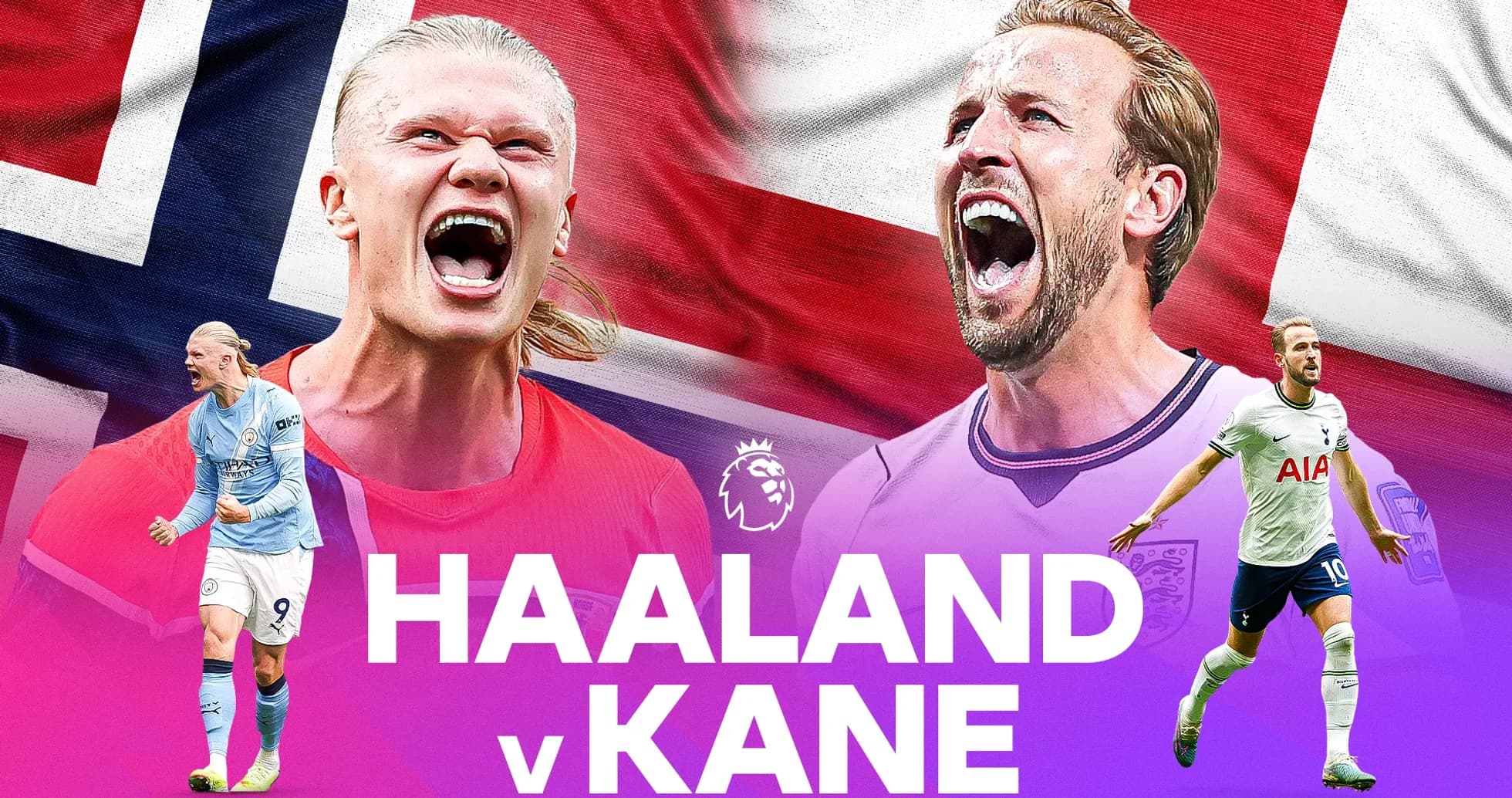
Harry Kane vs Erling Haaland: A Clash of Premier League Giants
Harry Kane and Erling Haaland are cut from the same cloth and yet could not be more different.
Two of the greatest strikers the Premier League has ever seen. Two men who bend seasons to their will. One wears the mask of a ruthless finisher, the other the mind of a playmaker. Both have changed the way we talk about goals.
On Saturday, they finally collide with everything on the line: England v Norway in the 2026 FIFA World Cup quarter-final. A rivalry that has mostly run in parallel steps onto the same stage.
Two No 9s, two different worlds
Strip it back to numbers and they look like twin monsters.
Haaland has 112 Premier League goals, already 25th on the all-time list, and no one in history touches his 0.91 goals per 90 minutes. Kane sits on 213, second only to Alan Shearer’s 260, and his 0.71 per 90 puts him fourth all-time.
That’s the raw data. The reality on the pitch feels very different.
Haaland is the lurking shadow. Cold, economical, brutal. He hoards goals and trophies with the same dead-eyed focus, living for the final touch inside the box. His game is about angles, timing, and the split-second where defenders panic and it’s already too late.
Kane is the conductor. A No 9 who wore No 10 at Tottenham Hotspur because he has always seen himself as more than a finisher. He drops off the line, dictates the rhythm, sprays passes, then arrives in the area to finish the move he started. Creator and executioner in one body.
Both are dominant. They just dominate in different ways.
The race against Shearer – and time
Kane’s Premier League story was a slow burn. He didn’t explode until 21, under Mauricio Pochettino in 2014/15, and then never stopped. Nine seasons as a first-team regular at Spurs produced those 213 goals, plus records for the most goals for a single club (213) and the most in London derbies (51).
He is only 47 short of Shearer. At his usual 25-goal-a-season pace, that’s roughly 18 more months of Premier League football to stand alone at the top.
Haaland has had just four seasons in England. That’s the context you can’t ignore.
At his absurd rate of 0.91 goals per 90, he needs only 113 more Premier League games – around four campaigns at 33 matches a season – to score the 102 goals required to leapfrog Kane into second place. Give him another 52 matches on top of that, and the 47 goals needed to pass Shearer come into view.
On paper, the path is clear. Haaland has eight years left on his current deal. He doesn’t even need all of them to tear down the record books.
The numbers suggest one thing: unless something dramatic intervenes, the Norwegian is on course to become the most prolific goalscorer the competition has ever seen.
Seasons of plenty, honours divided
When Haaland arrived, he did not ease himself in. He detonated.
His debut Premier League season, 2022/23, produced 36 goals – a single-season record. In the same campaign, Kane quietly hit 30 for Spurs, the second time he had reached that mark after doing it in 2017/18. He also had a 29-goal campaign in 2016/17.
Between them, the top five Premier League scoring seasons read like a shared billboard:
- Haaland – 36 (22/23)
- Kane – 30 (22/23)
- Kane – 30 (17/18)
- Kane – 29 (16/17)
- Haaland – 27 (25/26)
Kane edges that list in volume, as you’d expect from a man with more years in the league. Haaland owns the single biggest season.
The same pattern appears across their records and awards. Haaland is the fastest to 100 Premier League goals, holds the record for most in a single season, and owns the best per-90 rate in history. Kane counters with those club and derby records that speak to longevity and consistency.
Individual accolades tell another tight story. Haaland has five Golden Boots – three in the Premier League and two in the Champions League – plus three Player of the Year awards across the Premier League, Bundesliga and UEFA. Kane has nine Golden Boots, spread across three Premier League seasons, three Bundesliga campaigns, and one each in the Champions League, World Cup and Euros, along with a Bundesliga Player of the Year. The Englishman has done it over more competitions; the Norwegian is seven years younger and still accelerating.
When you zoom out to team honours, the balance tilts.
Haaland’s clubs have lived at the summit. He has three league titles – two in the Premier League and one in the Austrian Bundesliga – and a Champions League to his name. He has lifted five domestic cups across England, Germany and Austria.
Kane’s trophy cabinet is thinner. Two Bundesliga titles and a single DFB-Pokal underline his impact at Bayern Munich, but they also highlight how long he spent carrying a Spurs side that never quite crossed the line. For some, that makes his numbers even more remarkable: goals scored without the platform of a serial winner.
Kane in Germany, Haaland with Norway
Kane’s move to Bayern has answered any lingering doubts about whether his numbers were a product of English football. They were not.
He has 98 goals in 94 Bundesliga matches. Those are the kind of figures usually reserved for Lionel Messi and Cristiano Ronaldo, the realm of the truly freakish. Put that version of Kane into a Pep Guardiola side at Manchester City and the imagination runs wild. How many would he have scored with that machine behind him?
Haaland, though, has his own argument when the conversation turns to context.
At international level, his output is staggering. Sixty-two goals in 54 caps for Norway, at 1.26 goals per 90, and a current run of scoring in 14 consecutive internationals. These are elite numbers in a team that is not. It’s a far sharper ratio than Kane’s, even if the England captain’s record – 85 goals in 119 caps at 0.83 per 90 – is itself historic.
One scores relentlessly for a heavyweight nation with deep tournament runs and high expectations. The other drags his country into games they have no right to be in.
Both are rewriting their countries’ record books. They are just doing it from very different starting points.
The state of the debate – and a looming verdict
So where does all this leave the argument?
Kane leads many of the career metrics right now, largely because he has been at the top level longer. Haaland has more team trophies, largely because he has played for clubs perched on the title-winning ledge from day one.
But as of July 2026, one detail cuts through the noise.
In 2025/26, Kane scored more goals in all club competitions than any player in Europe. He finished with 61. Kylian Mbappe trailed on 42. Haaland, by his own towering standards, was back on 38.
In the here and now, Kane stands as the best striker in the world.
Haaland, though, is never far away. The numbers say he will own the future. The medals suggest he already owns the present.
On Saturday, they don’t share charts or timelines. They share a pitch.
One game. One quarter-final. One more chapter in a duel that could define an era. Who walks off that stage as the man of his generation?