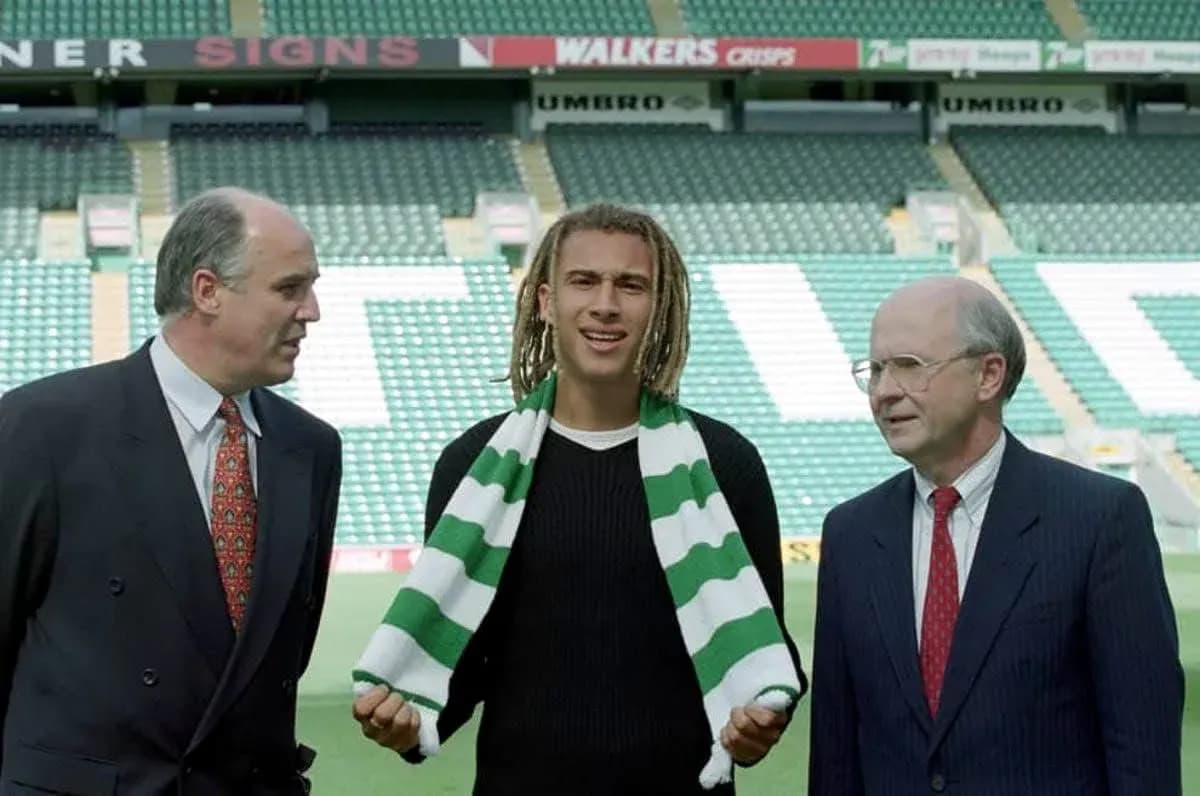
Henrik Larsson: Celtic's King of Kings
On a July afternoon in 1997, a slim, dreadlocked Swede stepped out onto the Celtic Park turf in a Hoops top and denim jeans. No fanfare, no pyrotechnics. Just a name that would soon be etched into club folklore: Henrik Larsson.
He cost £650,000 from Feyenoord, a fee that looked modest even then. New manager Wim Jansen knew exactly what he was getting, having signed Larsson for the Dutch club a few years earlier and spotted a clause in his contract that made the deal possible. It was shrewd business. It turned out to be one of the greatest bargains in Celtic’s unbroken history.
A shaky start, a rapid love affair
It didn’t begin like a fairytale. Larsson’s first competitive outing brought a costly mistake in an opening-day defeat at Hibs. He looked human, uncertain, even vulnerable. For a support desperate to topple Rangers and end a decade without a league title, patience was in short supply.
But talent has a way of forcing the issue.
Game by game, Larsson’s touch, movement and courage began to shine through. The goals came, then kept coming. The League Cup went into the cabinet. More importantly, so did the league title – Celtic’s first in ten years, the one that “stopped the ten” and changed the trajectory of the club. In that debut season, Larsson didn’t just settle. He became central.
Under Dr Jozef Venglos the following campaign, he went up another level. Thirty-eight goals. A complete centre-forward emerging in front of Scottish football’s eyes – strong in the air, ruthless in the box, clever with his back to goal, selfless for the team. Celtic had found their talisman.
Broken leg, unbreakable mentality
Then came Lyon. A tangle, a fall, a leg bent at a sickening angle. The kind of injury that ends careers or at least dulls them. For Larsson, it became a turning point of a different sort.
He attacked his rehabilitation and came back sharper, leaner, somehow even more clinical. The psychological strength required to return from that kind of trauma underlined what Celtic really had on their hands. This was not just a gifted striker. This was a relentless competitor.
The team around him fluctuated. Managers came and went. John Barnes’ brief tenure unravelled, with Larsson’s long absence a major blow to any hopes of stability. When he returned, Celtic’s fortunes began to rise again.
O’Neill, Sutton and a treble for the ages
Martin O’Neill’s arrival in 2000 lit the fuse. The Irishman built his Celtic side around Larsson’s brilliance and paired him with Chris Sutton in a partnership that tormented defences.
The result was astonishing: 53 goals in a single season as Celtic stormed to a domestic treble, their first clean sweep in 32 years. Larsson was everywhere – poaching in the six-yard box, glancing in headers, whipping in finishes from impossible angles. He didn’t just score; he dictated the mood of matches.
On 27 August 2000, he produced one of the defining images of that era. Celtic 6, Rangers 2. Larsson, dreadlocks flying, lifting the ball over a defender and drilling it past the goalkeeper in front of a delirious Celtic Park. It was a goal that summed him up: audacious, ruthless, perfectly timed.
Europe takes notice
Domestically, Larsson dominated. But his legacy stretched far beyond Scotland. In Europe, his goals dragged Celtic into places they had not been for a generation.
The run to the UEFA Cup Final showcased his class on the continental stage. Two world-class finishes against Porto in Seville, both in extra time of a draining final, underlined his ability to rise when the stakes were highest. Celtic lost the trophy that night, but Larsson’s reputation soared. He was no longer just a hero in Glasgow. He was recognised as one of Europe’s elite forwards.
Numbers, history and a lasting crown
By the time he walked away in 2004, the numbers were staggering: 242 goals in 313 appearances. Third on Celtic’s all-time scoring list. A figurehead in an era that restored the club’s swagger at home and credibility abroad.
Older generations will always have Jimmy Johnstone and the Lisbon Lions, names carved into marble. Those who grew up in the 1970s will rightly point to Kenny Dalglish, another King who later became Liverpool’s greatest. Celtic’s story is rich with royalty.
Yet for many supporters alive today, the argument ends with Larsson. The King of Kings. The best they have ever seen in the Hoops.
He arrived in a denim jacket and a borrowed shirt. He left as a legend whose shadow still stretches across Celtic Park every time a new forward pulls on the No.7 and dares to dream.