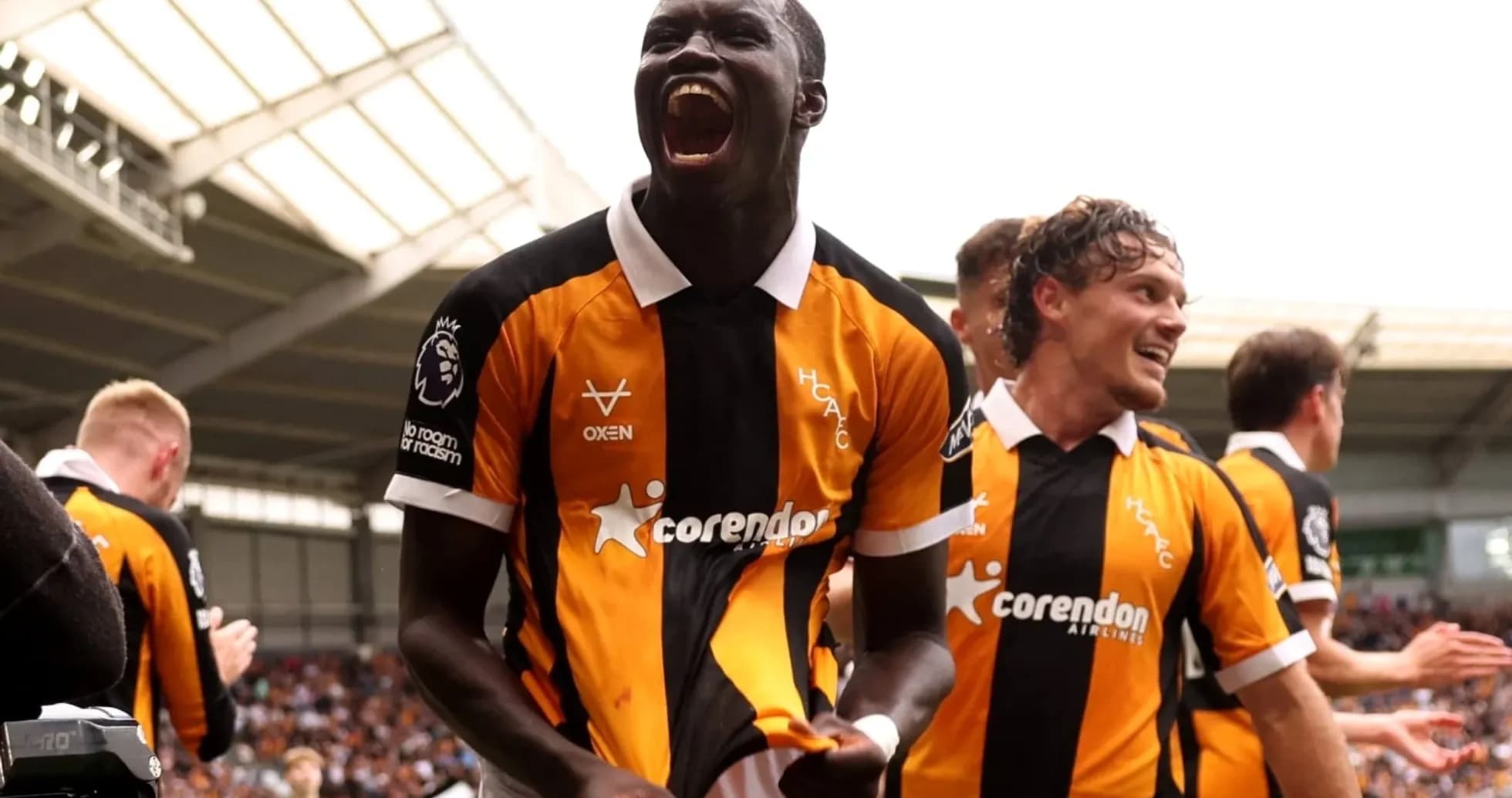
Hull City Defeats Manchester United 2-0 in Premier League Opener
The MKM Stadium felt like a statement more than a setting. On the opening weekend of the 2026 Premier League season, Hull City did not just beat Manchester United; they authored a 2–0 win that instantly reframed expectations for both clubs.
Following this result, Hull sit 5th with 3 points, a goal difference of +2 from 2 goals scored and 0 conceded in total. Manchester United, by contrast, find themselves 16th, pointless, with a goal difference of -2 after failing to score and conceding twice on their travels.
I. The Big Picture – A New Hull, A Shaken United
Sergej Jakirovic’s decision to go with a 5-4-1 was not a retreat; it was a calculated ambush. With K. Tzolakis behind a back five of L. Coyle, S. Ajayi, J. Egan, N. Mendy and R. Giles, Hull built a defensive shell that doubled as a launchpad. The numbers from the early season are stark: at home they have scored 2.0 goals per game and conceded 0.0, with a clean sheet in their only outing.
Manchester United, under Michael Carrick, lined up in a 4-2-3-1 that looked progressive on paper. S. Lammens started in goal behind N. Mazraoui, H. Maguire, A. Heaven and L. Shaw, with Y. Tielemans and Andrey Santos as the double pivot, B. Mbeumo and P. Dorgu wide, B. Fernandes as the central creator and M. Cunha up front. But on their travels so far, United’s numbers are the mirror opposite of Hull’s: 0.0 goals scored away, 2.0 conceded, no clean sheets and one failure to score.
The tone of the contest was set in the first half. Hull’s half-time lead of 2–0 reflected a side that knew exactly how to exploit United’s structural uncertainties, then managed the game with maturity.
II. Tactical Voids – Injuries and Discipline
Hull came into this fixture with a lengthy absentee list: J. Butland (arm), J. Gelhardt (ankle), D. Gyabi and C. Hughes (both groin), M. Jacob (hip), E. Matazo (knee), H. Morita (calf) and O. Zambrano (hamstring) all missed out. That stripped depth from multiple lines, particularly in midfield, yet Jakirovic’s selection showed a clear hierarchy: stability at the back, work rate in midfield, and O. McBurnie as the lone reference point.
United’s own absences were no less significant. T. Heaton, M. Mount (foot), M. Ugarte (knee) and M. de Ligt (back) were unavailable, removing a senior goalkeeper option, a high-energy midfielder, a ball-winning anchor and a defensive leader. The result was a back line where H. Maguire had to marshal A. Heaven through a difficult afternoon, and a midfield double pivot that lacked a true destroyer.
Disciplinary trends from the early data underline the edge Hull brought. Their season card profile shows two yellow cards so far, split evenly: 50.00% between 31–45 minutes and 50.00% in the 91–105 window, underlining a side that is willing to foul to protect transitions before the break and to disrupt rhythm late on. In this match, M. Crooks embodied that edge, collecting a yellow while still winning 8 of his 13 duels and making 4 tackles, plus 2 successful blocks.
For United, P. Dorgu’s yellow card – part of a profile where 100.00% of their early yellow cards have arrived between 31–45 minutes – symbolised their frustration. He committed 4 fouls, won only 1 of 7 duels and was withdrawn at the interval after 45 minutes. The disciplinary picture speaks to a United side reacting to problems, not dictating terms.
III. Key Matchups – Hunter vs Shield, Engine Room Battles
Hunter vs Shield
Hull’s “hunters” emerged unexpectedly from the back line. S. Ajayi and N. Mendy, both nominally central defenders in the back five, not only anchored the defence but also delivered the goals that have placed them among the league’s early top scorers.
Ajayi’s performance was quietly dominant: 1 goal from his only shot on target, 16 passes at 87% accuracy, 2 interceptions and a perfect 3 duels won from 3. Mendy, rated even higher, matched him with 1 goal from 1 shot on target, 19 passes at 94% accuracy and 1 successful block. That block is not a near-miss; it is a successful intervention, emblematic of a defender who reads danger and steps in decisively.
Against them, United’s attacking shield was blunted. M. Cunha led the line but found himself isolated, starved of high-quality service. With United’s total goals for still at 0 in all competitions so far and their away average at 0.0, the contrast with Hull’s set-piece and secondary scoring threat is striking. United’s biggest defeat on their travels to date is already this 2–0 loss; Hull’s biggest home win is the same scoreline, underlining how this fixture has defined both teams’ early-season narratives.
The Engine Room
In midfield, Hull’s R. Slater quietly knitted everything together. Across 90 minutes he completed 21 passes at 90% accuracy, created 1 key pass and registered 1 assist. That combination has already placed him among the league’s leading assist providers. His role was less about Hollywood passes and more about ensuring Hull’s 5-4-1 never collapsed into a flat back five; he stepped out to connect with M. Crooks and M. Belloumi, giving Hull an outlet to relieve pressure.
Crooks, meanwhile, was the enforcer. His 4 tackles and 2 blocks set the tone in central areas, and while he took a yellow card, his duel success (8 won out of 13) ensured United’s creative hub, B. Fernandes, rarely received the ball between the lines in comfortable pockets.
On the other side, Y. Tielemans and Andrey Santos were meant to be United’s metronomes. Tielemans tried to progress play, but without a true ball-winner beside him – the void left by M. Ugarte’s injury – United’s midfield was often bypassed by Hull’s direct out-balls to McBurnie and the aggressive stepping-out of Ajayi and Mendy.
Wide, B. Mbeumo’s threat was sporadic rather than sustained. His starting position in the line of three behind Cunha promised overloads against Giles and Coyle, but Hull’s wing-backs, supported by the wide midfielders E. Stroud and Belloumi, repeatedly doubled up, forcing United’s wide men into predictable, easily defended zones.
IV. Statistical Prognosis – What This Game Tells Us
With only one league match played, any statistical verdict must be framed as an early sketch, not a finished portrait. But the outlines are clear.
Hull’s overall record of 1 win from 1, 2 goals scored and none conceded is backed by structural coherence. Their most-used formation so far is the 5-4-1, played in 100% of their fixtures, and the early evidence suggests it maximises their current squad: it protects Tzolakis, gives license to attacking defenders like Ajayi and Mendy, and provides a platform for Slater and Crooks to control central zones.
Their penalty record is still untouched – no spot-kicks taken, scored or missed – but their set-piece threat from defenders and the willingness of midfielders to break lines means they are not dependent on high-variance moments to score.
Manchester United’s early numbers are more worrying. Across all games so far, they have played 1, lost 1, scored 0 and conceded 2. Their away defensive average stands at 2.0 goals conceded per match, with no clean sheets and one failure to score. Their only recorded formation is the 4-2-3-1, used in 100% of their fixtures, but the personnel gaps – particularly without de Ligt and Ugarte – make that structure feel more aspirational than stable.
Disciplinary trends hint at a psychological undercurrent. Hull’s willingness to take tactical yellows at key game states contrasts with United’s reactive bookings, like Dorgu’s, which come amid duels they are largely losing.
Projecting forward, a notional xG narrative would likely favour Hull in set-piece and transitional situations, given the efficiency of Ajayi and Mendy in front of goal and the quality of Slater’s delivery, while United’s current lack of cutting edge suggests their xG is lagging behind their possession and territory.
The tactical lesson from MKM Stadium is simple but profound: Hull have a clear identity that aligns with their personnel and early-season realities. Manchester United, for now, have a formation on paper but too many voids on the pitch. Until Carrick can restore balance in the spine – with a fit Ugarte, the authority of de Ligt, and more cohesion around Fernandes – United’s away days may continue to look like this: plenty of names, not enough structure, and a scoreboard that tells a harsh truth.