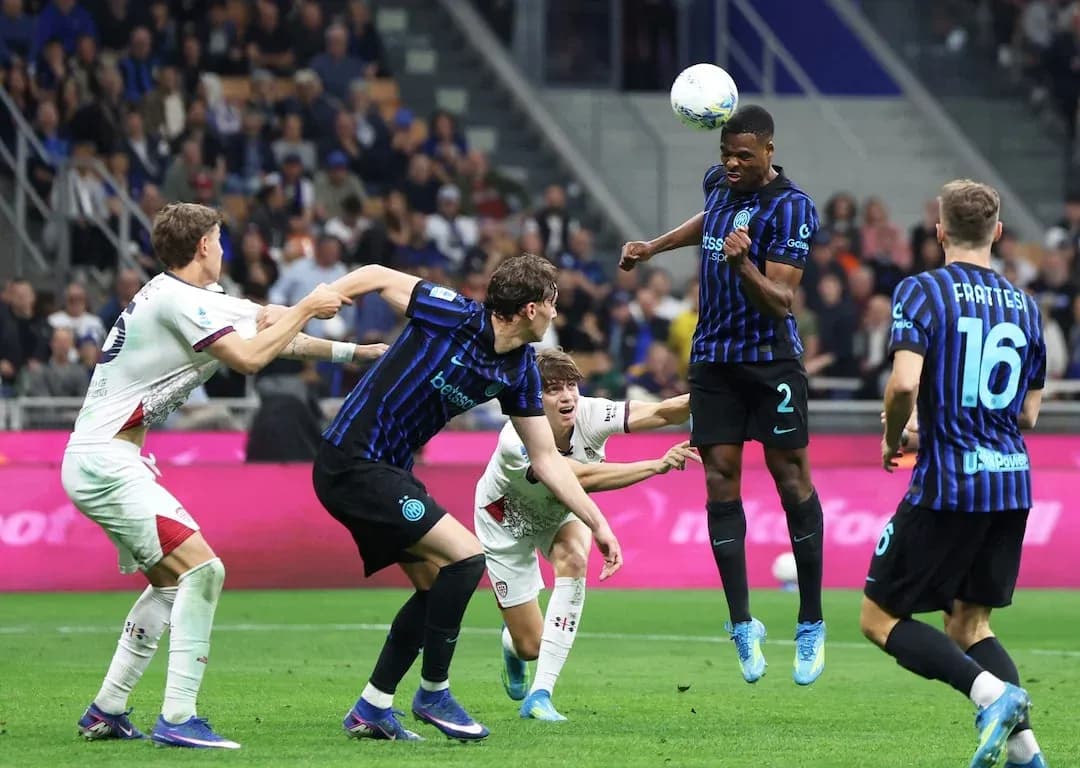
Inter edges Cagliari 1–0 in tactical battle
Under the late-summer lights of the Unipol Domus, this was a meeting between two sides already sketching out very different Serie A storylines. Cagliari, 12th heading into this game with three points from two matches, were still discovering their identity under Fabio Pisacane. Inter, second with six points from two games and a goal difference of +4 overall (5 scored, 1 conceded), arrived as a fully formed contender, their early-season profile that of a team expecting to dominate.
The 1–0 scoreline to Inter at full time felt narrow on the surface, but tactically it underlined the gap in control and maturity between the sides. Cagliari’s overall record after two rounds showed a perfect balance – 1 goal scored and 1 conceded in total, 0.5 goals both for and against per game overall – but that symmetry masked a split personality: away, they had been efficient and ruthless; at home, they had been blunt. At the Unipol Domus, they had now failed to score in their only home outing, averaging 0.0 goals for and 1.0 against at home.
Tactical Setup
Pisacane’s 4-2-3-1 was bold in shape but fragile in structure. E. Caprile anchored the side in goal, shielded by a back four of J. Pedro, A. Deiola, J. Rodriguez and A. Obert. In front of them, the double pivot of A. Romano and H. Winks was designed to be the stabilising hinge: Romano to screen, Winks to circulate. Ahead, a fluid band of three – M. Adopo, D. Maldini and J. Fazzini – supported lone forward P. Mendy.
The plan was clear: use Winks as the tempo-setter, Maldini between the lines as the creative fulcrum, and Fazzini as the vertical runner. But the execution ran into an Inter side that compresses space as well as anyone in the league. Inter’s 3-5-2 under Cristian Chivu was an aggressive, modern take on the system: J. Martinez in goal; a back three of B. Pavard, M. Akanji and A. Bastoni; wing-backs F. Dimarco and Luis Henrique stretching the width; and a central trio of N. Barella, H. Calhanoglu and P. Sucic orchestrating and suffocating in equal measure. Up front, L. Martinez and F. Esposito formed a mobile, pressing partnership.
Squad Absences
From a squad perspective, both coaches had to navigate notable absences. Cagliari were without R. Idrissi (knee injury) and Y. Trepy (injury), trimming Pisacane’s options for wide rotation and late-game thrust. Inter, for their part, missed D. Spence (inactive) and M. Spinacce (injury), reducing Chivu’s flexibility in defensive and midfield cover. Yet the depth on Inter’s bench still looked imposing: J. Stones, Carlos Augusto, P. Zielinski, H. Mkhitaryan, A. Diouf and M. Thuram were all waiting in reserve, a luxury Cagliari simply could not match.
Discipline and Card Timing
Discipline and card timing added another layer to the tactical narrative. Heading into this game, Cagliari’s yellow cards were clustered in the middle of matches: 25.00% in the first 15 minutes, 50.00% between 46–60 minutes, and 25.00% in the final quarter of normal time. It painted a picture of a side that starts emotionally, then strains physically after the interval. Inter’s yellows were more evenly spread – 33.33% in each of 0–15, 31–45 and 46–60 – suggesting a team that plays on the edge but within a controlled framework.
Individually, the disciplinary tone was set by players like J. Fazzini and Inter’s spine. Fazzini, already on one yellow in the league, is a dual-edged presence: his 4 successful dribbles from 4 attempts and 15 total duels show a midfielder willing to take responsibility, but 3 fouls committed in just 123 minutes underline the risk of overexuberance when chasing games. On the other side, M. Akanji and L. Martinez both carried a yellow into this fixture, their aggression central to Inter’s identity – Akanji dominating 7 of 8 duels, Martinez leading the press and engaging in 16 duels overall.
Key Players
The “Hunter vs Shield” duel was embodied not by a pure striker, but by H. Calhanoglu. With 2 goals in total from midfield, both shots on target and both converted, plus 125 passes at 91% accuracy and 3 key passes, he arrived as one of Serie A’s early-season protagonists. Against a Cagliari side that had conceded only 1 goal in total across two matches but were now averaging 1.0 conceded at home, Calhanoglu’s ability to dictate tempo and threaten from distance was the scalpel poised above a defence that prefers structure over chaos.
Behind him, Inter’s defensive shield was imposing. Overall, they had conceded just 1 goal in total, with 0.5 goals against per game overall and a clean sheet on their travels. Akanji’s 4 interceptions and 1 blocked shot, combined with Bastoni’s positional calm and Pavard’s aggression, gave Inter the platform to hold a high line and squeeze Cagliari’s attempts to play through Maldini and Fazzini. For Mendy, isolated up front, that meant living on scraps against a back three that wins its duels and rarely gets pulled into open-field foot races.
Engine Room Matchup
In the “Engine Room” matchup, Winks and Romano faced a daunting triangle. Barella’s energy, Sucic’s balance and Calhanoglu’s orchestration gave Inter numerical and qualitative superiority in central zones. Even off the bench, Chivu could inject A. Diouf – already with 2 assists in just 75 league minutes, 3 key passes and 94% pass accuracy – or P. Zielinski and H. Mkhitaryan to maintain technical control. Cagliari had willing runners like M. Adopo and the option of N. Cavuoti or I. Sulev from the bench, but not the same level of line-breaking passing or creative depth.
Statistical Prognosis
From a statistical prognosis standpoint, the patterns align with what unfolded. Inter’s attack, averaging 2.5 goals for per game overall and 1.0 on their travels, met a Cagliari defence that had been stingy in total but was still adjusting at home. Cagliari’s own attack, averaging 0.5 goals for per game overall and 0.0 at home, simply did not carry enough threat to consistently unsettle a back three that had yet to concede away.
There were no penalties to tilt the balance – both sides entered with 0 penalties taken and none missed this season – so the match was always likely to be decided in open play and set structures. In that environment, Inter’s superior xG profile (implied by their volume and efficiency of goals, especially a 4–1 home win and a 0–1 away win) and defensive solidity made them clear favourites to edge a low-scoring contest.
In the end, the 1–0 away win fit the script. Cagliari showed the outlines of a competitive, disciplined side, particularly in how they kept the overall goals against column at just 1 after two rounds. But Inter’s layered midfield, ruthless control of central spaces, and the decisive quality of players like Calhanoglu, Esposito and Dimarco ensured that, even when the margin on the scoreboard was slim, the balance of power on the pitch was never truly in doubt.