Inter Dominates Fiorentina: A Tactical Analysis of Serie A Showdown
San Siro feels less like a stadium and more like a statement this season. Inter arrive into this Regular Season - 8 fixture against Fiorentina as league leaders, with 22 points from 8 matches and a goal difference of 13, their football defined by control, vertical surges and ruthless finishing. Fiorentina, 18th with 4 points and a goal difference of -10, come to Milan looking less like a rival and more like a side trying to survive the storm.
The 2–1 full-time scoreline underlines the existing hierarchy rather than overturning it, but the way the two squads were constructed for this match tells a deeper tactical story.
I. The Big Picture – Structures and Seasonal DNA
Cristian Chivu’s Inter stayed loyal to their core identity: a 3-5-2 that has become the platform for the best attack in Serie A so far. Overall this campaign they have scored 23 goals and conceded 10 in 8 league games; at home, the numbers are even more brutal – 17 goals for and 7 against in 5 matches. An average of 3.4 goals scored at home and 1.4 conceded frames San Siro as a place where Inter overwhelm rather than edge opponents.
Chivu’s back three of Y. Bisseck, M. Akanji and A. Bastoni is built for both security and progression. Ahead of them, the midfield five is where Inter’s identity crystallises: N. Barella, H. Calhanoglu and H. Mkhitaryan inside, with Carlos Augusto and A. Diouf as the wing and half-space conduits. Up front, M. Thuram partners F. Esposito, a blend of reference point and runner.
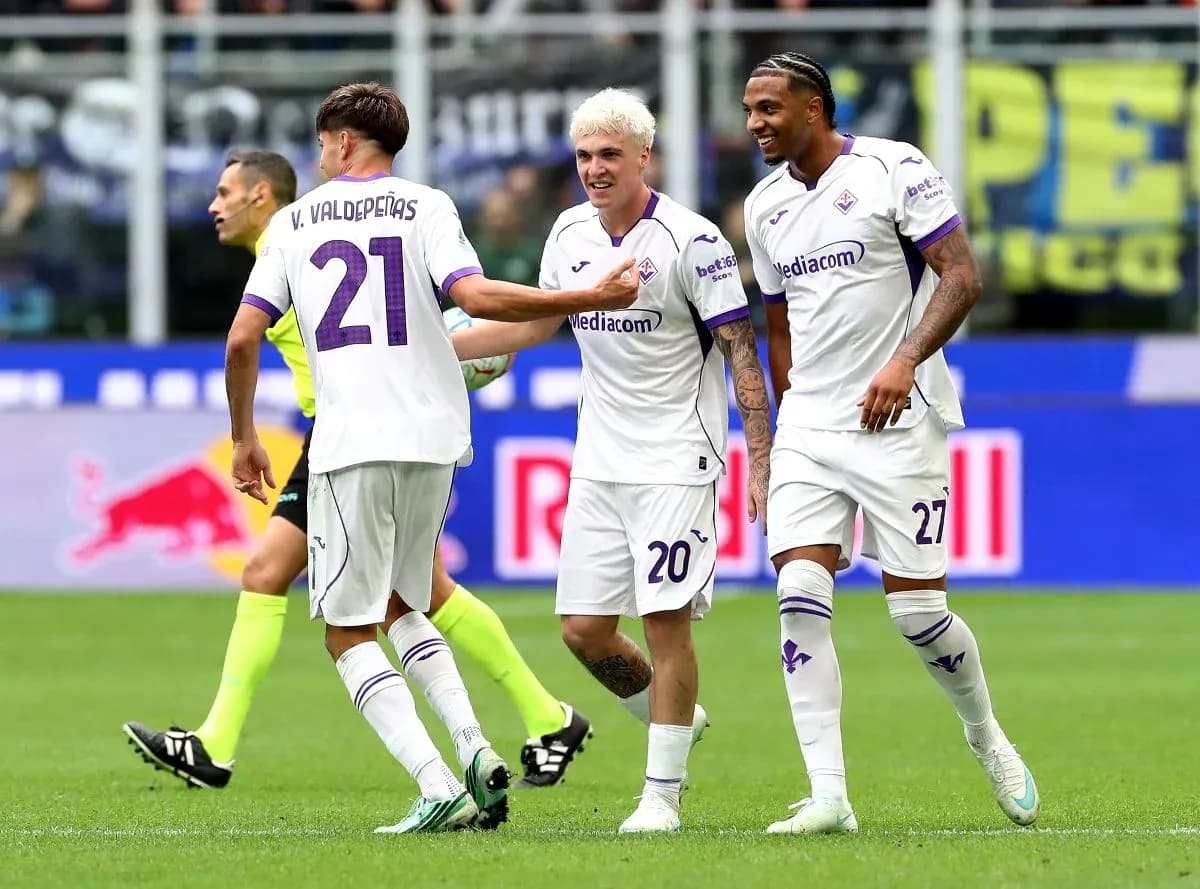
On their travels, Fiorentina arrived with a 4-3-3 under Paolo Vanoli, a system that in theory offers width and pressing lanes but, in practice this season, has not protected them. Away from home they have scored 6 and conceded 10 in 4 games, an average of 1.5 goals scored and 2.5 conceded. That imbalance is the defining trait of their campaign so far: they can hurt you, but they are almost always hurt more.
The back four of A. Jimenez, R. Dragusin, M. Pongracic and V. Valdepenas sat in front of D. de Gea, with a midfield trio of C. Ndour, N. Fagioli and M. Brescianini. Up front, Franco Mastantuono, M. Pellegrino and A. Njie formed a young, mobile line meant to exploit transitions.
II. Tactical Voids – Absences and Discipline
Inter came into this match without several high-profile names: C. Jones, Luis Henrique, L. Martinez, B. Pavard and J. Stones were all listed as missing, predominantly through thigh and general injuries. The absence of L. Martinez in particular forced Chivu to lean fully into M. Thuram as the attacking talisman and to trust Esposito as his partner. Without Pavard and Stones, the responsibility on Bisseck and Akanji to defend space and build under pressure increased.
Fiorentina’s absentees were more structural than star-driven but no less significant. A. Atta, F. Parisi, L. Ranieri and R. Sottil were all unavailable, stripping Vanoli of defensive depth and a natural attacking outlet on the flank. That meant a heavier load on Valdepenas at full-back and on Mastantuono as the primary creative and carrying force from the front line.
Disciplinary trends this season added another subtle layer. Inter’s yellow cards are spread across the game, but there is a clear spike between 46–60 minutes, where 36.36% of their cautions arrive. That often corresponds to a period of aggressive pressing immediately after half-time. Fiorentina, by contrast, see 29.41% of their yellows between 61–75 minutes and a further cluster in the late phases, hinting at a team that increasingly defends under duress and arrives late into challenges as matches slip away.
III. Key Matchups – Hunter vs Shield, Engine Room vs Enforcer
The Hunter vs Shield duel here was embodied by M. Thuram against a Fiorentina defence that has already conceded 19 goals overall in 8 matches. Thuram’s league output – 5 goals and 2 assists in 7 appearances, with 24 shots and 11 on target – marks him as one of Serie A’s most efficient forwards. He thrives on vertical deliveries, quick combinations and attacking the space between full-back and centre-back.
Dragusin and Pongracic were tasked with containing him, but Fiorentina’s defensive record away – 10 goals conceded in 4 games – suggested that the “shield” was likely to splinter under sustained pressure. With Inter failing to score in none of their matches so far and Fiorentina yet to keep a single clean sheet, the statistical weight was always behind Thuram finding decisive moments.
In the Engine Room, the duel was as fascinating as it was one-sided on paper. For Inter, Barella and Calhanoglu are the dual conductors, while Diouf has emerged as one of Serie A’s premier link men. Diouf leads the league in assists with 4, backed by 247 passes at 91% accuracy and 16 key passes. Barella, with 18 key passes, 1 goal and 2 assists, supplies the tempo and the third-man runs. Calhanoglu stitches phases together and dictates rhythm.
Opposite them, Fagioli and Ndour offered technical quality, while Brescianini provided legs and coverage. But Fiorentina’s midfield has been unable to shield a fragile back line: overall this season they concede an average of 2.4 goals per match. The risk for Vanoli’s trio was being stretched horizontally by Inter’s wing-backs and vertically by Thuram and Esposito, leaving Mastantuono too isolated.
Mastantuono himself is Fiorentina’s brightest light – 3 goals, 21 shots (9 on target), 14 key passes and 36 attempted dribbles with 16 successful. He is both their leading scorer and primary ball-progressor. But against Inter’s back three, particularly with Bastoni’s anticipation and Bisseck’s athleticism, he needed support runs and quick combinations that Fiorentina’s current structure rarely guarantees away from home.
IV. Statistical Prognosis – Why Inter’s Edge Was Always Likely
Inter’s season-long numbers read like the profile of a champion. Overall they average 2.9 goals scored and 1.3 conceded per match, with no defeats in 8 games. At home, five wins from five, 17 scored and 7 conceded, underline a side that does not simply edge matches; they impose them. They have failed to score in 0 matches and already taken and converted 2 penalties overall, with no misses.
Fiorentina’s statistical profile is the mirror image. Overall, they average 1.1 goals scored and 2.4 conceded, with only 1 win and 6 defeats in 8 games. On their travels, they have 1 win and 3 losses, scoring 6 but conceding 10. They have yet to keep a clean sheet anywhere, and have already failed to score in 2 matches.
Layer those trends onto the tactical setups at San Siro and the 2–1 outcome feels almost conservative. Inter’s 3-5-2, loaded with creators – Diouf, Barella, Calhanoglu, Mkhitaryan, Carlos Augusto – against a Fiorentina side that leaks chances and has no penalty threat at all this season (0 taken, 0 scored, 0 missed) was always likely to tilt the xG and shot volume heavily in the hosts’ favour.
In narrative terms, this fixture was less a clash of equals and more a test of whether Fiorentina’s young talent, embodied by Mastantuono, could disrupt a machine in full flow. Inter’s depth, structure and statistical dominance suggested that, even with key absentees, they would find enough solutions between the lines and in the box. The final scoreline, and the way the squads were shaped, simply confirmed that the league leaders remain on a different tier – and that Fiorentina’s season will be defined not by nights like this at San Siro, but by whether they can tighten the shield before the relegation tide pulls them under.