Iran's Unique World Cup Journey Amid Political Tensions
On Monday night in Los Angeles, Iran will walk into a World Cup unlike almost any other in the nation’s footballing history – a tournament where the noise outside may drown out the sound of the whistle.
Until this week, the host nation, the United States, was at war with Iran. On Sunday, an agreement to halt hostilities and reopen the Strait of Hormuz finally came. It lowered the temperature. It did not remove the heat.
The squad has felt it from the start.
Visas delayed. Base camp moved. Training plans shredded and reassembled. After months of uncertainty, Iran abandoned Tucson, Arizona, and shifted its World Cup headquarters to Tijuana, right on the Mexican border, a relocation driven by security concerns, visa anxiety and a political climate that grew more volatile by the week.
Amir Ghalenoei, a coach who prefers his battles on the tactics board, has been forced to manage a crisis off it.
“Without any doubt, this kind of behaviour has impacted the spirit of football,” he told the BBC. “Football is supposed to bring nations and cultures together. It is about bringing joy. These conditions have affected our focus, but I have tried to make sure the players concentrate on strategy and performance.”
They arrived late. They have had little time to acclimatise. The manager knows it, and so do his players.
“But I know how committed these players are to performing,” he said.
A World Cup in “Tehrangeles”
If there is a city outside Iran that understands the weight this team carries, it is Los Angeles.
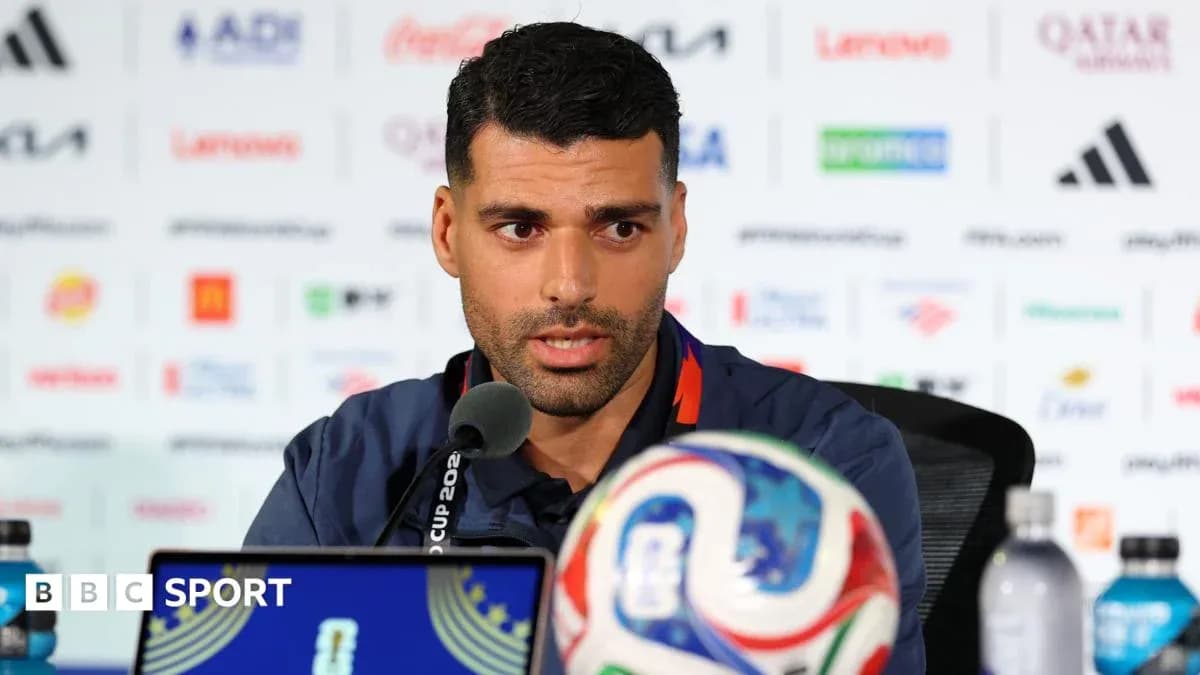
The nickname “Tehrangeles” drew a brief smile from both Ghalenoei and Mehdi Taremi when it came up in the pre-match news conference. The joke lands because it is true. This is the largest Iranian community outside Iran, a vast and vocal diaspora that has never really stopped arguing with the regime it left behind.
On Monday, many of those Iranian-Americans will head to SoFi Stadium, where Iran open their World Cup campaign against New Zealand. Some will go in shirts and scarves, ready to sing. Many others will arrive with placards and flags, ready to protest.
At the heart of the anger sits a symbol: the pre-revolutionary Lion and Sun flag. For many in the diaspora, it is not just a relic but an identity. Fifa has banned it from the stadium, a decision that has cut deep.
“You don't come to Los Angeles and tell us we can't fly the Lion and Sun flag,” said activist Arezo Rashidian, who is helping organise demonstrations outside SoFi. “This is the largest Iranian community outside Iran. Many of us came here after the revolution. We're opposing Fifa's ban and standing in solidarity with the people of Iran.”
For parts of this community, the national team is not a neutral shirt. It is seen as an extension of the Islamic Republic.
“It's unfortunate that the regime turns athletes into mouthpieces,” Rashidian said. “We want athletes to remain athletes.”
Yet even she will be there. Many like her will be too.
“We understand the pressure they're under,” she said. “We'll carry our colours. We'll cheer for Iran – the country – held captive by the Islamic Republic.”
So the scene is set: chants and counter-chants, flags allowed and flags forbidden, a stadium wrapped in politics long before kick-off.
Players caught in the crossfire
Inside that storm, Iran’s players are trying to hold on to something simple: the game itself.
“This kind of tension undermines the joy of the World Cup,” said Taremi. “I felt the tension from the first moment we arrived. The tension started even before we got here.”
He insists, though, that their purpose remains clear.
“As players of the national team, we play for every single Iranian, whether in the diaspora or in Iran,” he said. “In every country people have different opinions. We are here to unite people and bring joy. Everyone is entitled to their opinion. We don't get involved in politics.”
It is a clean line in theory. In practice, it is almost impossible to hold.
This is a World Cup where Iran’s football has often felt like a subplot to a larger story. Every training session, every media appearance, every decision about who speaks and who stays silent becomes loaded with meaning.
“There is no winning for Iran's team,” said investigative football journalist Samindra Kunti. “Given the circumstances, the political pressure, the location of the matches and the diaspora in Los Angeles, they're under enormous pressure.
“It's impossible to avoid the politics. Everything becomes a reminder of their situation.”
Pressure from home, where every performance will be parsed through a political lens. Pressure from the host nation, fresh from a conflict that has only just been paused. Pressure from a diaspora determined to make itself heard on the world’s biggest stage.
All of it converges on a rectangle of grass in Inglewood, where Iran must try to play a normal World Cup opener in anything but normal conditions.
Before a ball is kicked, they are already one of the tournament’s most scrutinised teams. The question now is whether, in a city that mirrors their country’s divisions, 90 minutes of football can offer even a glimpse of the unity they say they want to bring.