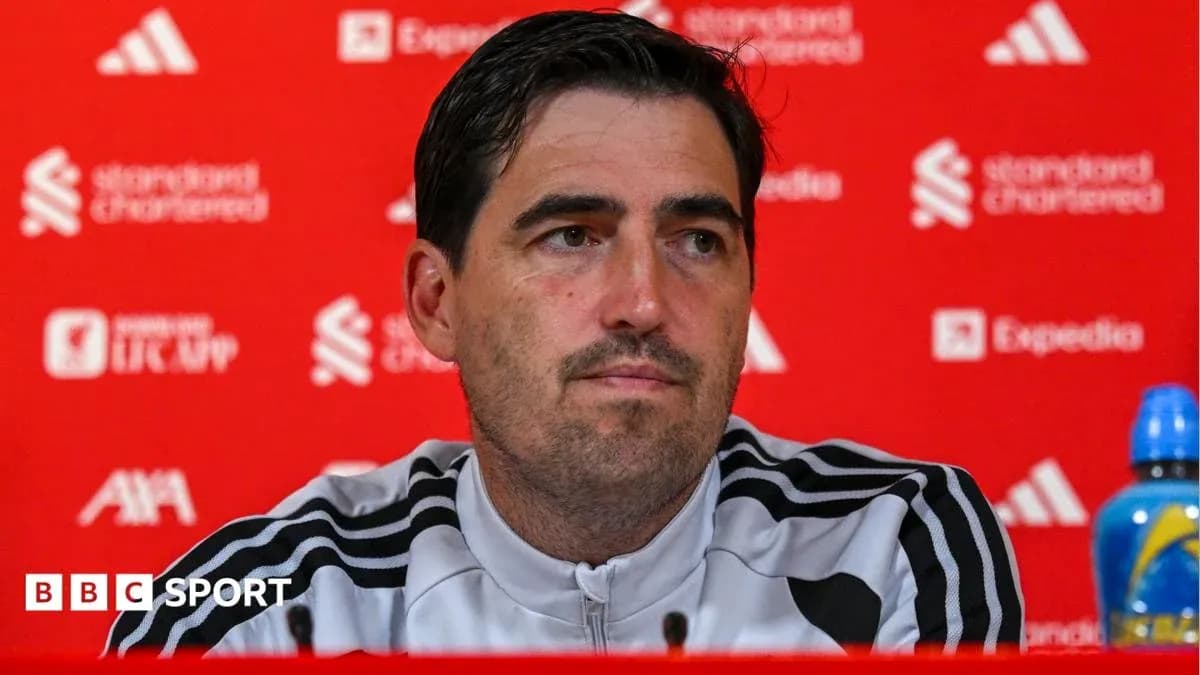
Iraola Faces Tough Cup Test Against Spurs
Andoni Iraola is only a few weeks into the job at Liverpool, but the brutal reality of English football’s schedule has already landed on his desk.
Asked whether he can simply pick his strongest XI for every competition, the Liverpool manager didn’t pretend.
“No,” he said. “You can decide and put the same players in every game. The problem is there'll be a moment when they're really tired. And there is more risk of injury.”
That’s the tightrope. He knows some players can go every three days without blinking. Others can’t.
“There are players who play every three days with no issues. They are very robust, their performances don't change too much,” Iraola explained. “There are other players where the risk is bigger and the performances are different. I have to learn who is ready to play games every three days and who needs a rest so their performance level isn't affected.”
He thought he already had a decent handle on it. The early weeks have told him otherwise.
“I thought I had it quite clear in my mind with some, but with others, it's new, even for them, because they haven't played as many games. We are learning.”
Learning time is over on Tuesday night. Tottenham are coming to Anfield in the Carabao Cup, and this is no gentle introduction.
No soft launch in the Cup
This is where the draw has been cruel. The EFL Cup is usually when Premier League managers exhale. Lower-league opposition, a sprinkling of academy talent, minutes for the understudies.
Not this time.
Liverpool’s name came out alongside Tottenham’s. A fellow top-flight side, even one stumbling through a difficult start, changes the calculation completely. Rotation suddenly carries sharper edges. One wrong call, and you’re out.
There is also the emotional baggage of Saturday. A flat, goalless draw with Fulham. Two home league games, two draws, and a new coach already discovering how unforgiving Anfield can feel when the tempo drops.
So what now? Go strong to jolt the team back into rhythm? Or stick to the long-term plan and protect legs for a season that is already threatening to become a slog of three-day turnarounds?
Either way, Iraola’s team sheet against Spurs will say plenty about who he trusts to be “robust” and who he believes needs shelter from the storm.
A Cup that belongs to Liverpool
If any competition feels like it lives at Anfield, it’s this one.
Liverpool have lifted the League Cup 10 times, more than anyone else. Their first came in 1980-81, the start of a remarkable run of four in a row that ended in 1984 and helped define an era of dominance.
The fifth title didn’t arrive until 1995, when Steve McManaman’s brace sank Bolton at Wembley. Then came the Houllier years: another triumph in 2001, and a seventh in 2003 with Manchester United beaten in the final.
Kenny Dalglish added the next in 2012, edging past Cardiff City on penalties during his second spell in charge.
The wait after that felt long. It ended in chaos and drama in 2022, an extraordinary 11-10 penalty shootout against Chelsea under Jurgen Klopp. Two years later, Klopp signed off in this competition with a 10th trophy for Liverpool, again at Chelsea’s expense in 2024.
That’s the weight of history Iraola walks into. Ten titles. A fanbase that knows this Cup is there to be won. And a simple, pointed question hanging over the season:
Can he take Liverpool to number 11?
Anfield stalls as fatigue bites
The answer to that will depend on how quickly Liverpool adapt to life under Iraola with two games a week. Saturday’s evidence was not encouraging.
A 0-0 draw with Fulham means Liverpool have failed to win either of their opening two home league fixtures for only the third time in 63 years. It is a statistic that jars at a ground built on early-season momentum.
The contrast with midweek was stark. Against Atletico Madrid in the Champions League, Liverpool were sharp, aggressive, relentless. Against Fulham, they were anything but. The visitors arrived low on confidence, having shipped seven goals in their first three league matches under Alvaro Arbeloa. They left with their first point of the season and few complaints.
“The Reds looked physically and mentally tired,” was the blunt assessment from Anfield.
They looked like a different team to the one that had overpowered a Diego Simeone side which reached the Champions League semi-finals last season.
This was the first real look at how Iraola’s high-intensity style holds up under the strain of a packed calendar. The verdict? Not yet ready.
Liverpool remain unbeaten and this is not a crisis, but six points from four league games is short of what Iraola would have expected. Dropped points at home to Nottingham Forest and Fulham, another draw at Newcastle, and a solitary win at Ipswich leave them playing catch-up before autumn has even settled in.
Big-money attack misfires
The spotlight inevitably falls on the front line. Liverpool’s £364m attacking trio of Alexander Isak, Bradley Barcola and Florian Wirtz started a league game together for the first time. On paper, it looks terrifying. On the pitch, Fulham handled it.
Liverpool had chances, but nowhere near enough for a side with that kind of firepower.
Isak’s numbers were startling. He had just 16 touches in 90 minutes – the second fewest for any Liverpool outfield player on record. The only time he had fewer? Two weeks ago against Forest, with 14. When your centre-forward is drifting out of the game like that, something is badly off.
Wirtz, so bright and inventive against Atletico, looked a shadow of that player. Barcola and Isak produced flickers, but nothing sustained. It felt like a front line still in pre-season mode, learning each other’s movements on the fly.
That understanding will come. It has to, given the investment. For now, though, Iraola is staring at a team that can look electric one night and blunt the next.
Fulham dig in, Liverpool run out of ideas
Arbeloa, back at Anfield where he played 98 games between 2007 and 2009, arrived under pressure after three straight league defeats. He left with a clean sheet, a point and a performance built on organisation and nerve.
His changes worked. David Affengruber came in for his Premier League debut at centre-back, Sander Berge replaced Cesar Palacios, and Fulham settled quickly.
They should have led early. A mix-up between Alisson and Ryan Gravenberch gifted Gonzalo Garcia a golden chance, only for Jeremy Jacquet to bail Liverpool out with a goal-line clearance. It was a warning born entirely of Liverpool’s own making.
Fulham had the better of the first half. Josh King forced Alisson into action from inside the box, Antonee Robinson headed wide, and the home crowd grew restless.
Liverpool’s response was patchy. Victor Munoz saw a header clawed away by Bernd Leno, Barcola’s volley was deflected behind by Timothy Castagne, but the hosts never built a sustained spell of pressure.
Iraola’s changes at the break and on the hour – Milos Kerkez for Kostas Tsimikas, then Alexis Mac Allister and Cody Gakpo for Gravenberch and Munoz – were aimed at lifting the tempo. The pattern barely shifted.
Isak finally worked a sight of goal, but Leno gathered comfortably. Dominik Szoboszlai unleashed a powerful strike, again Leno stood firm.
Two more changes on 72 minutes, Rio Ngumoha and Jeremie Frimpong thrown on, underlined Iraola’s desperation to tilt the game. The breakthrough never came. Isak headed wide from an injury-time corner. Fulham, who still threatened on the counter through King and Kevin, held on.
For Arbeloa, it was a platform. For Iraola, it was another data point in a growing file on his squad’s limits.
Adapt or fall away
This is the reality now. At least seven more Champions League fixtures. A Carabao Cup tie against Tottenham on Tuesday. The league grinding on, relentless.
Iraola has already accepted he cannot flog the same XI through every competition. He must identify his iron men and his fragile ones, his three-games-a-week warriors and those who need careful handling.
Liverpool’s season will be defined by how quickly he gets those calls right.
Tottenham in the Cup is not just another fixture. It’s an early test of judgment, of rotation, of nerve – and of whether Liverpool can still turn this competition, their competition, into a springboard for something bigger.