Irish Fans Turn Prague Into Home Ahead of World Cup Qualifier
Thousands of Irish fans are turning Prague into a second home this week, chasing a dream that has been out of reach for almost a quarter of a century.
Ireland stand one game away from a World Cup they have not graced in 24 years. The setting is the Fortuna Arena, home of Slavia Prague. The soundtrack will come from the streets.
A city turning green
Only about 1,200 tickets have been allocated to Irish supporters inside the 20,000-seater stadium. That number barely scratches the surface of what is happening beyond the turnstiles.
More than a dozen flights are leaving Dublin for Czechia this week, almost half of them extra services laid on for the surge. Yet the real story is in the detours: fans funnelling through other European airports, cramming onto trains, hiring buses, driving across borders. By Thursday, thousands are expected to pour into the Czech capital by road and rail.
Gary Spain, Supporter Liaison Officer for the Republic of Ireland men’s team, is braced for an invasion.
He expects at least 6,000 Irish fans to be in Prague for what he calls one of the biggest games in a generation. The problem is not getting there. It is finding somewhere to watch it.
There is no formal fan zone for travelling supporters. Prague is said to have more Irish pubs per capita than anywhere else in the world, but even that might not be enough.
"There aren't enough pubs I think in Prague's Old Town for everyone to watch the match in a pub," Spain said, a line that tells its own story about the scale of the travelling support.
Inside the Fortuna Arena, just 1,024 Irish fans will be in the away end, joined by an estimated 200 friends and family of the players scattered elsewhere in the ground. Small in number. Not in volume.
The away allocation, Spain explained, has gone to those who have put in the hard miles: fans who have been to six of the last ten under-subscribed away games were guaranteed a ticket, with those on five games going into a ballot.
"They will definitely make their voices heard," he said. "Wherever you go, the Irish fans will always be heard."
A hostile arena, a hardened opponent
If anyone understands what awaits Ireland in Prague, it is Diarmuid O’Carroll.
The Killarney native is assistant manager at Czech giants Sparta Prague and also serves as assistant to Michael O’Neill with Northern Ireland. He knows the Fortuna Arena. He knows Czech football. On Thursday, he will be in Italy with Northern Ireland, but his eyes will not be far from Prague.
"It's a very hostile environment," O’Carroll said of the Fortuna Arena. "They create that for the Champions League games. They create that for the domestic games. I would envisage something very, very similar. It'll be a loud, whistley, kind of aggressive nature to the game."
He paints a picture of a side and a stadium that do not do half measures.
"They're very passionate. They're very hard working, very physical," he said. "There'll be an element of aggression within the stadium, and an aggression with how they play. It'll be a physical game. It won't be a beautiful football game by any means. They'll make it a little bit horrible."
Czechia have cleared the decks for this. The Czech FA wiped its domestic calendar in the past week so that players — almost half of whom come from the national league — could focus solely on this World Cup qualifier. After a turbulent campaign that included a change of manager, the hosts now have a singular target: get past Ireland and move on to face either Denmark or North Macedonia.
The current Czech manager has called his players "soldiers" and framed the match as "war". The language is not subtle. Nor is the pressure.
O’Carroll sees it clearly.
"Czech people are brilliant but they are passionate and they demand success, because the two clubs have done quite well in European competitions, ourselves and Slavia over the years," he said.
"So I think they'll be adamant that they expect to go through, they'll be looking to do the business. I think there is an assumption that they will go through and I think that's maybe a little bit disrespectful to our team."
Underdogs with a puncher’s chance
Ireland travel as underdogs. That suits them.
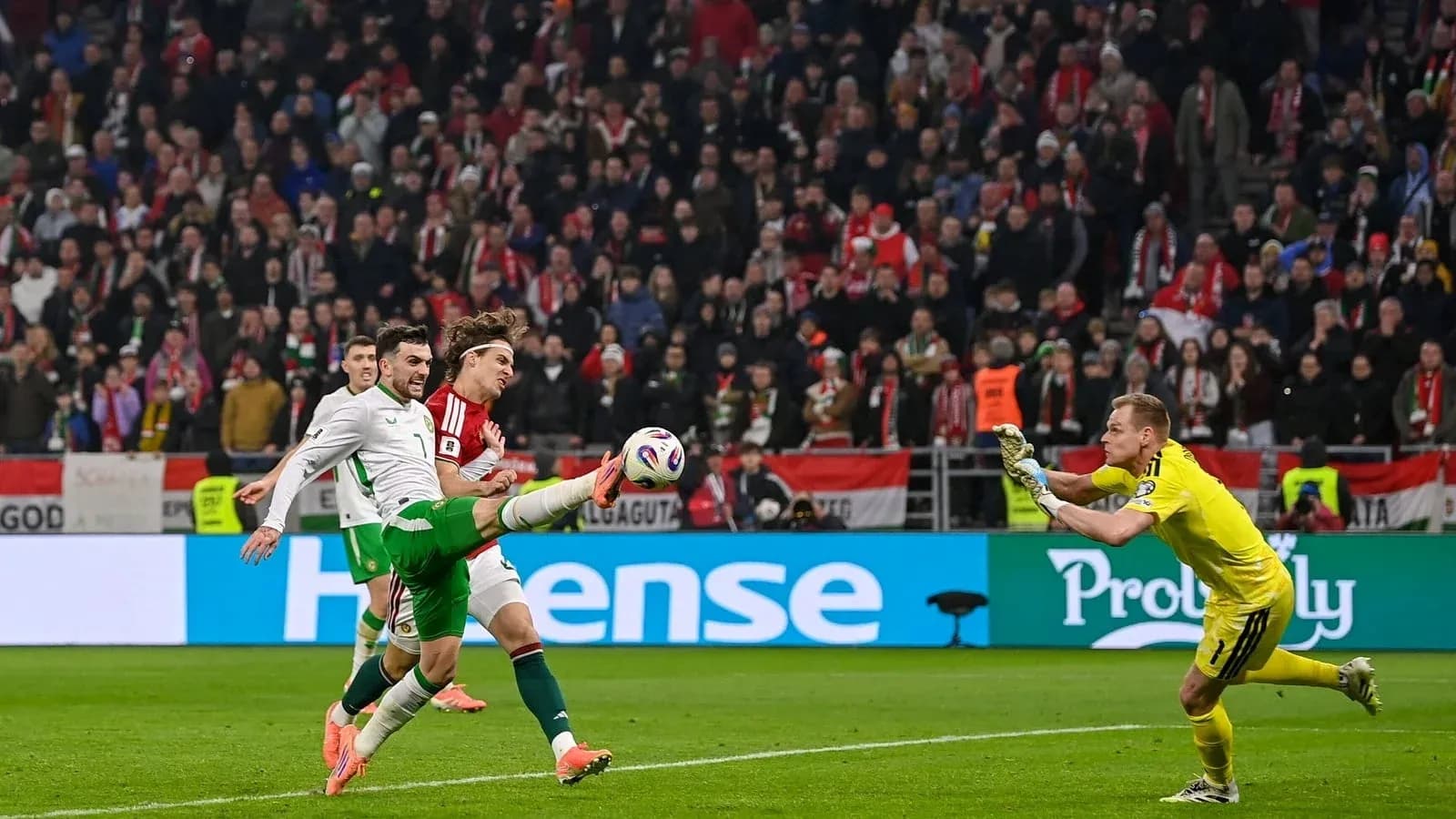
They arrive on the back of unexpected, momentum-shifting wins over Portugal and Hungary. Two shocks already banked. They now need a third to reach the final qualifying game next Tuesday.
The stakes are enormous. A place at a World Cup in the US, Canada and Mexico this summer, and the chance to end a 24-year exile from the biggest stage of all.
Spain believes it can be done. Not as a slogan, but as a genuine possibility.
"I think we can. I mean, I'm really, really hoping we can," he said. "World Cups are just so special. I'm conscious of the younger fans that have never had the chance to see us in a World Cup. It would be absolutely massive. And I'm sure everyone will be dreaming of Guadalajara on the 11 June."
The reference is deliberate. Guadalajara, June 11, the date and place where Ireland could begin a World Cup adventure that a new generation has never experienced.
O’Carroll, torn between professional objectivity and personal allegiance, does not hide where his heart lies.
"I think if I was going purely analytical, I'd say it could go 2-1 either way," he said. "But listen, I'm Irish, I want them to succeed, I want to go through.
"So I think we could catch them, probably with a little bit of arrogance, a little bit of overconfidence and we'll say 2-1 to Ireland on the night."
A hostile arena. A favoured home side. An Irish team that has made a habit of defying logic. And thousands of supporters turning Prague into a rolling, restless away end.
For a country that has waited 24 years, one brutal, ugly, glorious win would be enough.