Jacob Bergström's Rise: From Subway to Champions League
On a quiet strip of Sweden’s Baltic coast, where fishing boats outnumber floodlights, Jacob Bergström is living a dream he never dared to have.
At 22, he was still playing amateur football and making sandwiches at Subway. No academy pedigree, no glossy pathway, no agent whispering about potential. Just shifts, lower-league games and a body built more for graft than glamour.
Now, at 31, he is preparing to face a Champions League winner in the dugout and trying to drag Mjällby a step deeper into Europe’s elite competition.
From Subway shifts to Swedish champion
Bergström’s story is not supposed to happen in modern football. Not like this.
He joined Mjällby in 2018, still juggling football with work to pay the bills. He did not become a full-time professional until he was 24. By then, most players on this stage have already been branded prodigies or written off as nearly-men.
When he first arrived, Mjällby were in Sweden’s third tier. The club, tucked away in the tiny village of Hällevik, felt big to him then. Big enough.
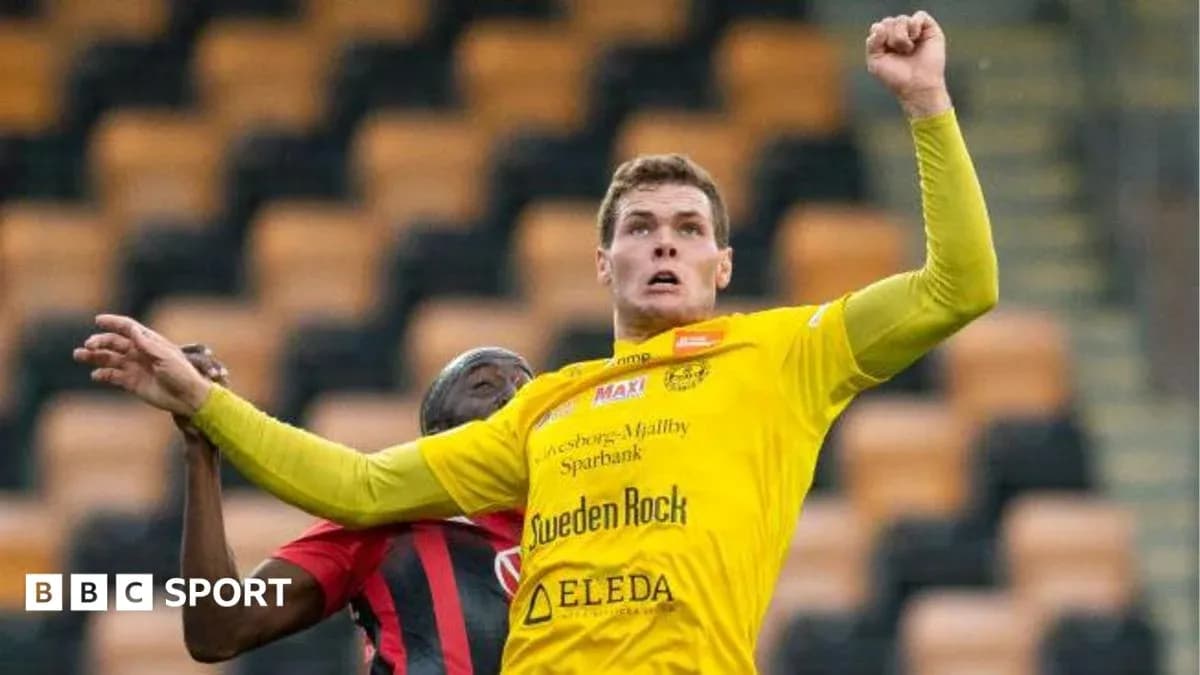
He never plotted a route to the Champions League. He never really thought about it at all. Yet over the past year, the burly 6ft 3in striker has helped Mjällby rip up their own history books: a first-ever Swedish championship, a first Swedish Cup, both in the same season, both in the club’s 87-year existence.
Now he has a Champions League goal to his name as well, scored on debut, and another improbable target in front of him: Slovan Bratislava, coached by Yaya Touré.
A superclub in a village of 1,000
Mjällby’s success would be remarkable anywhere. In Hällevik, it borders on surreal.
The village has fewer than 1,000 residents. On paper, this is a place for holiday cabins and quiet winters, not European nights and national headlines. Yet Mjällby, the strongest team in Blekinge County, pull in crowds of around 5,000. On matchdays, the region converges on Strandvallen, a ground wedged between woods, a campsite, an outdoor pool and the Baltic Sea, just 100 metres from the water.
Bergström grew up about an hour north in Karlskrona, the county capital, where handball and ice hockey usually steal the spotlight. Football was not supposed to lead him here, but it did. When he returned to Mjällby in 2023 after a brief spell with Djurgården in Stockholm, he and his wife committed fully. They moved to Hällevik with their two children. This unlikely Champions League outpost became home.
The rhythm of the place suits him. In winter, Hällevik is sleepy, the streets sparse. In summer, tourists flood in and the population multiplies. Through it all, Bergström climbs on his bike and pedals to training and games, past the water, past the flags, past the same faces who once watched him as a part-time player.
The face of an underdog
On the pitch, he has become the embodiment of the club’s edge. A classic target man, big, combative, impossible to miss. Off it, he is still the guy you might bump into at the local supermarket.
Mjällby fans have claimed him as one of their own. They love his stubborn streak. When he scored and celebrated in front of Malmö supporters, he stood there as beer rained down from the stands. He later joked that it “tasted very good”. After a win away to the same big-city rivals last season, he grabbed a megaphone and led the away end in a chant: “Whoever doesn’t jump is a Malmö pig.”
This is not the curated, polished world of superstar forwards. This is a player who still cycles to games, who still moves through the village like any other resident, yet now carries the hopes of a region that has long been overlooked.
A village turns European
Europe came to Strandvallen last month, and Hällevik responded like a place that knows this might never happen again.
For the first Champions League qualifier against Lincoln Red Imps of Gibraltar, the entire village seemed to dress in yellow and black. A jazz band played as 3,500 fans packed into the ground. Another 2,300 set up at the marina with deckchairs and cool boxes, eyes fixed on a big screen by the water.
A goalless draw in Gibraltar was enough to send Mjällby into the third qualifying round. It was not glamorous, but it was efficient, and it meant one thing: another European night, another step up in class, and a visit from a man who once ruled midfields at the very top.
Yaya Touré in Hällevik
Slovan Bratislava appointed Yaya Touré as head coach in June, handing the former Manchester City and Barcelona midfielder his first managerial job. He knows the Champions League as a player who conquered it, winning the 2009 final with Barcelona at the Stadio Olimpico in Rome.
He has walked out at the Etihad, Camp Nou, the biggest arenas the sport can offer. Now he will walk out at Strandvallen, where away teams arrive at the end of a long drive through farmland, greeted by tractors flying Mjällby flags and a compact, hostile stadium.
Many visitors hate it. The journey feels endless, the surroundings unglamorous, the atmosphere claustrophobic. For European games, Mjällby’s most fervent supporters move into the largest seated stand, packing it tight and turning the noise up another notch.
Touré has already recognised there is something different here, admitting Mjällby have “something that other teams don’t have”. On Tuesday, he will find out exactly what that means.
A fairytale with more pages to turn
Slovan Bratislava arrive as 24-time Slovak champions, with the expectation and pedigree that brings. They are supposed to be the heavyweight in this tie. Yet Mjällby have been hearing that kind of talk for a while now, and ignoring it has taken them from Sweden’s third tier to the brink of the Champions League play-offs.
Even if they fall short, the story does not end. Their run already guarantees a place in at least this season’s Conference League. More trips, more names, more stars for Bergström to test himself against.
From Subway counters to a seat at European football’s top table, the journey has already stretched far beyond anything he imagined when he first signed for a third-division side in a forgotten corner of Sweden.
Now comes the question that hangs over Strandvallen, over Hällevik, over every yellow and black flag fluttering by the Baltic: how much further can this unlikely ride really go?