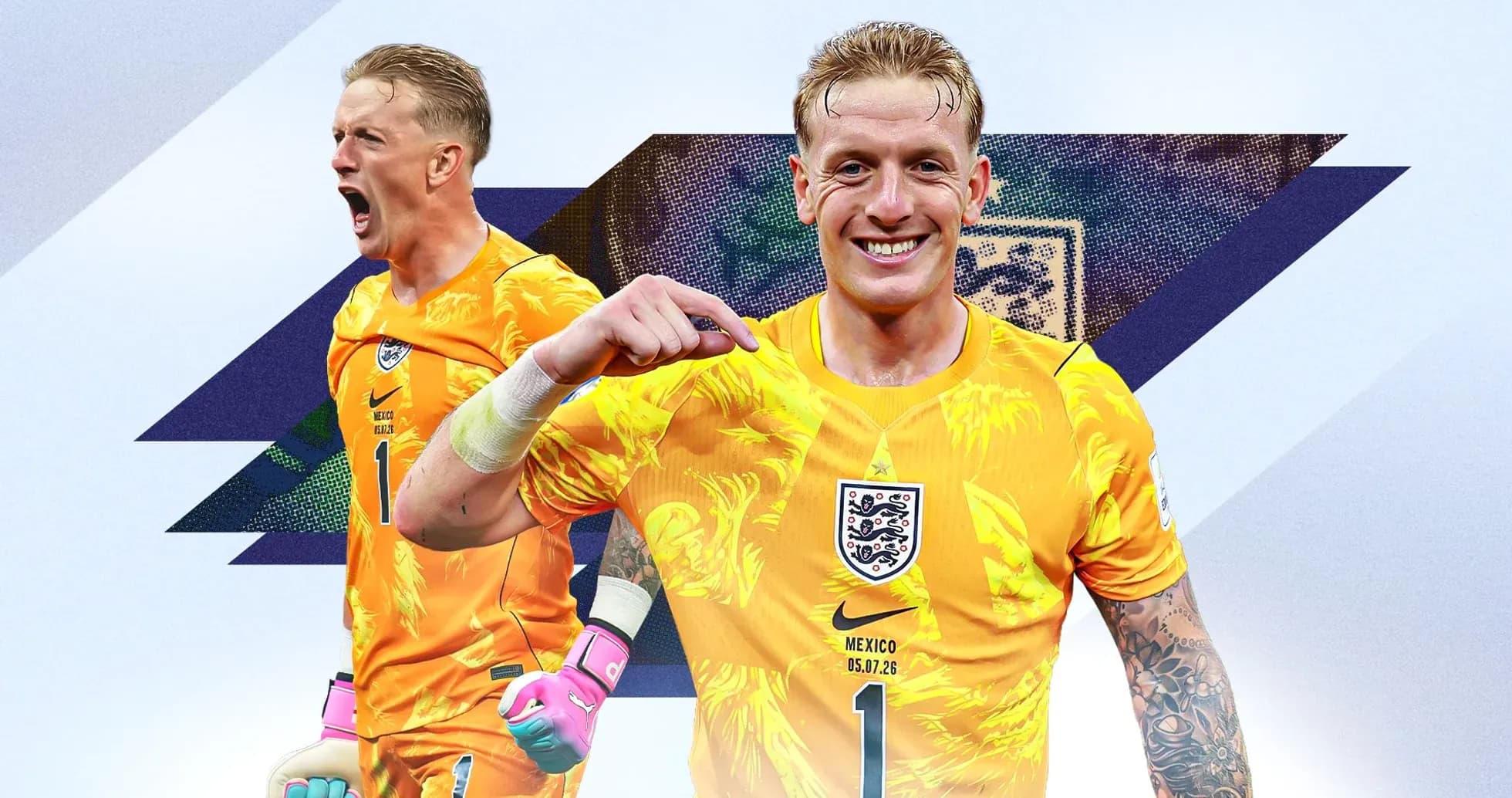
Jordan Pickford's Journey: From Doubts to Dependability in the World Cup
Jordan Pickford walked into this World Cup with questions hanging over him. Not about his character, not about his competitive edge – those are beyond doubt – but about his form.
The start of the tournament did him no favours. Against Croatia he wasn’t poor, just short of the standard he has set for himself in an England shirt. He got a strong enough touch on Martin Baturina’s strike but couldn’t keep it out as Croatia levelled at 1-1. His distribution, usually a weapon, was loose. Cameras in Dallas caught Thomas Tuchel raging on the touchline at his goalkeeper’s passing. It was the kind of moment that lingers.
Ghana brought no relief. Pickford charged from his box, misjudged the ball and clattered into Prince Adu. On another night, with another referee, he’s walking. Only the force of the Ghanaian forward’s own challenge saved him from a red card in a turgid 0-0 that did nothing to quiet the doubts.
Then came DR Congo in the last 32. Another uncomfortable frame in the early-tournament montage. Brian Cipenga beat him at his near post in Atlanta to open the scoring. Had Harry Kane not dragged England out of the mess in the final 15 minutes, Pickford would have worn a heavy share of the blame.
All of which made what happened at the Azteca feel like a turning point rather than just another knockout tie. England were always going to suffer in Mexico City. The altitude, the noise, the waves of green shirts – this was a night for a goalkeeper to stand up or fold.
Pickford stood up.
Mexico’s first real opening fell, inevitably, to Raul Jimenez. A dart to the near post, a firm header, and for a split second the stadium held its breath. Pickford read it, snapped low to his left and clawed the ball around the post. A big save, early. A statement.
Jimenez came again just before the interval, another header, this time arrowing towards the roof of the net. Pickford adjusted, sprung, and tipped it over. If that goes in, England trudge off at 2-2, their hard-earned lead shredded. Instead, they walked down the tunnel 2-1 up, still in control.
The real show, though, came in the final half-hour.
As Mexico piled on the pressure, Pickford seemed to grow taller with every cross. He barked at his centre-backs, dragged his defensive line into place, and attacked anything that hung in the air. By the end, he had five punches, three vital saves and a handful of clearances that don’t make highlight reels but win knockout games.
“He’s not pleasing on the eye, but my god he’s effective, and you can trust him, and in the big moments he wants to stand there and be that guy,” Joe Hart said on the BBC afterwards. “That’s massive to have in a team.
“To be the England number one for so long, and to keep improving and stepping up in a big game, I’m so pleased he had that night tonight and he deserves every bit of praise he’s going to get.”
Hart’s words hit on something that has followed Pickford for years. Respect, yes. Trust from managers, absolutely. But love? Not quite. Tuchel even made a point before the tournament of stressing that no position was safe, goalkeeper included, a nod to Dean Henderson’s outstanding form at Crystal Palace.
The numbers tell a different story. Since his debut in November 2017, Pickford has been the constant in England’s modern era. He quickly nailed down the shirt under Sir Gareth Southgate and has started every game at five straight major tournaments. Barring a late twist before Norway in Miami, he will become England’s most-capped World Cup player, moving past Peter Shilton’s 17 appearances on the biggest stage.
Shilton himself has joined the chorus.
“I think he’s probably the best since I finished with England,” the former No.1 said. “If you look at the record, World Cup semi-finals, penalty saves... I think he’s probably up there. I would put him up there as the best. Obviously, David Seaman, he’s very close. But I think, generally, looking at his overall situation, I think he’s probably the best since I played.”
You don’t get that kind of endorsement lightly.
Pickford’s ledger in an England shirt is already stacked with defining nights. In 2018, he helped banish decades of penalty trauma, saving in the shootout win over Colombia in the last 16 and then producing a Player-of-the-Match display against Sweden in the quarter-final. Euro 2020 brought more agony than joy in the end, but he still saved two spot-kicks in the final against Italy at Wembley. In 2024, he did it again, denying Manuel Akanji as England edged Switzerland in another quarter-final shootout. Four saves from 14 penalties faced in World Cup and Euros shootouts: that’s not luck, that’s a specialist at work.
Ben Foster captured the essence of that mindset in 2024.
“When it comes to a penalty shootout, I don’t think I would have anyone else,” he said. “I reckon at that moment in time when you get a penalty shootout, he’s genuinely thinking, ‘It’s showtime, baby’. If you could take a blood reading or a sample of how much adrenaline is coursing through his body at that moment, I reckon it would be right at the top, right at the limit. It’s like he’s had six double espressos.”
The drama of penalties has always drawn the spotlight, but his work in open play is just as compelling. Since 2018, statistical models credit him with only one error that directly led to a goal for England. One. In a position defined by scrutiny, he has become one of the most reliable operators in international football.
That dependability stretches back to Merseyside. Pickford is the Premier League’s longest-serving starting goalkeeper, almost a decade as Everton’s No.1. He has been named the club’s Player of the Season three years running – 2022, 2023 and 2024 – and since 2022-23, Opta data has him preventing more goals than any other goalkeeper in the division.
“He is a top ’keeper, he has made top saves all season, he is fully capable of it,” Hart added after the Mexico win. Those inside the profession rarely sound so unequivocal without reason.
Of course, the flaws have been magnified. They always are with goalkeepers. A handful of high-profile errors have stuck to his reputation, not least the reckless challenge on Virgil van Dijk that ruptured the Liverpool defender’s ACL and ignited fury across the city. Yet every Everton manager since 2017 has backed him, through dips, through noise, through relegation battles.
They know what he gives them. Leadership. Presence. A habit of producing outrageous saves when the club is staring into the abyss. On several occasions, Pickford has effectively kept Everton in the Premier League on his own.
Now comes another examination, this time in Miami, and a familiar face waiting in the Norway line-up.
Erling Haaland has feasted on Everton since landing at Manchester City, scoring seven times past Pickford. Only four goalkeepers have picked the ball out of their net more often after facing the Norwegian. Haaland arrives in Miami in terrifying form: goals in 14 straight competitive games for his country, 27 in that run alone. He barely touched the ball against Brazil in the last 16 and still scored twice, dismantling the Selecao almost single-handedly.
Right now, he is the most ruthless finisher on the planet. By some distance.
Yet England know this terrain with Pickford. Tournament after tournament, when the stakes rise, he usually rises with them. The Three Lions go into Saturday as slight favourites, but they also understand the context. Norway have taken the harder road, they looked fresher dismantling Brazil than England did clinging on against Mexico, and they carry the kind of centre-forward who can turn a tight game with one swing of his left boot.
All of that points to one conclusion: England will need their goalkeeper again. Not just the shot-stopper, but the organiser, the shouter, the man who feeds off the chaos rather than shrinks from it.
The evidence of the past seven years is clear. When the moment comes, Jordan Pickford usually answers. The question now is whether he can do it once more with Haaland bearing down and history within reach.