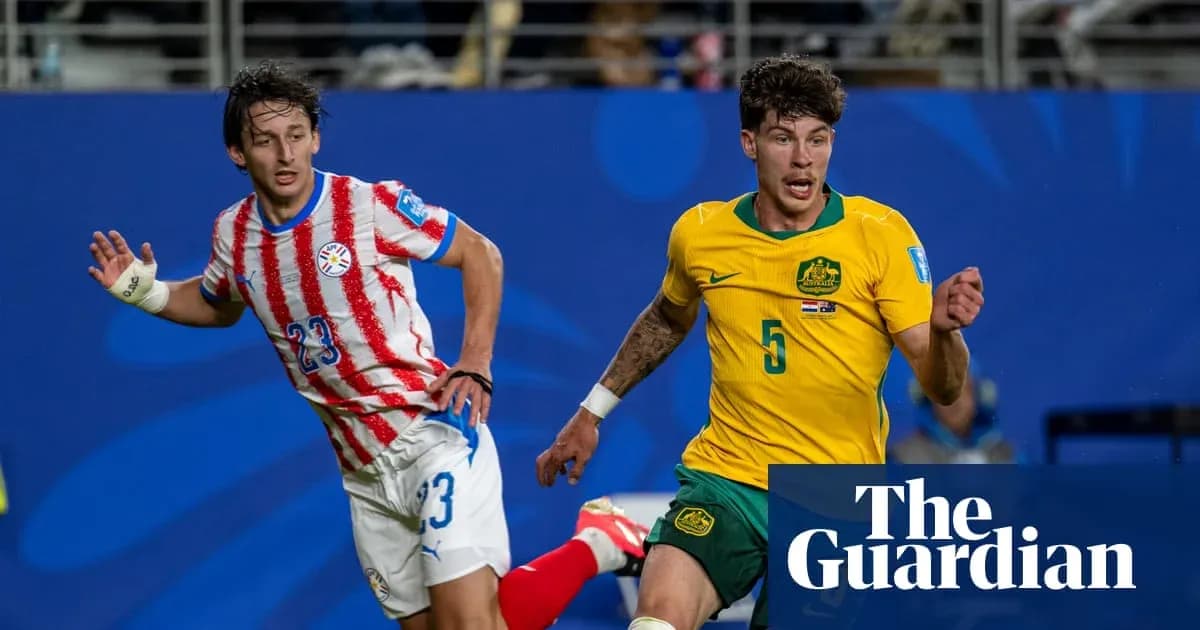
Jordy Bos Shines as Australia Advances in World Cup
Jordan Bos did not so much play right-back as rip up the job description and write his own.
Again and again the natural left-back tore down the opposite flank, shrugging off one challenge, then another, driving into the box as if the penalty area were pulling him in on a rope. At 0-0 against Paraguay, with the Socceroos edging minute by nervous minute towards the World Cup last 32 on a cool night by the San Francisco Bay, Bos became the rising tide that kept lifting everything green and gold around him.
Every surge mattered. Every metre he stole dragged the ball further from danger, further from Julio Enciso’s orbit, further from the moments when goalkeeper Patrick Beach had to fling himself into another save. Each time Enciso found space, the collective heart rate of the Australian section spiked. Each time Bos took off, it dropped again.
Tony Popovic kept glancing at the clock. So did the 12,000 Australians who had painted the stadium yellow, eyes locked on the digits as they crawled through a fraught second half. A draw would be enough for second place in Group D. A goal was a luxury, not a necessity. What Australia really needed, after the flatness of the defeat to the US, was a jolt of belief, a performance they could hang this World Cup campaign on.
They found it in the most unlikely of places: their left-back, playing on the right.
Popovic had sprung a surprise when his teamsheet dropped. With recognised right-sided defenders like Kai Trewin and Jason Geria in the squad, Bos at right-back looked like a gamble. Popovic had seen it before, though, during Bos’s spell at Westerlo in Belgium and in a half-hour cameo against New Zealand nine months earlier. He trusted the adaptation. On this evidence, he undersold it.
This is the best game he’s played of the three [World Cup matches] by far,” Popovic said later. It was obvious to anyone who had watched from the first whistle.
Bos arrived at this tournament with a solid reputation already secured in the Dutch Eredivisie and, at 23, as one of the standard-bearers of this young Socceroos generation. Until Thursday, his World Cup had been steady rather than spectacular. Then came the explosion – out of position, under the threat of a yellow card that would have ruled him out of the last 32, and under the weight of a nation’s nerves.
The risk of a booking did not slow him. He crashed into duels, leapt into aerial contests, carried the ball with a fearlessness that belied the stakes. By the end, no Australian had taken more shots than his three. He had created the joint-most chances. He completed four dribbles, won more duels than anyone else on the pitch, and dominated in the air, taking seven of nine aerial battles.
I was enjoying it too, honestly, tonight,” Bos said afterwards, a mild understatement for a performance that had his teammates reaching for the highest shelf of footballing comparisons.
From the right wing, Ajdin Hrustic had the perfect vantage point. “He’s a great player, he’s got power, you’ve seen it,” he said, having spent the evening watching Bos roar past him on the overlap. In training this week, Hrustic had already started calling him “Dani Alves” – a nod to the Brazilian great who redefined the modern full-back.
Midfielder Aiden O’Neill walked off with the official player of the match trophy but admitted it probably belonged elsewhere. He looked almost embarrassed to hold it while Bos’s name rang around the mixed zone.
Harry Souttar went for something simpler. “A special player, a special guy, and just takes everything in his stride,” the captain said. Then he smiled and pushed the line a little further. “The guy’s body’s just unbelievable to look at. I don’t want to obviously put too much pressure on him, but if he keeps performing like that then there’s no ceiling.”
Milos Degenek dispensed with restraint altogether. He called Bos already a top-five left-back in the world and the best at his age. “That’s my opinion, I’m very biased, and I love him,” he said. When a journalist asked how Bos ranked at right-back, Degenek did not miss a beat. “Top 10,” he shot back, laughing.
Nestory Irankunda, the hero against Turkey who watched much of this one from the bench after being substituted, went even higher. “He’s the best player in the world, Jordy Bos, best winger in the world,” he said. “He might have to switch to a winger, in my opinion. He’s done so well at right-back today, but he got so high up the pitch today and he showed glimpses of what he can do with the ball.”
That was the story of Australia’s second half. As Cristian Volpato and Irankunda were withdrawn, Bos simply kept going. The cast around him changed; his role did not. He kept driving, kept smashing into bodies, kept forcing Paraguay backwards. The right flank belonged to him.
With that came the inevitable lineage talk. Arjen Robben’s name surfaced again, as it has before with Bos – another left-footed presence cutting in from the right. He brushed the comparison away with a hint of regret. “Unfortunately I didn’t score like him, but I tried,” he said. Hrustic’s “Dani Alves” tag lingered. So did the echoes of Gareth Bale, the former Wales left-back who morphed into a right-sided force at Tottenham and Real Madrid, fuelled by the same blend of power and relentless running that Bos showed here.
Asked which comparison he saw the most of himself in, Bos gave a small nod to the gallery. “Yeah, Robben … I don’t mind Bale, to be honest,” he replied.
In truth, the names are a sideshow. They are flattering, and they tell you something about how his teammates view him, but they are not the point. What mattered on this night, in a tense 0-0 that carried Australia into the last 32 and breathed life back into their World Cup, was that Bos stepped out from under all of those shadows.
Dani Alves, Arjen Robben, Gareth Bale – they are the reference points.
This was the night Jordy Bos became the headline.