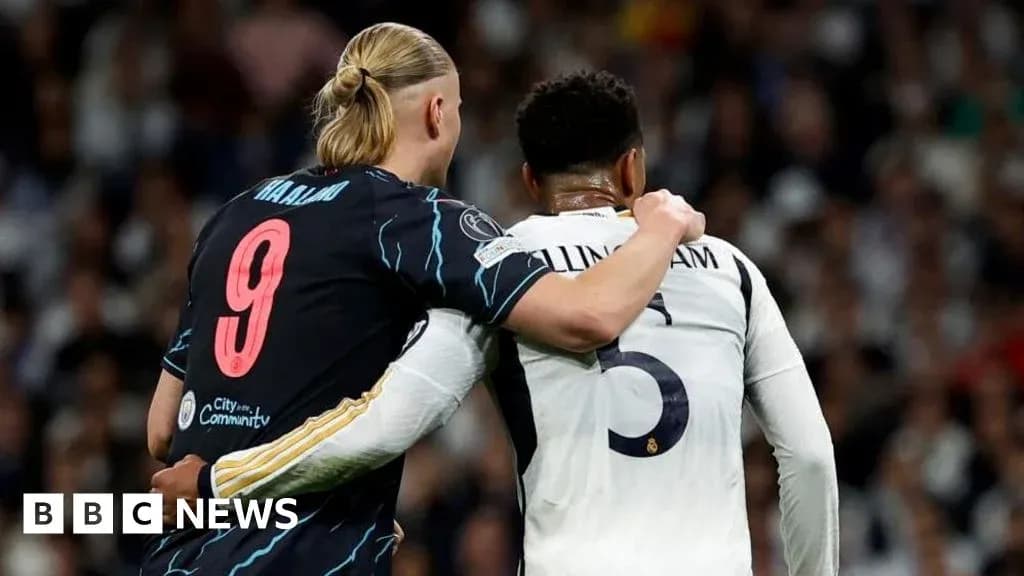
Jude Bellingham and Erling Haaland: A Refreshing Football Friendship
In an era when every gesture is clipped, captioned and fired around the world in seconds, the friendship between Jude Bellingham and Erling Haaland has become one of football’s most unexpected soft-focus subplots.
It started at Borussia Dortmund. Two prodigies, one dressing room, and a club savvy enough to sense the chemistry. BVB even leaned into it on Valentine’s Day, releasing a YouTube video of the pair reading deliberately awful pick‑up lines to each other. Haaland, stone-faced, delivered one of the standout lines: “I'd like to take you to the movies but they don't let you bring in your own snacks.” The clip was pure theatre, but the warmth was real.
That bond has since followed them across Europe and into the glare of a major tournament, where old footage has been dug up, remixed and re‑shared. The internet has done the rest. Fans have gone beyond the usual “bromance” tag, invoking the gay ice hockey novel Heated Rivalry and cheekily rebranding Bellingham vs Haaland as “Cleated Rivalry” – a fictional football romance layered over two very real, very competitive careers. Both are reportedly in relationships with women, yet the running joke taps into something else: the rare sight of two elite male athletes whose ease with each other reads, to many, like genuine emotional intimacy.
PR expert Mark Borkowski sees a generational shift at work. “If you go back to the days of the 90s or 00s a lot of brands fell out with footballers because they were so badly behaved,” he told the BBC. This crop is different. Sharper to the power of image, raised on social media rather than blindsided by it. “If you look at this generation of footballers they are a different breed and I think it is a lot to do with social media,” he said, pointing out that Haaland, in particular, “comes from a pretty wholesome family as well.”
The European club pathway matters too. Both players left home young, learned new languages, absorbed new cultures. “I think with both of them it is the European touch (playing in Europe at club level) that has made them aware of different cultures and made them who they are,” Borkowski added. The result is a public persona that feels less guarded, less combative, more willing to let people in.
That openness has cut through the usual online noise. One cultural commentator, speaking to the BBC, described the clips of Bellingham and Haaland as “a bit of an antidote” to the relentless fury of football social media. “Football online is often built around outrage and tribalism and turning every player into either heroes and villains,” he said. In that landscape, short videos of two superstars laughing together do something deceptively simple: they “re-humanise two people who are normally cast as multi-million pound assets or rivals or goal-scoring machines.”
It’s the contrast that grips people. On the pitch, Bellingham and Haaland are among the most ruthless competitors in the game. Off it, the cameras catch them being “funny, affectionate and clearly comfortable in showing they care about each other.” No snarling, no forced needle, no pantomime animosity for the sake of the spectacle.
“There is also something incredibly refreshing,” the same observer noted, “about two young male athletes displaying a warm notionally open friendship without feeling the need to perform hostility for the cameras – they can desperately still want to beat each other but still like and respect each other.” In a sport that still leans heavily on machismo, that simple refusal to posture feels radical.
They work, too, as characters in a story. Bellingham is “polished, articulate, emotionally expressive.” Haaland is “much more eccentric, deadpan, naturally meme-able.” Put them together and each unlocks something in the other that you rarely glimpse when they are in full, hyper-professional mode. The polished England star becomes sillier. The Nordic goal machine softens at the edges.
Away from the spotlight, their lives are more conventional than the social feeds suggest. Haaland has spoken briefly about his private world, once admitting, “I cook dinner… It's going to be a little embarrassing for her that I say this, but she likes video games,” when talking about his partner. Bellingham, widely reported to be dating US model Ashlyn Castro, has kept that side of his life firmly out of public view. What he does talk about, often and with obvious feeling, is his family.
“Looking back, I think if I had a dad that didn't play football, I probably would never have got into football really, because there was nothing there for me that motivated me to play at the start,” he told the England Football website. His father, a former player himself, opened the door to the game. His mother shaped the person who walked through it.
“And then I have my mum who has taught me more about life outside football, but it merges quite well,” he said. Lessons about composure and responsibility at home bleed into his performances on the pitch. “Even some of the stuff that my mum has taught me, I do take it on to the pitch, about staying calm, staying cool, being a good example to my team-mates and trying to lead and stuff like that. I think a lot of that comes from my mum because she's a very good leader.”
Those roots matter. They explain why a 20‑year‑old can stride through a tournament as if he has been doing it for a decade, yet still look entirely at ease joking around with an old team-mate. They also explain why supporters latch onto these glimpses of humanity. In a sport obsessed with numbers, tactics and transfer fees, the enduring image of Bellingham and Haaland might not be a goal or a trophy lift at all, but a shared laugh, a terrible chat-up line and a reminder that, beneath the branding, the rivalry and the noise, football’s biggest stars are still just people who like each other’s company.