Jurgen Klopp's Bold Start as Germany Coach
Jurgen Klopp has not eased his way into international management. In his first major act as Germany head coach, he has named two entirely separate squads for the upcoming Nations League fixtures, calling up a remarkable 44 players and drawing a sharp line under the previous era.
Germany face four games in quick succession — the Netherlands, Serbia and a double-header against Greece — and Klopp has chosen to attack that schedule with depth and experimentation rather than caution.
Two squads, one message
One group will handle the first phase: the trip to Amsterdam to face the Netherlands next Thursday, September 24, and then Greece in Augsburg three days later on September 27. A second, largely distinct squad will then take over for Serbia in Munich on October 1 and the return meeting with Greece in Thessaloniki on October 4.
It is a bold structural reset. It is also a clear signal: nobody’s place is safe, and the door is wide open.
Sixteen of those 44 players have yet to make a senior appearance for Germany. Among the debutants are Said El Mala of Köln, Freiburg trio Max Rosenfelder, Philipp Treu and Derry Scherhant, and Celtic midfielder Mika Baur. Klopp has wasted no time refreshing a squad that stalled badly under Julian Nagelsmann.
Nagelsmann stepped down after Germany’s World Cup exit in the last 32 against Paraguay, a limp end that demanded change. Klopp has answered with volume and variety.
Big calls on big names
The headline omissions and role changes underline his intent.
Deniz Undav, so influential for Stuttgart, has been left out. Klopp put that down to fitness, but any absence of a striker in this form will be noticed.
Joshua Kimmich, long shunted between roles for club and country, finally has clarity. Under Nagelsmann he often operated at right-back. Under Klopp, he will be a midfielder. No caveats, no half-measures. Germany’s new coach has nailed his colours to that particular mast.
In goal, there is no ambiguity either. Marc-Andre ter Stegen, currently on loan at Ajax from Barcelona, has been confirmed as first choice. The long-running debate over the No 1 shirt has been parked, at least for now.
There are also recalls for Karim Adeyemi, Leeds United midfielder Anton Stach and Brentford forward Kevin Schade, names that hint at Klopp’s preference for energy, direct running and aggression in transition.
A cap, a flag, and a divided country
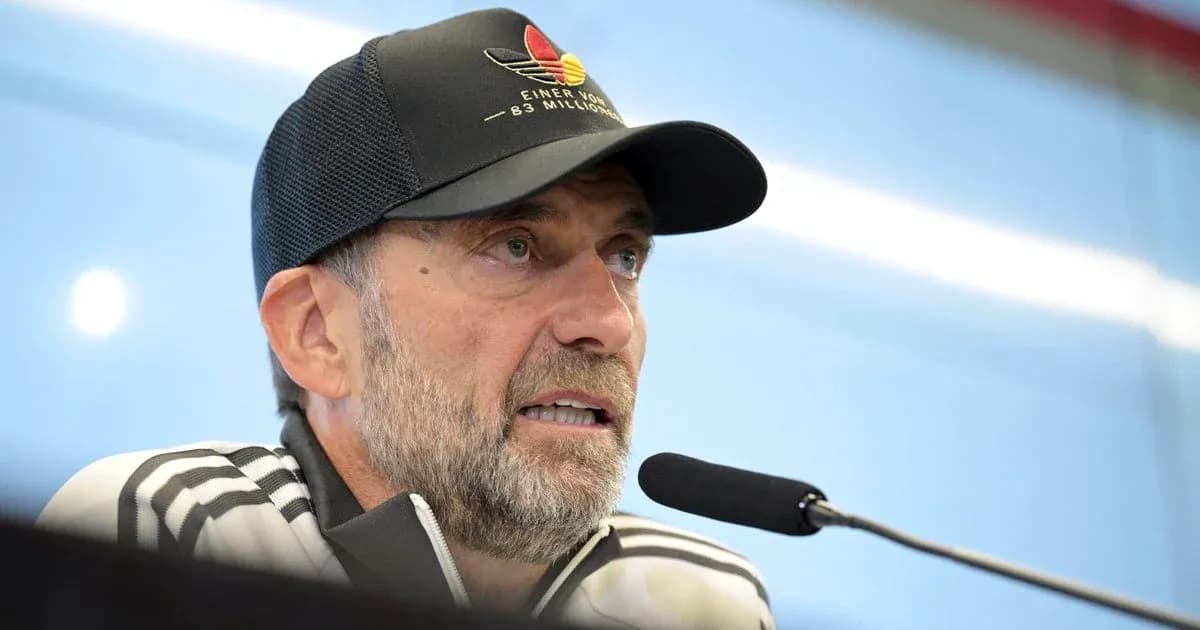
Yet the most striking image of Klopp’s first squad announcement was not on the team sheet. It was on his head.
He arrived at the press conference wearing a baseball cap in the colours of the German flag, emblazoned with the words: “one of 83 million”.
In a different time it might have passed as a quirky fashion choice. Not now. Not in this Germany.
The country is wrestling with a fractious political climate. The far-right Alternative für Deutschland (AfD) party recently secured over 43 per cent of the vote and a majority in the Saxony-Anhalt state election, another marker in their growing strength across East Germany and beyond. Their anti-immigration, nationalist rhetoric has found fertile ground in regions hit by industrial decline, and their rise has been steady at both state and federal level.
Klopp did not pretend his cap existed in a vacuum. He leaned into its meaning.
“We need to rediscover the fun in all of this,” he said. “I hope I won’t have to talk about political matters in the future. But I want to reclaim the flag for us. So that people feel happy and fortunate to live in this wonderful country.
“I don’t want to leave national pride to the wrong people. It fills me with pride to do this job. When we spend time focused on football, it’s meant to foster a sense of community and make us feel better. We have to create that atmosphere. But we also need people who embrace it.”
The cap, then, was not just a slogan. It was a challenge. A reminder that the flag does not belong to any one group, and that the national team can still be a shared space.
Patriotism, contested
That is no simple task in Germany.
Questions about what constitutes acceptable patriotism, what the flag represents, and who gets to define “national pride” are loaded with history. The legacy of national socialism has long made overt displays of nationalism complicated. As the country has grown more multicultural, the meaning of those symbols has become even more contested — and, at times, hijacked.
The AfD’s surge is only one symptom. There are deeper fractures: different visions of what Germany is, and what it should be. Federalism adds another layer, with states shaped by their own identities and political currents. Saxony-Anhalt’s election result did not happen in isolation; it sits within years of polling that reflect a divided, uneasy nation.
Klopp stepped into that space and, with a cap and a squad list, tried to draw a line.
On the pitch, he has ripped up the hierarchy, thrown in 16 uncapped players, and handed clear roles to established leaders. Off it, he has made it plain that the national team should be a place of unity, not a canvas for anger and exclusion.
The Nations League will reveal how quickly his football ideas take root. The bigger question lingers in the background: can this Germany side, under this manager, really help a fractured country feel like “one of 83 million” again?