Juventus Dominates Bologna in 2–0 Victory
Juventus’ 2–0 home win over Bologna at Allianz Stadium in Serie A Round 33 was a controlled, structurally solid performance built on an ultra-early strike and a dominant defensive platform. Jonathan David scored after just 2', and substitute Khéphren Thuram added a second on 57' to seal a match in which Bologna never registered a shot on target. Juventus’ 3-4-2-1 out-possessed (55%–45%) and out-shot Bologna (14–7), but the real story was how effectively they compressed space between the lines, funneled Bologna wide, and denied central progression. Bologna’s 4-3-3 had phases of neat circulation but lacked vertical threat and penalty-box presence.
In terms of scoring sequence, Juventus struck immediately. At 2', Jonathan David finished a move created by Pierre Kalulu, whose involvement as assister underlined Juventus’ aggressive use of the wide centre-back. That goal set the tactical tone: Juventus could sit in a compact mid-block or step high selectively, always with a lead to protect.
The second half opened with Massimiliano Allegri’s first adjustment. At 46', Khéphren Thuram (IN) came on for Emil Holm (OUT), a like-for-like on paper but with very different tendencies: Thuram more interior and progressive, Holm more linear and wide. The change paid off on 57', when Thuram scored Juventus’ second, assisted by Weston McKennie. The sequence reflected Juventus’ central overloads and McKennie’s role as a high, second-line runner arriving to connect play.
Bologna’s response came through a flurry of substitutions aimed at refreshing their midfield and front line. At 58', Nikola Moro (IN) came on for Tommaso Pobega (OUT). One minute later, at 59', Jonathan Rowe (IN) replaced Nicolò Cambiaghi (OUT), and Lewis Ferguson (IN) came on for Simon Sohm (OUT), signaling a more attacking interior profile. Discipline-wise, the match remained clean: the only card was a yellow to Manuel Locatelli at 60' for a foul, highlighting his role as the primary disruptor in front of the back three.
Thiago Motta continued to adjust his back line at 68', with Torbjørn Heggem (IN) replacing Eivind Helland (OUT), likely to add fresh legs and perhaps more aggression in the right half-space. Juventus then managed their own energy and threat. At 72', Edon Zhegrova (IN) came on for Francisco Conceição (OUT), and Kenan Yıldız (IN) replaced Jonathan David (OUT), adding fresh creativity and ball-carrying to protect the lead. Bologna’s last attacking throw came at 77', when Federico Bernardeschi (IN) replaced Santiago Castro (OUT), adding experience and delivery from wide. Juventus closed with two more game-management moves: at 80', Federico Gatti (IN) came on for Andrea Cambiaso (OUT), reinforcing the back line; at 86', Loïs Openda (IN) replaced Jeremie Boga (OUT), providing depth running for the final minutes. The halftime score was 1–0 to Juventus; the full-time result 2–0.
Tactically, Juventus’ 3-4-2-1 was the decisive framework. Michele Di Gregorio had a quiet but precise evening: just 1 save, and with Bologna generating 0.59 xG and no shots on target, his main function was build-up support. Juventus’ defensive line of Lloyd Kelly (left), Bremer (central), and Pierre Kalulu (right) controlled depth and duels. Kalulu’s early assist illustrated how the right-sided centre-back stepped into midfield to create a 3+1 or 3+2 base with Manuel Locatelli and Weston McKennie, allowing wing-backs and forwards to stay high.
The wing zones were key. Emil Holm started as the right midfielder/wing-back, with Andrea Cambiaso on the left. Both held wide, high positions in settled possession, pinning Bologna’s full-backs and preventing them from stepping into midfield. After Thuram replaced Holm, Juventus shifted subtly: Thuram often tucked inside, forming a three-man central unit with Locatelli and McKennie, while the right flank could be occupied by the right-sided forward or Kalulu stepping up. This change increased central ball progression and led directly to the second goal, with McKennie exploiting the half-space to assist Thuram.
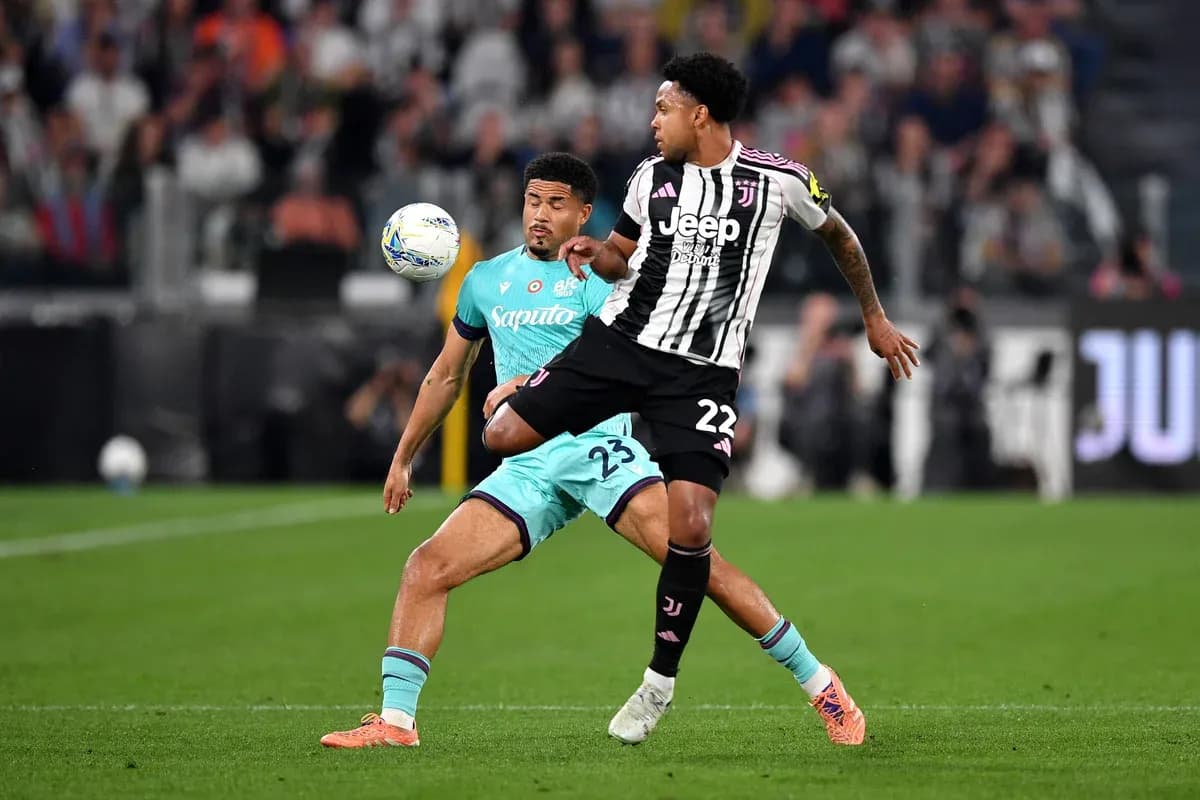
Locatelli’s yellow card at 60' for a foul is consistent with his role as the single pivot screening in front of the back three. He was Juventus’ main defensive reference in midfield, breaking up Bologna’s attempts to play through Remo Freuler and Simon Sohm (later Lewis Ferguson). McKennie, wearing 22, operated higher and more dynamically, shuttling between lines, supporting the press, and contributing decisively with the assist for 2–0.
Up front, Juventus used a fluid front three: Francisco Conceição and Jeremie Boga as the two attacking midfielders/inside forwards behind Jonathan David. Their movements stretched Bologna’s 4-3-3 into a 4-5-1 defensively, forcing the visitors’ wingers Riccardo Orsolini and Nicolò Cambiaghi deep. David’s early goal came from his sharp occupation of central spaces and Kalulu’s willingness to break the line from the back.
Bologna’s 4-3-3, with Federico Ravaglia in goal, struggled to convert possession into penetration. Ravaglia made 2 saves and conceded 2 goals from Juventus’ 1.31 xG, which suggests Juventus were relatively efficient without being wildly clinical. Bologna’s back four of Juan Miranda, Jhon Lucumí, Eivind Helland, and Nadir Zortea faced constant stretching from Juventus’ width and diagonal runs. The midfield trio of Sohm, Freuler, and Pobega offered work rate but lacked the vertical passing and third-man runs to unsettle Juventus’ compact 5-2-3/5-4-1 defensive shapes once the wing-backs dropped.
Statistically, Juventus’ superiority was controlled rather than overwhelming. They led possession 55%–45%, with a clear edge in total shots (14–7) and shots on goal (4–0). The shot profile shows Juventus creating more in and around the box (9 shots inside the box to Bologna’s 4), consistent with their structured occupation of central lanes and half-spaces. Bologna’s 0.59 xG reflects some speculative efforts and half-chances but no clear-cut opportunities.
Passing data reinforces the picture of a balanced but assertive Juventus: 487 total passes with 413 accurate (85%), versus Bologna’s 398 passes and 332 accurate (83%). Juventus’ overall form in this match reads as a mature, game-state-aware performance: early lead, controlled tempo, limited risk. Defensively, their index is strong: 0 shots on target conceded, only 1 save required, and just 10 fouls committed, with a single yellow (Locatelli for a foul) pointing to disciplined aggression rather than chaos.
Bologna, with only 5 fouls and no cards, were tidy but too passive in key zones. Their 1 corner to Juventus’ 6 underlines their difficulty in sustaining pressure. With both goalkeepers recording 0 goals prevented and the xG split 1.31–0.59, the 2–0 scoreline is a fair reflection of Juventus’ territorial control, defensive solidity, and superior structure in both phases.