Juventus 2–0 Bologna: Tactical Masterclass Under Spalletti
Under the Turin lights at Allianz Stadium, this felt less like a routine league fixture and more like a late‑season statement. Following this result, Juventus’ 2–0 win over Bologna in Serie A’s Regular Season – 33rd round did more than protect their top‑four standing; it showcased a squad that has quietly forged a clear tactical identity under Luciano Spalletti, even while shorn of some of its marquee names.
I. The Big Picture – Structure, Stakes, and Seasonal DNA
Heading into this game, Juventus were 4th in Serie A with 63 points and a goal difference of 28, built on 57 goals scored and 29 conceded overall. That defensive platform is no illusion: at home they concede just 0.8 goals on average, while scoring 2.0, a profile of controlled dominance rather than chaos. Bologna arrived in Turin as one of the league’s more awkward mid‑table visitors: 8th place, 48 points, and a slender overall goal difference of 3 (42 scored, 39 conceded). Interestingly, their personality flips away from home – they average 1.5 goals on their travels, more than at home, and concede 1.2, a team comfortable in open fields rather than in tight home games.
The final score – Juventus 2, Bologna 0 – was therefore a clash of profiles that ended exactly in the direction the metrics suggested: the home side’s defensive discipline suffocating an away team that prefers to trade punches.
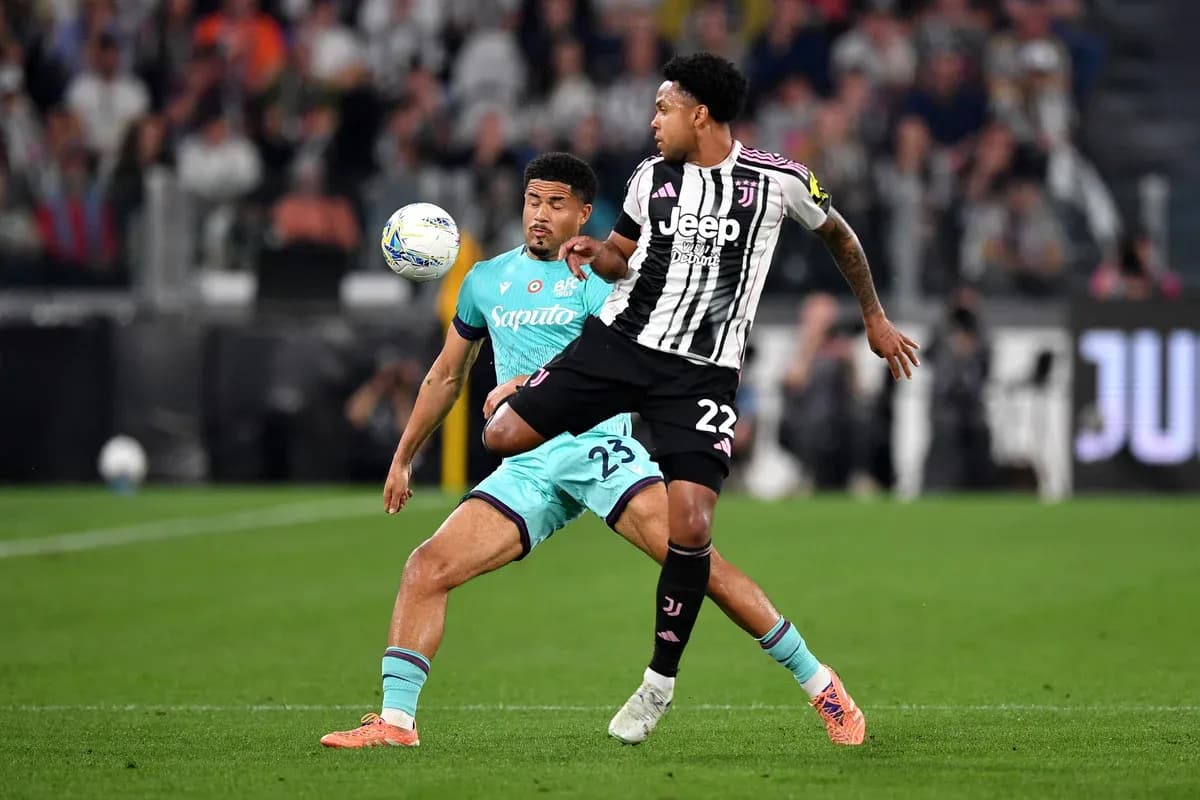
Spalletti doubled down on Juventus’ season-long structural theme: a 3‑4‑2‑1, the formation they have used in 21 league games, with M. Di Gregorio behind a back three of P. Kalulu, Bremer and L. Kelly. The wing lanes belonged to E. Holm and A. Cambiaso, flanking the double pivot of M. Locatelli and W. McKennie, with F. Conceicao and J. Boga supporting J. David as the lone central forward.
Vincenzo Italiano answered with Bologna’s more familiar 4‑3‑3, a slight tactical gamble against Juventus’ back three. F. Ravaglia started in goal, with a back four of N. Zortea, E. Fauske Helland, J. Lucumi and J. Miranda. The midfield triangle of S. Sohm, R. Freuler and T. Pobega was tasked with both screening and building, while the front three of R. Orsolini, S. Castro and N. Cambiaghi were meant to stretch Juventus horizontally.
II. Tactical Voids – Absences and Discipline
The absentees framed both game plan and bench options. Juventus were without J. Cabal, A. Milik, M. Perin and, crucially, D. Vlahovic. Losing a pure penalty‑box striker like Vlahovic forced Spalletti to lean into mobility and combination play up front, with David’s movement and the dribbling of Boga and Conceicao replacing aerial dominance and back‑to‑goal play. The presence of L. Openda and K. Yildiz on the bench, though unused in the starting XI, underlined the shift toward pace and fluidity in the attacking stable.
Bologna’s list of absentees was arguably more structurally damaging: K. Bonifazi and N. Casale thinned the central defensive options, while T. Dallinga and B. Dominguez removed alternative profiles in attack and midfield. L. Skorupski’s muscle injury handed the gloves to Ravaglia, changing the build‑up dynamics from the back.
Disciplinary trends added a hidden layer of risk. Juventus’ yellow cards skew toward the 61–75 minute window (22.73%), while Bologna’s are heavily concentrated late: 26.67% between 61–75 minutes and 28.33% between 76–90. In a match where Bologna would likely be chasing, those late surges of aggression always threatened to tilt the balance in Juventus’ favour, especially with Cambiaghi already carrying a red‑card history this season and Cambiaso having seen red once for Juventus.
III. Key Matchups – Hunter vs Shield, Engine Room Battles
The headline duel was always going to be “Hunter vs Shield”: Juventus’ multi‑headed attacking threat against a Bologna defence that, overall, concedes 1.2 goals per game. Without Vlahovic, the scoring burden is distributed, but the season’s data tells us the sharpest edge in this squad is K. Yildiz – 10 league goals and 6 assists overall, backed by 59 shots and 71 successful dribbles from 131 attempts. Even starting from the bench, his mere availability shapes how deep Bologna’s back line can dare to sit, wary of a late injection of direct running and one‑v‑one quality.
On the other side, Bologna’s primary hunter is R. Orsolini, with 8 league goals and 1 assist. His 59 shots (28 on target) and 23 key passes mark him as the one player capable of bending a game with a single action. Yet his penalty record this season – 3 scored but 2 missed – hints at a streaky finisher. Against a Juventus side that has kept 14 clean sheets overall (8 at home), Orsolini needed more than volume; he needed near‑perfect efficiency, which he never quite found.
The “Engine Room” battle was even more fascinating. Juventus’ midfield axis of Locatelli and McKennie is statistically one of Serie A’s most complete pairings. Locatelli’s season numbers – 2354 passes at 88% accuracy, 89 tackles, 23 blocked shots and 36 interceptions – paint him as the metronome and shield in equal measure. His 7 yellow cards underscore how often he operates on the edge, but also how central he is to breaking opposition rhythm.
McKennie complements him with more vertical chaos: 984 passes at 82% accuracy, 33 tackles, 7 blocked shots, 20 interceptions and 5 goals plus 5 assists overall. His willingness to arrive late into the box, combined with defensive work, made him the natural pressure point on Bologna’s midfield trio.
For Bologna, R. Freuler and S. Sohm were tasked with disrupting this axis, but their remit was reactive rather than proactive. With Juventus averaging 1.7 goals overall and only 0.9 conceded, the onus was on Bologna’s midfield to force transitions, especially for S. Castro, whose 7 goals and 2 assists are often born from broken‑field situations. Against a back three marshalled by Bremer and screened by Locatelli, those transitions were rare and heavily contested.
IV. Statistical Prognosis – Why 2–0 Felt Inevitable
Even without explicit xG data, the season‑long trends point clearly toward the kind of game that unfolded. Juventus’ home profile – 10 wins, 6 draws, just 1 defeat from 17, with 34 goals for and 13 against – is the record of a side that controls tempo, scoreline and space. Bologna’s away record is impressive in attack (26 goals on their travels) but still porous enough defensively (21 conceded) to be punished by a side with Juventus’ efficiency.
Juventus’ penalty record this season is flawless in execution (2 from 2, 100.00%), while Bologna’s is perfect in conversion (4 from 4) but shadowed by Orsolini’s 2 misses in league play overall. That nuance matters: Juventus’ ruthlessness from the spot mirrors their broader approach – low‑margin, low‑error football – whereas Bologna rely more on volume and momentum.
Layer on the disciplinary curves – Bologna’s late yellow‑card surge between 61–90 minutes and Juventus’ ability to manage leads with 14 clean sheets – and the 2–0 scoreline reads less like a one‑off and more like a statistical fulfilment. Juventus’ back three, anchored by Bremer, were rarely stretched into desperation; the midfield, orchestrated by Locatelli and energised by McKennie, dictated the game’s rhythm; and the fluid front line, with David as a roaming reference point and Boga/Conceicao between the lines, exploited precisely the kind of defensive looseness that has kept Bologna’s goal difference so slim all season.
Following this result, the narrative is clear: Juventus look every inch a Champions League‑bound side whose structure and squad depth can absorb injuries and still impose their game. Bologna, brave and enterprising on their travels, discovered the limits of ambition when it runs into a machine that, at home, rarely allows the game to escape its grasp.