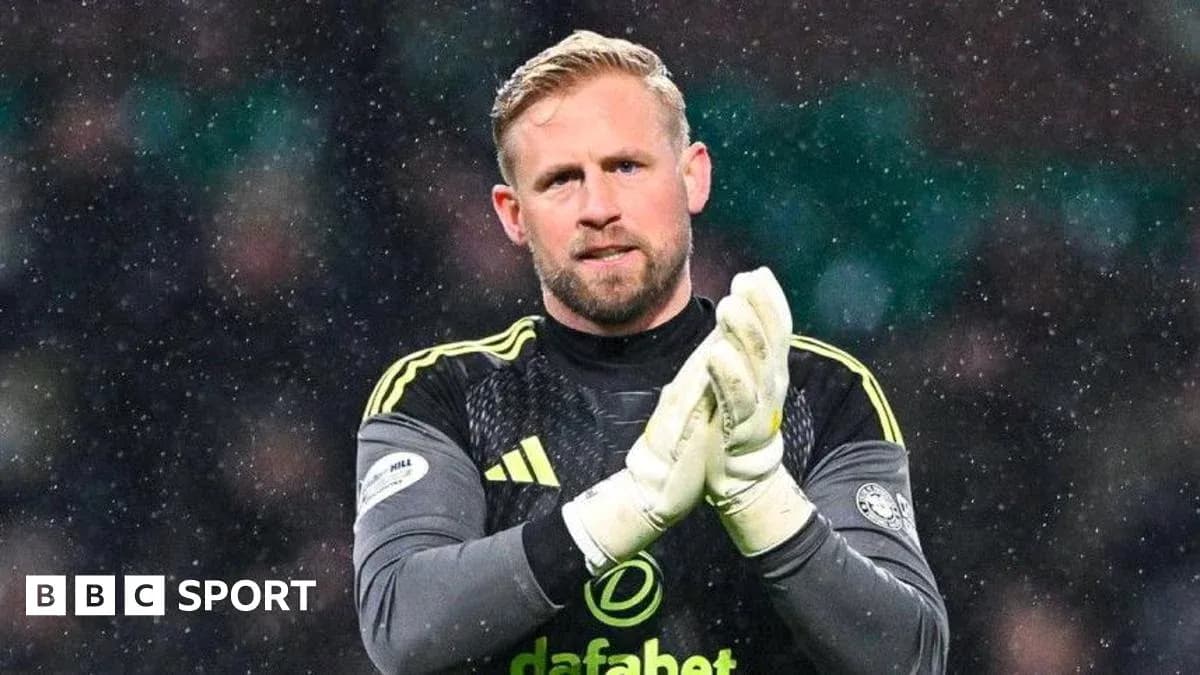
Kasper Schmeichel Retires: A Warrior's Journey Ends
Kasper Schmeichel has never been one to walk away from a fight. For years he stood unflinching behind shaky back fours, under swirling crosses, in the eye of title races and international tournaments. He stayed on when others would have walked off.
In the end, his shoulder made the decision he never wanted to take.
At 39, the Celtic and Denmark goalkeeper has retired, unable to recover from a serious shoulder injury that has kept him out since February and, according to specialists, will not allow him to return to top-level football.
“I believe that now is the right time,” he told TV2, the son of Manchester United legend Peter Schmeichel sounding more resigned than relieved. “This is a decision that has been made for me.”
A warrior’s injury
The damage traces back to March 2025, a Nations League quarter-final against Portugal. Denmark had used all their substitutes. Schmeichel went down, hurt, but stayed on. Of course he did.
He played through the pain in that defeat, not realising how deep the problem ran.
“I didn't realise how bad it was back in March. It's been a long process,” he said. The real shock came nearly a year later. “When I landed on it in February, I could tell straight away that something was seriously wrong.”
That second incident, in Celtic’s Europa League loss to Stuttgart 11 months after the Portugal tie, aggravated the shoulder again. From there, the clock started ticking. Out since February, out of contract at Celtic soon, and facing the prospect of up to a year of rehabilitation, he vowed to do everything to extend his career.
The surgeons gave him the answer no professional ever wants to hear.
“I have consulted with various surgeons and experts regarding my shoulder, and they have told me that I should not expect to return to playing top-flight football.”
That was it. Not a farewell tour. Not a planned last dance. Just a hard stop.
A career built on defiance
Schmeichel walks away with a body of work that stands up to any scrutiny.
He began at Manchester City, long before the Abu Dhabi money and global branding. From there, he carved out his own path, away from the shadow of his father’s statue at Old Trafford and into a legacy that carries its own weight.
Leicester City is where that legacy roared into life. Ten seasons. A dressing room that went from relegation candidates to the most improbable Premier League champions of the modern era in 2015-16. Schmeichel was one of the pillars of that miracle, a constant voice and presence as Claudio Ranieri’s side tore up the script.
He stayed to help Leicester lift the FA Cup in 2021, another first in the club’s history. From there came spells at Nice and Anderlecht, each a different chapter, before the move to Glasgow and Celtic.
In Scotland, even as the years stacked up, he remained a reliable last line. He featured 39 times for Celtic this season alone, picking up a second Premiership winners’ medal in his two years in Glasgow. Not a farewell cameo, but a full season of work at the top of the table before the shoulder finally gave way.
The heartbeat of Denmark
For Denmark, Schmeichel became far more than “Peter’s son”. He became the voice in the tunnel, the calm in the shootout, the constant presence in a generation that punched above its weight on the biggest stages.
He bows out with 120 caps, a landmark few reach. He played at the 2018 and 2022 World Cups, and he stood in goal during Denmark’s stirring run to the semi-finals of Euro 2020, a tournament that tested the squad emotionally and physically and revealed its steel to the world.
Those nights, those anthems, those saves – they defined his international career as much as any medal.
No perfect ending, but no regrets
Schmeichel always imagined a different goodbye. Most players do.
“I think everyone dreams of saying goodbye on the field, but you don't always get what you want,” he admitted. There was no final wave to the crowd, no choreographed substitution in stoppage time. Just a medical verdict and a decision that arrived in a quiet room, not a roaring stadium.
Yet there is no hint of bitterness.
“I've had so much else along the way, so football doesn't owe me anything. I've had so many opportunities, so many experiences.”
For a goalkeeper who lifted the Premier League against 5,000-1 odds, won domestic titles in two countries, and carried his national team through some of its most emotional modern nights, that sounds less like a cliché and more like a cold, honest assessment.
What endures, he says, is not the silverware.
“What stands out most are the friendships and connections I've made. The moments I've shared with them - for better or worse.”
The medals will sit in cabinets. The clips will roll in highlight reels. But for the teammates who heard his voice behind them and the supporters who trusted him when everything was on the line, Kasper Schmeichel’s career will be remembered in something far simpler: a goalkeeper who never ducked a challenge, right up until his body finally told him he had to.