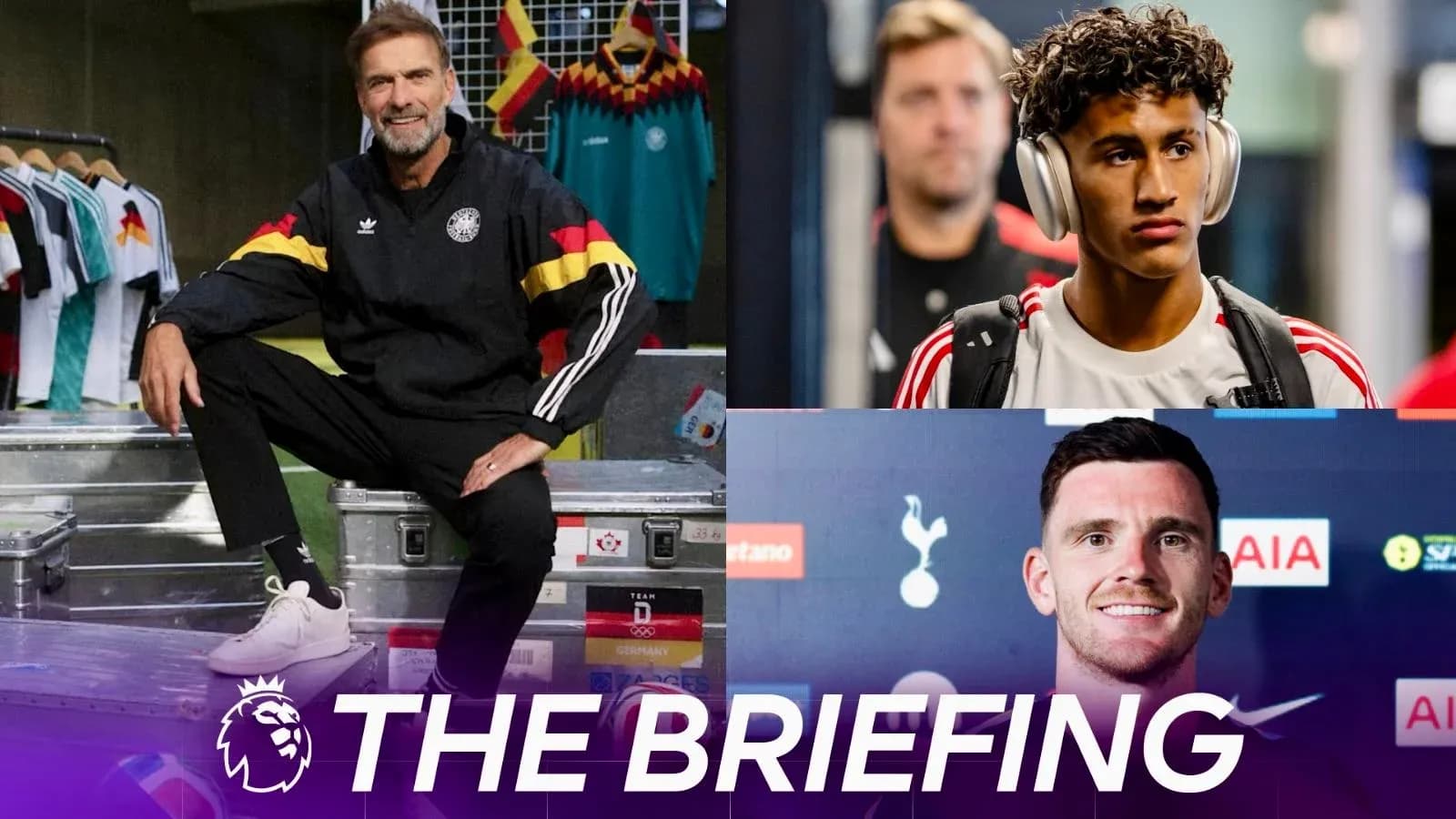
Klopp Takes Germany Job Ahead of UEFA Euro 2024
Jürgen Klopp is back. Not in a dugout on a wet Saturday in the Premier League, but on the biggest stage his country can offer.
Germany have confirmed Klopp as their new head coach on a contract running until the end of the 2030 FIFA World Cup, ending his brief hiatus from the touchline after leaving Liverpool in 2024. The man who dragged Liverpool back to the summit of English and European football now walks into a national team at one of its lowest ebbs.
He arrives with a Champions League, Premier League and FIFA Club World Cup on his CV, along with a reputation for turning doubt into belief. He walked away from Anfield citing fatigue after nine relentless years, but the pull of the national job has finally proved too strong.
Germany need it. Julian Nagelsmann resigned last month after a dismal round-of-32 exit to Paraguay, a defeat that crystallised years of drift. Klopp will now lead them through the next UEFA European Championship and the 2030 World Cup, with a mandate that goes beyond tactics. He has to reconnect a bruised football nation with its team.
He will not do it alone. Former Liverpool lieutenants Pep Lijnders and Peter Krawietz will join him on the touchline, restoring a backroom trio that defined an era at Anfield. Off the pitch, Per Mertesacker will become the German Football Federation’s sporting director in January, leaving his role overseeing Arsenal’s academy at the end of the 2025/26 season to help reshape the DFB.
The scale of it all has already hit Klopp. “Over the last few days it was almost like a movie happening to myself,” he said, reflecting on a whirlwind spell that ends his stint as Red Bull’s global head of soccer, a role he has held since late 2024. He has long understood the size of the job in theory; now, as he put it, the reality of being national coach is “really dawning” on him.
For years, he admitted, the idea of taking the Germany job felt unimaginable. Over time, it became inevitable he would be asked. Now, he says, the timing finally feels right.
His first test will carry a familiar face. In September, Germany face the Netherlands, captained by Virgil van Dijk, the defensive pillar of Klopp’s Liverpool side. Old alliances will be set aside, and a new era for German football will begin with a glance across at a player who helped define his greatest club team.
Gabriel, 15, steps into United’s senior spotlight
At Manchester United, the story is about the future, not the past. JJ Gabriel, just 15, has been named in a senior squad for the first time for Friday’s pre-season friendly against Rosenborg in Trondheim.
He will travel as part of a 25-man group, a teenager suddenly sharing a dressing room with the players he has been watching from the fringes of first-team training. United supporters have heard the hype. Now they get the first glimpse.
Gabriel was named Under-18 Premier League player of the season last term, a remarkable accolade given he started the campaign aged only 14. Rules meant he could not be named in a Premier League matchday squad – academy players must turn 15 before the end of August to feature – so his work stayed largely out of the spotlight.
The numbers did not. Gabriel scored 29 goals in 32 appearances for the Under-18s, driving United to the FA Youth Cup final and the Premier League Under-18 Cup final. He is a winger by trade, but spent much of last season in a central role, showing the kind of versatility that tends to fast-track careers at Old Trafford.
He has already been a regular presence in first-team training, even if selection rules kept him off the teamsheet. The record he is chasing belongs to David Gaskell, who became United’s youngest competitive player in 1956 at 16 years and 19 days. Gabriel turns 16 in October. The clock is ticking, and the path is clear.
Michael Carrick, speaking last season, did not disguise the club’s excitement. “JJ’s a big talent,” the United manager said. “It’s pretty obvious to know that. And he’s had a really good season for the Under-18s. We obviously think an awful lot of him, but patience is important in managing everything that comes with working with him.”
United have seen prodigies come and go. The challenge now is to let this one grow at his own pace, even as the spotlight sharpens.
Newcastle double down on youth with Bamba deal
Newcastle United’s transfer strategy has become unmistakable. They are buying potential, and lots of it.
Their latest move is the signing of 20-year-old central midfielder Aladji Bamba, who only made his professional debut for Monaco last season. On paper, it is another gamble. On the pitch, his numbers suggest something more calculated.
Bamba’s arrival drags the average age of Newcastle’s summer signings down to 19.5. He joins goalkeeper Ewen Jaouen (20) from Reims, winger Bazoumana Toure (20) from Hoffenheim and central midfielder Sean Steur (18) from Ajax in a window that has clearly prioritised youth.
It comes in the wake of two significant departures. Sandro Tonali has gone to Tottenham Hotspur and Anthony Gordon to Barcelona, stripping Newcastle of established quality and forcing a reset. The response has not been to chase like-for-like replacements at premium prices, but to build a new core that can grow together.
Bamba could be central to that. Primarily a defensive midfielder, though capable of playing higher up, he profiles as a long-term successor to Tonali. Among Ligue 1 midfielders who played at least 500 minutes last season, he ranked in the top five for duels won (9.1 per game on average), tackles (3.6), successful take-ons (1.6) and aerial duels won (1.9). Those are the numbers of a player who relishes contact and does not hide from responsibility.
Newcastle are betting that with time, those raw edges can be refined into a Premier League force. The risk is obvious. So is the upside.
Robertson trades 26 for 3 in tribute to King
At Tottenham, a different kind of decision tells its own story.
Andy Robertson, fresh from a summer move after nine years at Liverpool, has turned down his usual No 26 shirt at Spurs out of respect for club legend Ledley King. The number has not been worn since King retired in 2012, and while it is not officially retired, it carries a quiet reverence around the club.
Robertson has worn 26 throughout most of his domestic career at Dundee United, Hull City and Liverpool. This time, he chose a different path. “From my point of view, I wanted to respect that,” he said of King, now a club ambassador. “He was an unbelievable player and has done so many good things for this football club.”
Instead, the Scotland captain will wear No 3, a shirt that already means plenty to him. “Number 3 means a lot to me – that’s my national team number, I’ve had so many good memories as number 3 for Scotland so when I knew 3 was going to become available, it was a no-brainer for me.”
He is expected to make his Spurs debut on the club’s pre-season tour of New Zealand and Australia, with fixtures lined up against Auckland, Sydney FC and Chelsea. A new left-back, a new number, a new league challenge.
The settling-in process has already gone public. Robertson revealed that his closest ally in the squad is James Maddison, who promptly used social media to tease his new team-mate, posting a photo of the Scot looking glum on the long-haul flight to New Zealand with the caption: “He better liven up if he’s my company for this 26 hour flight.”
Twenty-two hours later, Maddison shared an update: Robertson smiling. A small detail, but a telling one. The serious work will come soon enough; for now, Tottenham’s new No 3 looks ready for the ride.