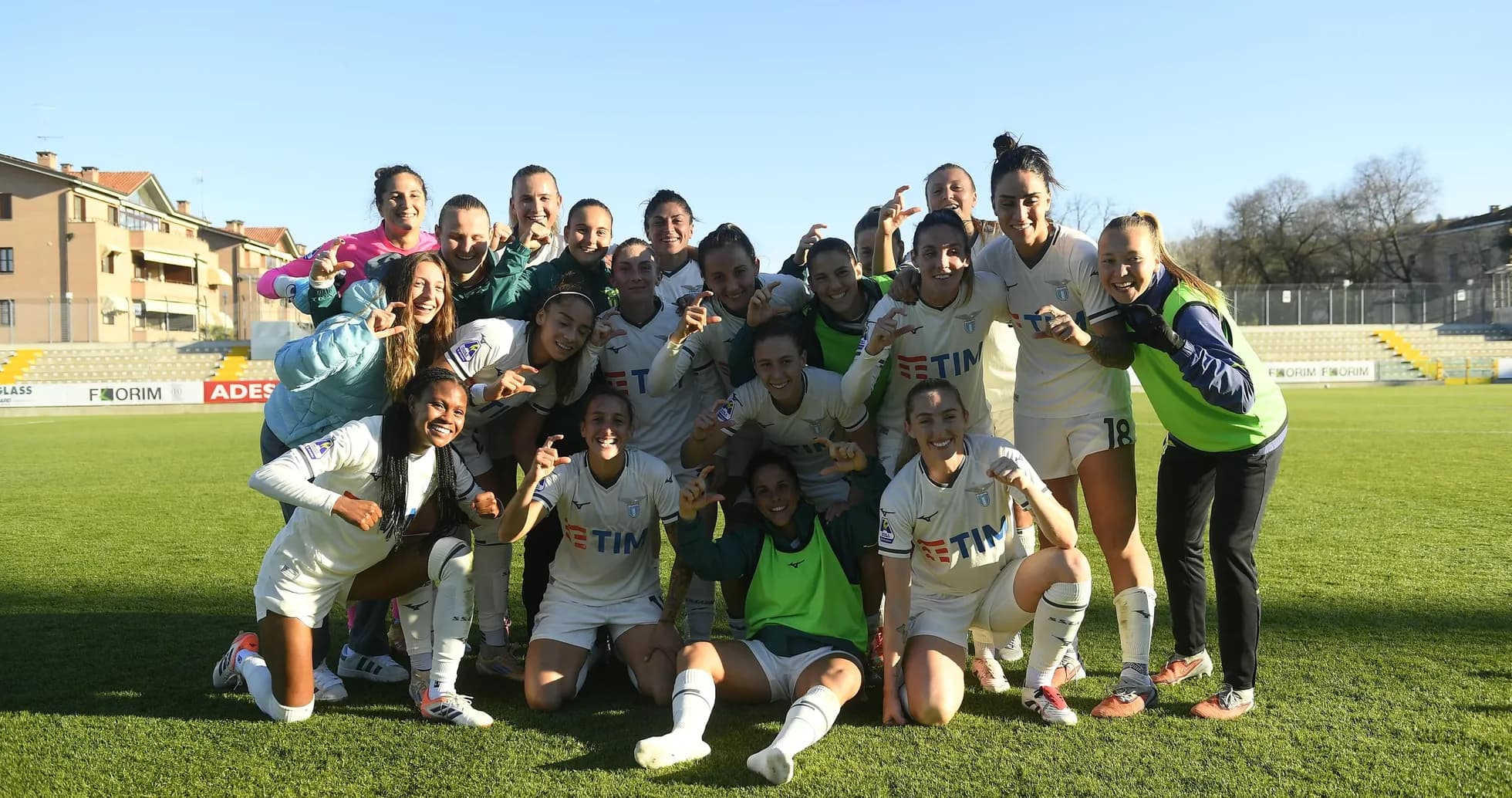
Lazio W vs Sassuolo W: Match Preview and Betting Insights
On 25 April 2026, Campo Mirko Fersini in Rome stages a meeting between two clubs heading in opposite directions but tied together by recent history. Lazio W, safely in mid-table yet still chasing a statement finish, welcome a Sassuolo W side fighting to drag themselves away from danger. For Lazio W, it is about consolidating a solid return to the elite and perhaps climbing higher; for Sassuolo W, every point now feels like a lifeline in a campaign defined by struggle in both boxes.
Season Context
Lazio W arrive as the division’s sixth-placed side, with 27 points from 18 matches and a narrow positive goal difference (25 scored, 24 conceded). Their record hints at a competitive, if inconsistent, team: eight wins, three draws and seven defeats overall, with 11 goals scored and 9 conceded at home. They are not runaway contenders, but they are firmly part of the league’s competitive core.
Sassuolo W sit much lower, in 11th place with 13 points from 18 games and a heavy negative goal difference (13 scored, 30 conceded). Three wins, four draws and eleven defeats tell the story of a side that has struggled to keep pace, especially defensively. Away from home they have managed only one win and three draws in nine outings, scoring 10 and conceding 18, a profile that underlines why this trip to Rome is as much about survival as pride.
Form & Momentum
Lazio W’s official form line in the standings reads “LLWDD”. That run is mixed, but still competitive (27 points and a +1 goal difference overall), suggesting a team that has recently stumbled yet remains structurally sound. The broader league form string in the data — “WWLLWLLWWLWDWDDWLL” — underlines their streaky nature (eight wins and seven defeats in 18 league matches), capable of sharp peaks and dips within a short span.
Sassuolo W come in with the standings form “LDLLL”, a sequence that reflects a difficult period (13 points and -17 goal difference overall). Across the league campaign, their longer form “DLWLDLDLWLLLWLLLDL” paints a picture of a side rarely able to sustain momentum (only 13 goals scored and 30 conceded). Recent numbers in the prediction data back that up: in their last five, they have scored just 3 goals and conceded 12, with an attacking index of 15% and defensive of 40%.
Head-to-Head Patterns
The modern history between these sides has tilted towards Lazio W, and recent meetings have often been decisive rather than cagey. In December 2025, Lazio W went to Stadio Enzo Ricci and won 2–1 in Serie A Women (“1-2 (Serie A Women, December 2025)”), overturning a half-time deficit and reinforcing their ability to hurt Sassuolo W away from home. Earlier in the same calendar year, on 3 May 2025 at Stadio Mirko Fersini, Lazio W produced a statement 5–0 victory in Serie A Women’s relegation round (“5-0 (Serie A Women, May 2025)”), a result that showcased a clear gap on that day in both quality and intensity.
Just weeks before that, in March 2025, Lazio W again travelled to Stadio Enzo Ricci and emerged 2–0 winners in a Serie A Women relegation round clash (“0-2 (Serie A Women, March 2025)”). Taken together, these three fixtures show a recurring pattern: Lazio W have recently found ways to control this matchup, both home and away, often by multiple goals and without needing high-scoring shootouts.
Tactical Preview
Lazio W’s statistical profile suggests a side comfortable playing on the front foot but aware of their own defensive limits. They average 1.4 goals per game in the league (25 in 18), with a fairly even spread between home (11) and away (14). The predictions data shows their attacking peak between 31–45 minutes — “Peak: 31-45 (6 goals, 25.00%)” — which points to a team that grows into halves and often finds breakthroughs just before the interval. Their goals-against timing reveals late-game vulnerability, with the highest concession window in the 76–90 range (9 goals, 36.00%), a warning that game management in the closing stages can be fragile.
Structurally, Lazio W have alternated between back-three and back-four systems, with 3-4-2-1 and 3-1-4-2 used most frequently (four matches each), plus occasional 4-3-3 and 3-4-1-2. That flexibility allows them to tilt the pitch through wing-backs or wingers, and the presence of creative and industrious profiles like E. Oliviero is central to that. Oliviero has 5 assists from 17 appearances and 352 passes at 71% accuracy, with 12 key passes and 19 tackles, illustrating a two-way midfielder who links build-up with final-third delivery. Up front, M. Piemonte offers a genuine cutting edge: 7 goals from 16 appearances, with 12 shots on target from 17 attempts and a strong 7.25 rating, making her the natural focal point for crosses and through balls. Behind her, N. Karczewska adds depth and a direct threat with 3 goals in 416 minutes.
Defensively, Lazio W are solid but not watertight, conceding 24 in 18 (1.3 per match). Yet they have managed 5 clean sheets, indicating that when their structure holds, it can be very effective. Players like A. Benoît and C. Baltrip-Reyes embody that resilience: Benoît has 347 passes, 13 interceptions and 3 blocks, while Baltrip-Reyes combines 398 passes at 82% accuracy with 24 tackles and 16 interceptions, underpinning both build-up and defensive solidity.
Sassuolo W, by contrast, are built more around counter-punching and survival. They score only 0.7 goals per game (13 in 18), with a stark split between home (3) and away (10), suggesting they are more dangerous when space opens up on their travels. Their attacking peak comes late: “Peak: 76-90 (4 goals, 30.77%)”, a sign that they often chase games and find goals in stretched, chaotic finales. However, their defensive timing is troubling: they concede most between 31–45 and 46–60 minutes (7 goals, 23.33% in each window), precisely when Lazio W tend to accelerate.
In terms of shape, Sassuolo W have leaned on both back-three and back-four frameworks, with 3-4-1-2 and 4-3-3 the most used, plus 4-1-3-2, 4-1-4-1 and 3-4-3. That tactical variety reflects a search for balance rather than a settled identity. Going forward, much rests on L. Clelland and E. Dhont. Clelland has 3 goals and 1 assist in 12 appearances, with 19 shots (12 on target) and a 7.21 rating, marking her as their most efficient finisher. Dhont, with 3 assists, 16 key passes and 90 duels (44 won), provides width, work-rate and delivery from the flanks. Yet the defensive base behind them is fragile: 30 goals conceded (1.7 per match), with only 4 clean sheets and a tendency to concede early and in clusters.
Discipline could also shape the rhythm. Lazio W show an aggressive edge with notable card counts for F. Simonetti (4 yellows, 1 red) and others, while Sassuolo W’s D. Philtjens has 4 yellows. In a game where Sassuolo W may need to disrupt Lazio W’s build-up, the line between tactical fouling and costly bookings will be thin.
Statistical Snapshot
- Competition: Serie A Women — 25 April 2026.
- Venue: Campo Mirko Fersini, Rome.
- Home Attack Peak: Peak: 31-45 (6 goals, 25.00%).
- Away Attack Peak: Peak: 76-90 (4 goals, 30.77%).
- Prediction: Win or draw — Double chance : Lazio W or draw.
- Poisson Edge: 70.0% vs 30.0% (Poisson win probability).
Betting Verdict
The model leans clearly towards Lazio W avoiding defeat, with a Poisson-based edge of 70.0% versus 30.0% and an official prediction of “Win or draw” backed by the advice “Double chance : Lazio W or draw”. That stance is supported by form (Lazio W on 27 points with a +1 goal difference versus Sassuolo W’s 13 points and -17) and by the recent head-to-head pattern, which includes emphatic Lazio W wins such as 5–0 in May 2025 and 0–2 away in March 2025. Sassuolo W’s late scoring peak and better away attacking record suggest they can contribute, but their defensive record (30 conceded) and recent run “LDLLL” make an outright upset less likely. From a betting perspective, siding with Lazio W on the double chance at around short odds appears justified, with any higher-risk plays needing to account for Lazio W’s late-game defensive lapses and Sassuolo W’s capacity to score in the final quarter-hour.