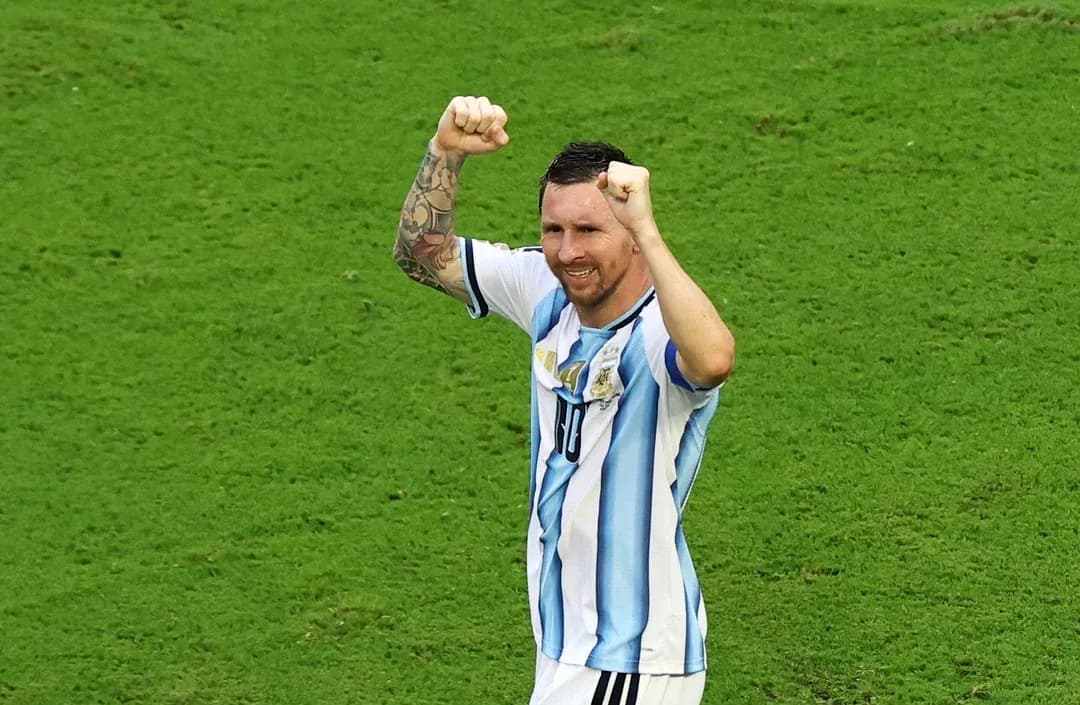
Lionel Messi Shines in Miami World Cup Knockout
In Miami, under the heavy glare of a World Cup knockout night, it was always likely to be him.
Lionel Messi, 39 years old and still dictating the biggest stage, broke open Argentina’s Round of 32 tie against Cape Verde with the kind of finish that has defined a generation. One touch to set, one swing of that left foot, and Miami Stadium felt the familiar surge: disbelief mixed with inevitability.
The goal arrived on 29 minutes, but the move started long before the ball reached him. Lisandro Martínez spotted space and didn’t hesitate, sweeping a superb diagonal from deep and snapping Cape Verde’s defensive line out of shape. Messi, starting wide on the right, drifted in off the flank with the quiet menace defenders have been studying for two decades and still haven’t solved.
The Inter Miami forward took the pass inside the box, shifted his weight, and opened up the angle. Vozinha, one of the breakout personalities of this World Cup and already a crowd favorite, squared himself, trying to read the trademark left foot. He read it. He still couldn’t stop it.
Messi lashed his shot with that same left foot, ripping it high into the top corner at the near post, on the goalkeeper’s left side. The ball flew past “El Abuelo” before he could fully launch, smashing into the roof of the net and sending Argentina’s fans behind the goal into chaos. A familiar celebration, a familiar roar, yet another piece of history.
This was Messi’s seventh goal of the 2026 FIFA World Cup, a number that now carries a new layer of significance. He becomes the first player ever to score seven or more goals in two different World Cups, having reached the same mark in Qatar 2022. In a tournament that has already stretched the limits of his longevity, he keeps pushing the record book further out of reach.
The numbers keep stacking up. Cristiano Ronaldo has finally ended his own drought in World Cup knockout matches at this tournament, but Messi still stands alone in one crucial category: he is the only player to have scored in five different World Cup knockout stages, and he has done it in five consecutive editions. From the early 2010s to this expanded 2026 showpiece, he has left a mark on every single knockout path Argentina have walked.
This new Round of 32 stage, introduced for the expanded format, offered a fresh line in his résumé. He took it. Before Miami, his World Cup knockout goals had come in the Round of 16, quarterfinals, semifinals, and final in Qatar: against Australia, the Netherlands, Croatia, and France. Now, the Round of 32 has been added to that list, another rung climbed on a ladder no one else is on.
Cape Verde’s resistance, anchored by the ever-animated Vozinha, had held firm for nearly half an hour. They tracked runners, closed passing lanes, and tried to compress the spaces Messi loves to slip into. The pressure, though, was building. Every Argentine attack seemed to end with the No. 10 on the ball, probing, pausing, then quickening the tempo by a fraction.
Eventually, the dam broke. One switch from Martínez, one touch from Messi, one ruthless finish.
In a World Cup that was supposed to belong to the next generation, the defining image of this night in Miami was familiar: Messi, arms outstretched, bathed in blue and white, while another milestone quietly rewrote what greatness looks like on the international stage.