Lionel Messi's 20th World Cup Goal in Miami
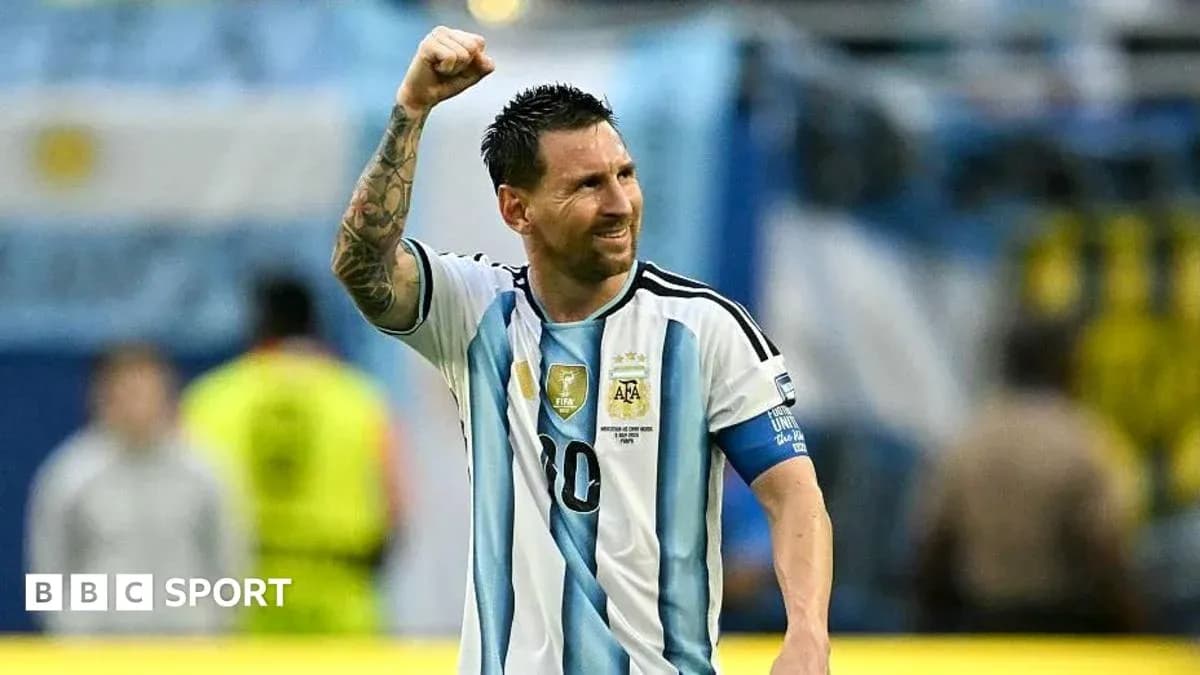
Lionel Messi did it again.
Three against Algeria, two against Austria, one against Jordan. Now another in Miami, as Argentina squeezed past Cape Verde 3-2 in a breathless World Cup last-32 tie that felt, at times, like it was being played on his personal stage.
This one was his 20th goal at World Cup finals. A number that barely seems real. He had already broken the all-time record during the group phase in the United States; here he simply pushed it further out of reach. Seven goals at this tournament alone. At 39.
A city dressed for one man
The match felt like a coronation long before kick-off.
Hours earlier, the streets around the stadium were already painted in sky blue and white. Drums pounded. Songs rolled through the humid Miami air. Fans posed under giant Argentina flags that hung from lamp posts and balconies like declarations of faith.
Inside, it was a home game in everything but name. Blue and white shirts swallowed the stands. The number 10 was everywhere – on children, on grandparents, on fans who had flown across continents just to be in the same building as him.
Flags hung from the railings, some hand-painted, some pristine from the shop. One banner cut through the noise: Messi and Diego Maradona, side by side, rendered as saints. Halos. Devotion in polyester.
“He’s our hero. He’s like our God,” said one supporter, clutching a drumstick and a plastic cup, the words tumbling out as if they’d been rehearsed for years.
“He has aged like fine wine,” added another. “The older he gets, the better he gets.”
Ask them about the Golden Boot and the answers come back with the same certainty. If Argentina reach the final, they expect him to be there at the top of the scoring charts. Yet there is a softness in their ambition.
“We’ve already had so much from him,” said one fan. “If he wins it, fantastic, but everything he’s already done for Argentina is enough. He is incredible.”
Cape Verde refuse to play the role
For long stretches, this was not Messi’s most dominant performance. By his standards, it was almost quiet.
Cape Verde refused to bow. Ranked outside the world’s top 60, facing the world’s number two, they played with a composure that ignored the script. They kept the ball. They broke with purpose. They irritated Argentina, who struggled to find rhythm and space.
The gap in ranking looked like a footnote rather than a prophecy.
Yet the problem with containing Messi is that it only takes one misstep. One channel left open. One pass played half a second too late.
The moment came.
Lisandro Martínez stepped out and slid a pass through the line. Messi’s run, as so often, was invisible until it was lethal. He ghosted beyond the backline, took the ball in stride with his first touch, and then, with the second, lifted it over the advancing goalkeeper.
No power. No fuss. Just a calm, hanging finish that left the keeper stranded and the stadium erupting.
On BBC Radio 5 Live, James McFadden called it “just incredible”. The former Scotland forward broke the goal down like a craftsman admiring another’s work.
“The run he makes is beyond the backline and the timing is excellent,” he said. “The weight of the pass into him is outstanding and his first touch is exquisite.”
On ITV, Ally McCoist needed fewer words: “Genius at work.” Then the line that has followed Messi for years: “It’s just one record after another. It’s amazing.”
Records that no longer sound human
The numbers are starting to sound like fiction.
Messi is the first player, male or female, to reach 20 career World Cup goals. No one else has scored in eight consecutive World Cup appearances. No one had ever scored seven or more goals at two different World Cups; he did it in 2022 and he has done it again now.
His tally of seven at this tournament would have been enough to win the Golden Boot in five of the last six World Cups. Since 1978, there have been 13 editions of this competition. Seven goals would have topped the scoring charts in all but two of them.
These are not statistics of a fading great hanging on for one last dance. They belong to a player still bending the sport around his own sense of timing.
The art of walking
What separates Messi now is not sprint speed or relentless pressing. It is his relationship with space.
While others chase the ball, he watches. While midfielders burn energy closing angles, he strolls, head on a swivel, scanning the pitch, replaying patterns before they happen. It looks casual. It is anything but.
At 39, that economy is his greatest weapon. He saves his legs for the seconds that matter. A glance over the shoulder here. A shuffle two yards to the left there. Then, when the pass arrives, he has already done the work.
This tournament, though, has shown another layer. The walk is still there, the study of the game still central, but there are moments when he snaps into the press, when he chases back, when he leads.
“Throughout the years, Messi has walked at times in games to assess what is happening,” McFadden observed. “But here he is getting back to try and win the ball and is leading the press. It’s not a full, high-energy press, but he is leading it.”
It is a small shift, but a telling one: the veteran star still willing to do the ugly metres when the situation demands it.
Miami, capital of Messi
If there is a place outside Argentina where Messi’s presence feels like a civic event, it is Miami.
Since his arrival at Inter Miami in 2023, the city has wrapped itself around him. His image is stitched into its streets: murals on the sides of buildings, flags fluttering from balconies, posters in shop windows, his face printed on T-shirts, caps, coffee cups.
On the beaches, children in Argentina’s number 10 shirt play barefoot games until the sun drops. In and around stadiums, his name is chanted long before the teams emerge, a rolling soundtrack to warm-ups and rehearsals.
Even the food tells the story. Argentine restaurants proudly push their milanesa – breaded beef or chicken – with a knowing nod. It is one of Messi’s favourites, and some places have stopped pretending otherwise, naming dishes after him and turning menus into tributes.
The media circus around him has become its own ecosystem. In the mixed zone after matches, the noise rises the second he appears. Journalists bunch together, arms raised, microphones and phones held high. Camera operators lean over shoulders, searching for a clean frame.
Conversations die mid-sentence. Lights flick on. Then, as quickly as he arrives, he is gone again down the corridor, leaving behind a tangle of cables and half-finished questions.
Across the world, dedicated digital platforms track his every step, every goal, every training-ground clip. His career is not just followed; it is archived in real time.
More than one nation’s story
The fascination stretches far beyond Argentina’s own support. This World Cup, for many, has become another chapter in the story of one man rewriting the limits of longevity and influence in the modern game.
Argentina are chasing another trophy. Messi is chasing something more elusive: the feeling of still being decisive, still bending nights like this to his will.
He scored again. The records grew again. And in Miami, under a sky painted in his colours, the question lingered: how much longer can he keep doing this?