Egypt Advances Over Australia in Tense Round of 32 Tie
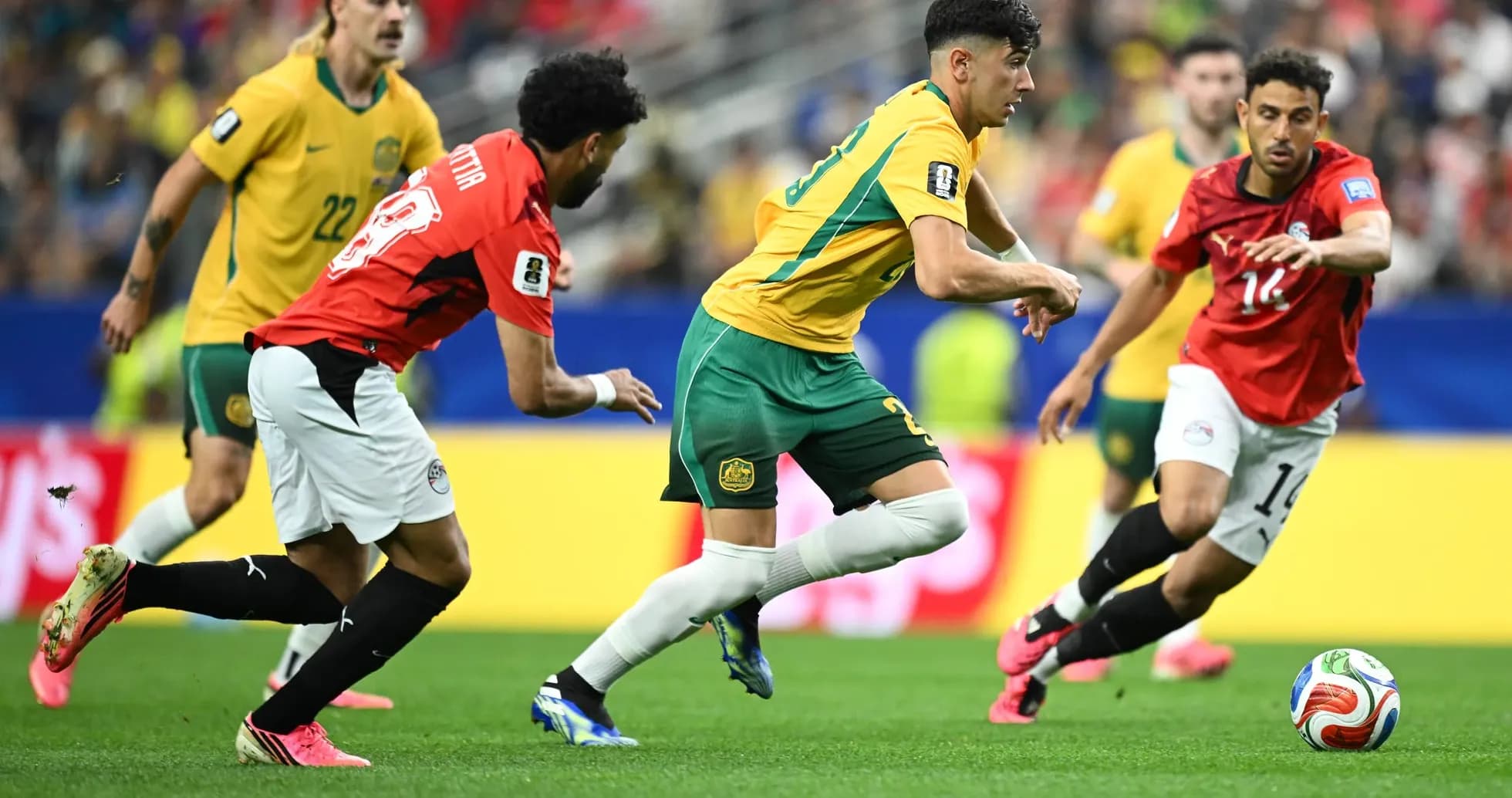
Australia and Egypt produced a tense, structurally rich Round of 32 tie at AT&T Stadium that finished 1-1 after extra time, before Egypt advanced 4-2 on penalties. Across 120 minutes, the contrast in game models was stark: Australia in a 3-4-2-1 trying to compress space and break with direct runs from the front three, Egypt in a 4-4-2 that morphed into a ball-dominant, possession-heavy structure built around Mohamed Salah’s gravity and a technically secure midfield. The underlying numbers support that split: Egypt had 58% possession, 723 passes at 85% accuracy and 1.36 xG, while Australia leaned on volume and chaos (16 shots, 9 blocked, 0.87 xG) rather than sustained control.
The scoring pattern underlined both teams’ identities. Egypt’s opener on 13 minutes came from a classic wide overload: Emam Ashour arrived from midfield to finish, assisted by left-back Karim Hafez, exploiting the space outside Australia’s narrow back three. Australia’s equaliser at 55 minutes was an own goal by Mohamed Hany under pressure, credited to Australia, reflecting the Socceroos’ reliance on forcing errors rather than carving open high-value chances. With no further goals in regular or extra time, Egypt’s superior penalty execution decided the tie, 4-2 in the shootout.
Discipline
Discipline tilted slightly towards Egypt, whose aggression without the ball was punished twice. The card log, in strict chronology, was:
- 105' Haissem Hassan (Egypt) — Foul
- 120' Yasser Ibrahim (Egypt) — Foul
Australia completed 120 minutes without a booking, a notable detail given their 12 fouls to Egypt’s 14. The timing of the cards is revealing: both arrived in extra time, when Egypt were defending transitions more desperately and duels became more stretched. There were no VAR interventions or dismissals to alter the tactical landscape.
Structural Analysis
Structurally, Australia’s 3-4-2-1 was designed to clog central lanes and funnel Egypt wide. Harry Souttar anchored the back three between Alessandro Circati and Lucas Herrington, with wing-backs Jordan Bos (right) and Aziz Behich (left) dropping into a five when Egypt built from the back. In possession, Aiden O'Neill and Jackson Irvine formed a double pivot, with Cristian Volpato and Connor Metcalfe operating as narrow attacking midfielders behind Nestory Irankunda. The idea was clear: concede territory, then spring quickly into the channels.
The statistical profile shows the strengths and limits of that plan. Australia generated 16 total shots but only 1 on target, with 9 blocked and 10 attempts from inside the box. This suggests they managed to reach shooting positions but often under heavy pressure, with Egypt’s back four and screening midfielders getting close enough to block. Their 507 passes, 404 accurate (80%), underline a relatively direct, medium-possession approach, more concerned with verticality than long passing sequences.
In goal, Patrick Beach (Australia) started and later came off at 119 minutes in a specialist move for the impending shootout, with Mathew Ryan entering. Across the team statistics, Australia recorded 3 goalkeeper saves and a goals prevented figure of -0.9, indicating that the goal they conceded was roughly in line with or slightly under what the model expected, and that the goalkeeping output was marginally below neutral relative to shot quality. The late switch to Ryan was a clear tactical decision aimed at leveraging his penalty experience rather than open-play shot-stopping.
Egypt’s Tactical Approach
Egypt’s 4-4-2 had more fluidity than the label suggests. In buildup, Hamdy Fathy and Marwan Attia (later introduced at 120') provided a stable double pivot, with Emam Ashour often stepping higher to connect with Salah and Mostafa Ziko. Omar Marmoush, starting wide and later reintroduced at 106', gave width and ball-carrying from the left. Full-backs Mohamed Hany and Karim Hafez pushed high, especially on the left where Hafez’s assist for the opener came from a deep, overlapping position.
With 58% of the ball and 723 passes (614 accurate, 85%), Egypt controlled tempo and territory. Their 14 shots included 4 on target, 6 off target and 6 blocked, with 8 attempts from inside the box and 6 from outside. The 1.36 xG figure reflects a steady stream of medium-quality chances rather than one or two huge opportunities. The 7 corner kicks to Australia’s 4 further underline Egypt’s territorial edge, pinning the Socceroos back for long spells.
Mostafa Shobeir (Egypt) had a relatively quiet but high-leverage night: only 1 save recorded, with a goals prevented value of -0.9, mirroring Australia’s number. That combination — few saves and a slightly negative goals prevented — fits the pattern of a game where Egypt limited Australia’s clear looks but were punished by a single, chaotic own goal moment rather than sustained defensive breakdowns.
Substitution Patterns
The substitution pattern from both benches was tactical rather than merely fitness-driven. At 46', Australia replaced Jordan Bos with Kai Trewin, subtly rebalancing the right side of the back line and wing-back corridor. At 74', Mohamed Touré (IN) came on for Nestory Irankunda (OUT) and Ajdin Hrustić (IN) for Cristian Volpato (OUT), injecting fresh legs and more ball security between the lines as Australia tried to turn broken play into clearer chances. Later, at 91', Awer Mabil (IN) for Connor Metcalfe (OUT) and Paul Okon-Engstler (IN) for Aiden O'Neill (OUT) added dribbling and energy for extra time transitions.
Egypt’s changes were more about maintaining structure while refreshing intensity. At 67', Hossam Abdelmaguid (IN) came on for Hamdy Fathy (OUT), and Haissem Hassan (IN) for Mostafa Ziko (OUT), slightly reshaping the front line and midfield balance. At 80', Mahmoud Trézéguet (IN) replaced Karim Hafez (OUT), pushing a more attacking profile into the wide role. At 106', Hamza Abdelkarim (IN) came on for Omar Marmoush (OUT), and at 120' Mahmoud Saber (IN) replaced Marwan Attia (OUT), ensuring fresh penalty takers and legs for the closing moments.
Statistical Overview
Statistically, Egypt’s edge in expected goals (1.36 to 0.87), possession (58% to 42%), passing volume (723 to 507) and accuracy (85% to 80%) paints the picture of a side that controlled the majority of the match. Australia, despite matching Egypt in goals and forcing an own goal, were living on thinner margins: only 1 shot on target from 16 attempts and a heavy reliance on blocked efforts in crowded penalty-box situations.
Discipline also mattered in shaping the game’s rhythm. Egypt’s 14 fouls and 2 yellow cards, both for Foul, contrasted with Australia’s 12 fouls and clean disciplinary sheet. Those late bookings for Haissem Hassan and Yasser Ibrahim reflected the strain of defending transitions against fresh Australian runners in extra time, even as Egypt maintained structural control.
Ultimately, the tactical verdict aligns closely with the data: Egypt were the more cohesive, possession-oriented side, generating better quality chances and dictating territory. Australia’s 3-4-2-1 and aggressive pressing in moments created enough chaos to level the score through an own goal, but their attacking execution never fully matched their shot volume. Over 120 minutes, Egypt’s control and shot quality advantage were only partially reflected in the 1-1 scoreline — the penalty shootout, won 4-2, merely confirmed the edge that the underlying numbers had already suggested.