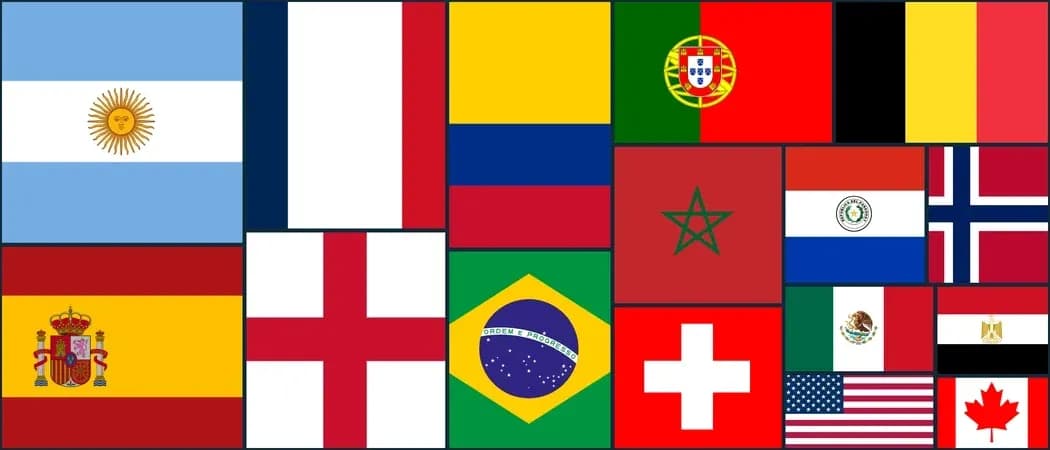
World Cup Last 16: England Faces Mexico in High Stakes Match
Six days, sixteen matches, and half the World Cup has disappeared. The field has been carved from 32 to 16, and it has not gone quietly.
Germany are out. On penalties. To Paraguay. The numbers had them at roughly a 63% chance of going through; the reality was a shoot-out exit and one of the tournament’s first true jolts. Had Senegal clung on against Belgium, that would have ranked alongside it – another heavyweight tipped to progress, dragged to the brink by a supposed outsider.
Morocco’s win over the Netherlands carried the feel of an upset, but the data tells a cooler story. Elo ratings had the Dutch at only about 55% to advance. A coin flip in all but name, and one of the round’s most finely poised ties.
The real drama came where the pre-match odds suggested processions.
Cape Verde, given just a 10% chance of progressing, dragged holders Argentina into extra time and refused to go away. Congo, with only a 17% shot at going through, led England with a quarter of an hour left. These were not supposed to be nervy nights for the favourites. They were.
A familiar shape to the last 16
Asia has vanished from the tournament. Almost all of Africa has too. Only two African sides remain, and the last 16 has settled into an old, familiar pattern: Europe and South America on top, everyone else clinging to the edges.
From outside the traditional power blocs, just five nations are left standing: Canada, Egypt, Mexico, Morocco and the United States. Between them, their combined chance of actually lifting the trophy is about 3.5%. They are the storylines, not the favourites.
At the sharp end, Argentina are still the team to beat, but their grip has loosened. Surviving extra time against Cape Verde has nudged their overall title probability down to 28%. Part of that is their own struggle. Part of it is the ripple effect of Germany’s exit, which has opened the door for others.
France are one of the main beneficiaries. Their chances of winning the World Cup have jumped to 14%, Spain’s to 16%, as both glide one step closer to the final. Spain brushed aside Austria. France did much the same to Sweden. No fuss, no drama, just heavyweight sides moving through the gears.
England, too, edge upwards. Their title probability now sits at 12%, driven as much by the shrinking field as by any great statement performance. The path, though, is brutal. Brazil and Argentina still loom in their half of the draw, assuming they first deal with a different kind of challenge: Mexico, in Mexico City.
England in Mexico City: thin air, thick tension
The numbers, on paper, are clear. Even after adjusting for home advantage, England carry the edge.
Expected goals: Mexico 0.6, England 1.6. A full goal of daylight.
Run those figures through the model and it yields a 62% chance of England winning inside 90 minutes, 13% for Mexico, and a 25% probability of a draw and the drama of penalties.
Yet the match is not being played on paper. It is being played at altitude.
Mexico City sits between 2000 and 2250 metres above sea level. The debate over what that does to visiting teams has rumbled for decades – thinner air, heavier legs, sluggish lungs. England arrive with little time to acclimatise. The question is how much that really matters.
The data offers a sharp counterpoint to the mythology. Looking across thousands of international matches at different altitudes, and rounding to the nearest 500 metres, the raw numbers show almost no increase in home win probability as altitude rises.
At sea level, where roughly a third of all international matches are played (within 250 metres either side), home teams win about 55% of the time. Between 250 and 750 metres – about 6% of matches, close to 4000 games – the pattern barely shifts. Even in the narrow band where Mexico City lies, 2000–2250 metres, home sides win 52% of the time. That is actually a lower raw home advantage than at sea level.
Strip away the romance and it looks underwhelming. But that is only the first layer.
What altitude really seems to do
The key is team strength. The model leans heavily on Economic Observatory Elo ratings – a system that tracks performance, mirrors FIFA’s rankings closely, and has a strong record of predicting international results.
To isolate altitude’s impact, you compare what actually happens to what the Elo ratings say should happen. Treat a home win as 1 and anything else as 0. Subtract the Elo-implied probability of a home win from that outcome, then take the average. That gives you a measure of over- or under-performance.
The twist is that many of the teams playing at serious altitude are not traditional powerhouses: Bolivia above 3000 metres; Ecuador, Ethiopia and Mexico above 2000. Their Elo ratings tend to be lower, so they are not expected to dominate.
Once you control for that, a different pattern emerges. Below about 1750 metres, home teams win roughly as often as the model expects. Above that, they start to outperform expectations. The higher you go, the more often the home side edges beyond the predicted line.
Even then, the effect is modest. At the very highest altitudes, the over-performance gap peaks at around 20 percentage points – and that still sits within the margin of error. Altitude seems to help. It does not transform.
A leveller, not a lottery
The model suggests that altitude will not hand Mexico a huge, decisive edge, but nor can it be dismissed. England’s lack of acclimatisation time leaves room for small shifts to matter.
If you assume altitude shaves 0.25 expected goals off England and adds 0.25 to Mexico – a plausible swing – the picture tightens. England’s win probability drops from 62% to 48%. Mexico’s climbs from 13% to 24%. Penalties still lurk in the middle.
Even under that scenario, England remain the stronger side by every metric: past results, Elo ratings, and market-based measures such as Transfermarkt squad values. The thin air becomes a leveller, not a coin toss.
They go into Mexico City as favourites, but not comfortable ones.
The rest of the last 16: favourites, frailties and one awkward tie
Across the other last-16 fixtures, the simulations lean heavily towards the established powers.
Argentina are 77% likely to beat Egypt. England are put at 74% to go through against Mexico. Morocco, fresh from that win over the Netherlands, are 70% favourites against Canada. Spain over Portugal? The model gives Spain a 72% edge.
On the other side of the bracket, Colombia are 70% likely to eliminate Switzerland, Brazil are at 69% against Norway, and Belgium hold a 64% advantage over the United States.
Then comes the awkward one: France against Paraguay.
On paper, France are superior. The model still makes them favourites, but only at 62% to progress. Paraguay’s defensive steel drags this fixture into a different category. That resilience has been on display throughout the tournament, the opening match against the United States aside.
The expected goals tell the story: France at 1.1, Paraguay at 0.6. For a side as free-scoring as France, that is a notable drop. This is not set up to be a procession. It looks more like their sternest examination so far.
The giants remain in control of the bracket, but the margins are narrowing. Germany have already gone. Argentina have been stretched. England are heading into the high, thin air with history and data pulling in different directions.
If altitude really is a leveller, who else might find the ground shifting beneath their feet?