Argentina's Tactical Masterclass: 2-1 Victory Over Cape Verde Islands
Argentina’s 2-1 extra‑time win over Cape Verde Islands at Hard Rock Stadium in this World Cup Round of 32 tie was a study in territorial control versus compact resistance. Argentina needed 120 minutes to translate their dominance into progression, with structure, circulation and late-game adjustments eventually overwhelming Cape Verde’s disciplined 4-1-4-1 block and direct transitions.
Argentina set up in a 4-4-2 under Lionel Scaloni, but in possession it quickly morphed into a 3-3-4. Facundo Medina tucked in from left-back alongside Cristian Romero and Lisandro Martínez to form the first line, while Nahuel Molina pushed high on the right. Enzo Fernández operated as the main pivot, with Rodrigo De Paul and Alexis Mac Allister stepping into advanced half-spaces to connect with Lionel Messi and Lautaro Martínez between the lines. Thiago Almada started nominally from the left but frequently drifted inside, giving Argentina a box of four in midfield against Cape Verde’s three central midfielders.
The statistical profile reflects that territorial control: 64% possession, 849 passes with 779 accurate (92%), and 22 total shots, 10 on goal and 7 blocked. Argentina consistently forced Cape Verde deep, using quick circulation and diagonal switches to move the 4-1-4-1 block. Messi dropped into the right half-space to overload around Steven Moreira and Ryan Mendes, while Molina’s width pinned the Cape Verde back line, creating interior lanes for De Paul and Mac Allister to arrive late.
First Goal
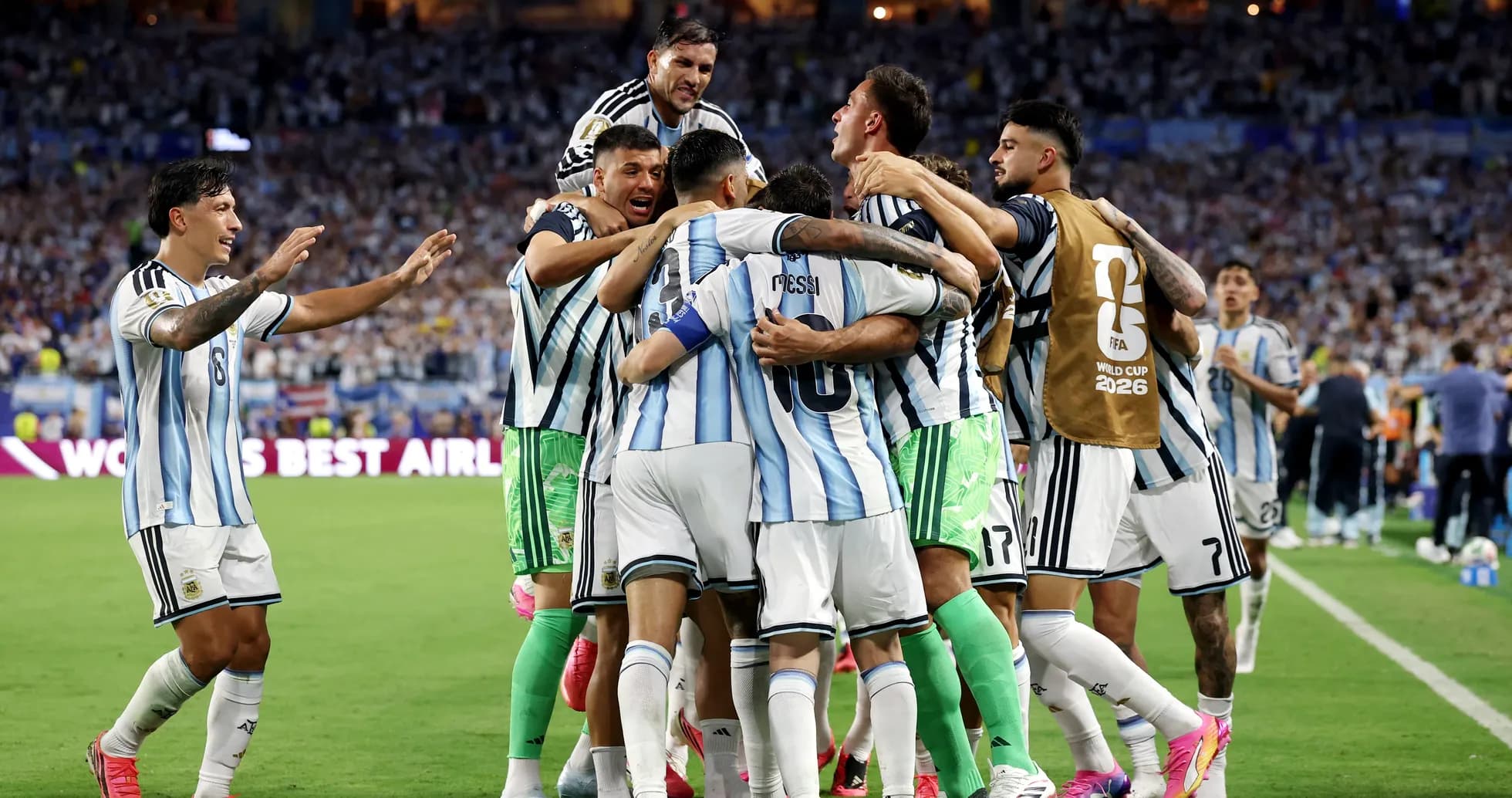
The first goal at 29’ came from precisely that structural superiority. With Cape Verde compressed centrally, Argentina could afford Lisandro Martínez to step into higher zones. His assist for Messi underlined how the centre-backs were encouraged to break lines when Cape Verde’s first line of pressure was bypassed. Messi’s finish capped a long spell of Argentine possession in the final third, leveraging the numerical advantage around the box created by Almada’s interior movements.
Cape Verde’s 4-1-4-1 under Pedro Leitao Brito was built around compactness and vertical threat. Kevin Lenini screened the back four, while Deroy Duarte and Laros Duarte (before his substitution) had to shuttle aggressively to close Argentine interiors. With only 36% possession and 476 passes (408 accurate, 86%), Cape Verde accepted long spells without the ball, focusing on protecting the central corridor and using Jovane Cabral and Mendes as outlets on the break. Their 16 shots (5 on goal, 6 blocked) reveal that, when they did escape, they committed numbers forward quickly and were prepared to shoot from distance.
Equaliser
The equaliser at 59’ from Deroy Duarte, assisted by Mendes, came from one of these transition moments. Cape Verde exploited the spaces left when Argentina’s full-backs and midfield pushed high, attacking quickly into the channels and finding Duarte in a more advanced pocket than Argentina’s shape would have liked. It was a reminder that Argentina’s aggressive rest defence — often a back three plus Fernández — could still be stretched when counter-pressing failed.
Tactical Changes
Scaloni’s double change at 63’ was clearly tactical: Nicolás González (IN) came on for Thiago Almada (OUT), and Julián Alvarez (IN) came on for Lautaro Martínez (OUT). This shifted Argentina towards a more vertical front line, with González providing depth and width on the left and Alvarez offering more mobility between lines and in the channels. Messi, consequently, could orchestrate even more from a free central role, with De Paul and Mac Allister supporting second balls around the box.
Cape Verde responded at 67’ with Dailon Rocha Livramento (IN) for Nuno Da Costa (OUT) and Jamiro Monteiro (IN) for Laros Duarte (OUT), freshening the front and central lines to maintain their ability to counter. The yellow card for Kevin Lenini at 68’ — “Foul” — reflected the strain on the lone holding midfielder as Argentina increased tempo and rotations around him.
Second Goal
The second Argentine goal at 93’ — Lisandro Martínez scoring from an Alexis Mac Allister assist — underlined Argentina’s set-piece and second-phase threat. With eight corner kicks to Cape Verde’s eight, but superior aerial presence and occupation of the box, Argentina repeatedly pinned Cape Verde deep. Martínez’s presence in the opposition area again showed how Argentina were willing to commit centre-backs aggressively when chasing the game.
Extra Time
Extra time became a test of depth and concentration. Cape Verde struck first in the additional period at 103’, when Sidny Lopes Cabral scored unassisted. By then, substitutions had reshaped their side: Gilson Tavares (IN) for Kevin Lenini (OUT) and Yannick Semedo (IN) for Deroy Duarte (OUT) at 100’ added fresh legs and a slightly more front-foot posture, and the goal reflected their willingness to push a defender into advanced zones when Argentina’s back line was stretched.
Scaloni’s response was to reinforce the right flank and defensive balance: Gonzalo Montiel (IN) came on for Nahuel Molina (OUT) at 104’. Montiel’s later yellow card at 115’ — “Foul” — was emblematic of Argentina’s increased urgency in protecting transitions as they defended a narrow lead.
That lead arrived in chaotic fashion at 111’, via an own goal by Diney Borges, credited to Argentina. The sequence emerged from sustained Argentine pressure and volume of balls into the box; Cape Verde, already under siege with 6 blocked shots and 8 corners faced, finally cracked under the cumulative load. The own goal was the logical endpoint of Argentina’s insistence on occupying central finishing zones with multiple bodies.
Goalkeeper Performance
Defensively, both goalkeepers were tested but within the limits of the shot quality. Emiliano Martínez (Argentina) made 3 saves, while Vozinha (Cape Verde Islands) made 8. The goals prevented metric (-0.6 for each team) suggests both conceded slightly more than the post-shot xG of the efforts they faced, but context matters: Vozinha was repeatedly exposed by waves of Argentine attacks (10 shots on goal), yet still kept his side alive deep into extra time with several strong interventions, particularly against cut-backs and low crosses.
From a statistical verdict, Argentina’s 2.16 xG against Cape Verde’s 0.45 underscores the structural superiority of Scaloni’s side. The shot profile (22–16 in total, 10–5 on target) and passing volume gap (849–476) align with the eye-test of a game largely played in Cape Verde’s half. Cape Verde’s compact 4-1-4-1 and disciplined fouling (12 fouls, 1 yellow card) kept them competitive, and their direct play generated more shots than their xG would suggest, indicating a bias towards lower-quality attempts, often from outside the box (10 shots from distance).
Discipline remained controlled: Cape Verde Islands recorded 1 yellow card (Kevin Lenini at 68’ — “Foul”), Argentina also 1 yellow card (Gonzalo Montiel at 115’ — “Foul”), total 2. The low card count, despite 25 combined fouls, reflects a match where tactical and positional fouls were used intelligently rather than excessively.
Ultimately, Argentina’s superior structure, bench impact, and relentless occupation of the final third wore down a resilient Cape Verde side. The late own goal was less an accident than the inevitable outcome of sustained territorial and statistical dominance.