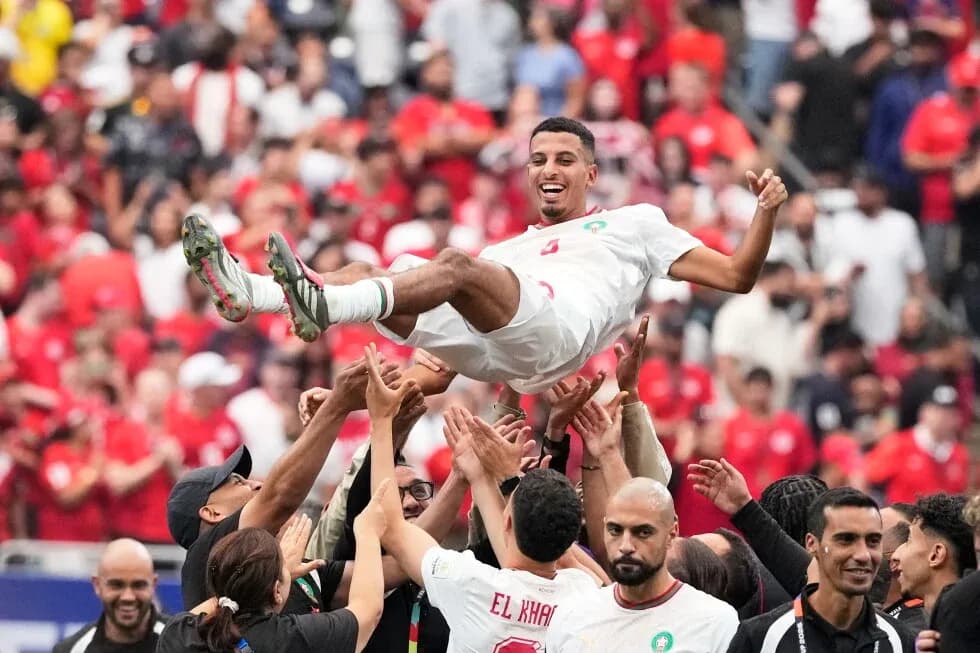
Morocco Dominates Canada 3-0 to Reach Quarterfinals
HOUSTON — Morocco no longer knocks on the door of the game’s elite. It walks straight through it.
Azzedine Ounahi struck twice and Soufiane Rahimi added a late flourish as Morocco swept aside Canada 3-0 in the World Cup round of 16 on Saturday, booking a second consecutive quarterfinal and underlining a new reality for African football’s standard-bearer.
“We are no longer a surprise,” coach Mohamed Ouahbi said through a translator. “Now when people talk about Morocco we’re a major contender.”
He meant it. His players proved it.
Ounahi breaks it open
For 49 minutes, this was a grind. A tense, physical contest heavy on collisions and light on clear chances, the kind of knockout tie where one moment of quality can rip the game away.
That moment belonged to Ounahi.
Five minutes after the restart, Achraf Hakimi stood over a free kick and clipped it into a crowded area. The ball spilled to Ounahi outside the box, and the midfielder didn’t hesitate. He whipped a right-footed shot through a thicket of bodies and into the bottom-right corner, past a helpless Canadian defense and beyond any argument about the game’s balance.
1-0. Pressure released. Morocco’s end of the stadium exploded.
Canada, co-hosts and darlings of this tournament after their first-ever knockout win, suddenly had to chase a team that relishes exactly that scenario. Morocco, ranked sixth in the world, knows how to suffer, how to bend without breaking, and how to punish any overreach.
The Canadians kept coming. They just couldn’t find a way through.
Canada’s brave run hits a wall
This was supposed to be the night Canada tested its ceiling. Instead, it discovered what the sport’s highest floor looks like.
Jesse Marsch’s side arrived in the round of 16 on a wave of optimism, having beaten South Africa 1-0 for the country’s first World Cup knockout victory. In a nation that lives and breathes hockey, this team had turned summer into something else entirely.
They did much of what Marsch asked. They pressed. They pushed. They tried to dictate tempo against one of the most seasoned tournament teams on the planet.
“The way we pushed, the way we were in the match, the quality we showed, the overall impact in the match, we were better,” Marsch said. “We were better than the No. 7 team in the world today.”
He misspoke on the ranking — Morocco are No. 6 — and Ouahbi did not let the broader point slide.
“In terms of intensity they were good,” the Morocco coach replied. “They were good for 98 minutes. Were they better? It’s hard to say. It takes some nerve to say that when you lose 3-nil.”
On the scoreboard, at least, there was no debate.
Bounou slams the door
Canada’s best spell came late, long after Ounahi’s opener had tilted the tie. They carved out chances; Yassine Bounou erased them.
In the 78th minute, Jonathan David stood over a free kick just outside the area, a glimmer of hope for a team desperate for a lifeline. His effort never threatened, sailing over the crossbar.
Moments later, Tajon Buchanan tried from distance, unleashing a drive from about 30 yards. This time Bounou had work to do. The Morocco goalkeeper, born in Canada to Moroccan parents, sprang across his goal and pushed the ball away with a full-stretch, diving save. It was one of three stops on the night, each one another reminder of why Morocco trusts its last line so completely.
Canada’s fight never really dimmed. Its margin for error did.
All of this came without Alphonso Davies, the Bayern Munich star who managed only 15 minutes all tournament, as a substitute against South Africa. Any hope of a late cameo in Houston vanished on Saturday morning.
“His hamstring didn’t feel right,” Marsch said. “We were hoping that by the time he woke up this morning that he would feel better, but he didn’t.”
Without him, Canada lacked the one player capable of turning a half-chance into something more.
A ruthless finish
Just when Canada’s legs began to fade, Morocco’s quality cut through again.
In the 82nd minute, with space finally opening up, Brahim Díaz slipped a pass into the heart of the box. Ounahi arrived right on cue. One touch, one calm, right-footed finish from the middle of the area, and the game was effectively done at 2-0.
Canada pushed numbers forward in desperation. Morocco smelled blood.
In the final minute of stoppage time, Rahimi joined the party, adding a third goal to give the scoreline the sheen Morocco’s control deserved and to underline the gulf in big-game experience. The African side had managed the occasion, the tempo, and the scoreboard. The co-host had run out of answers.
It was a fittingly clinical end for a team that has grown comfortable on this stage.
Africa’s standard-bearer marches on
This is not a one-off. Not anymore.
Two years ago, Morocco became the first African nation to reach a World Cup semifinal and finished fourth. Now they are back in the quarterfinals, the first team from the continent ever to reach that stage more than once.
“We are so proud to represent Africa because it’s a continent with a lot of talent and Africa deserves to be in the best level in football,” Bounou said.
The pride is matched by ambition. Ouahbi made that clear.
“We want to keep going,” he said. “We don’t want to stop.”
They’ll get that chance on Thursday at Boston Stadium against the winner of Paraguay vs. France, another heavyweight test in a tournament Morocco has no intention of quietly exiting.
The path here has not been gentle. They sent the Netherlands home in a penalty shootout in the previous round, forcing an early exit for one of Europe’s storied powers. They have now dispatched a host nation riding the crest of its own history.
Along the way, they have absorbed blows. Saturday’s match turned nasty at times, with eight yellow cards shown — four to each side. Hakimi and Richie Laryea were both booked in the 40th minute after a shove, a push, and a brief scuffle that reflected the edge of a knockout tie.
Morocco also lost midfielder Ismael Saibari to injury in the 22nd minute, another test of depth in a campaign already straining legs and lungs. The structure held. The standard never dropped.
Canada leaves with its best World Cup run, a fan base newly engaged, and a clear message from its coach about what comes next.
“I challenged them to understand that we can play like this all the time against the best teams in the world,” Marsch said. “We can be better on the day. And then the challenge is, can we hold that standard for 90 minutes?”
Morocco, by contrast, leaves Houston with something else: the look of a team that believes this is no longer just a dream run.
For Africa’s new benchmark, the quarterfinals are no longer a destination. They’re the starting point.