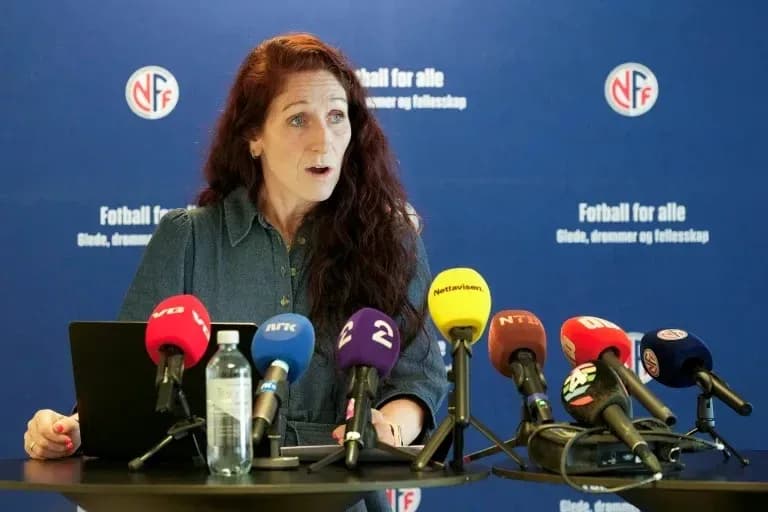
Lise Klaveness: A Voice for Change in FIFA
In the corridors of world football power, Lise Klaveness has never blended into the wallpaper. She has been the awkward question at the press conference, the lone raised hand in a room that prefers silence. Now, as Gianni Infantino fights off mounting criticism, some inside the game are daring to imagine her not as the outsider, but as his successor.
The head of Norway’s football federation is 45, a lawyer by trade and a former international with 73 caps. She speaks in clear lines, not slogans. And she has spent much of Infantino’s presidency pulling at the loose threads of his reform narrative.
When Infantino won the FIFA presidency in 2016, she recalls a man elected on promises of “good governance.” The mood then was one of renewal after the Sepp Blatter era. But in her eyes, that promise curdled quickly.
“Then things quickly deteriorated,” she told AFP. Distance from political power, she argued, gave way to proximity. Guardrails were removed. Independence from heads of state and powerful World Cup hosts, she said, eroded. The reformer started to look like just another operator.
The first major clash came in 2022. Newly installed as president of the Norwegian federation, Klaveness went straight into the lion’s den: Doha, on the eve of the Qatar World Cup. While many officials chose their words carefully, she didn’t. From the stage, she lamented that “human rights, equality, democracy, the core interests of football, were not in the starting 11.”
It was a direct shot at the decision to award the tournament to Qatar and at FIFA’s priorities. The room shifted uncomfortably. The message travelled.
Norway followed that stance with action. In 2023, when Infantino stood for re-election, the Norwegian federation refused to back him. Symbolic? Perhaps. But it was a clear marker that not everyone was willing to fall in line.
Mina Finstad Berg, a sports commentator for Norwegian broadcaster TV2, sees Klaveness as an early lightning rod for discontent that has since spread.
“She was in a way the first standard-bearer for much of this criticism that many others now share when it comes to the way Infantino runs FIFA,” Berg said. For her, Klaveness is someone who obsesses over rules, process, and decisions being respected. In a political environment built on deals and alliances, that can be both a strength and a liability.
The tension has intensified in recent months.
Infantino’s FIFA has faced outrage over a string of decisions and proposals: the idea of awarding a “Peace Prize” to former US President Donald Trump; the lifting of US forward Folarin Balogun’s suspension at the 2026 World Cup after an intervention by Trump; and the now-abandoned plan to open FIFA competitions, including the World Cup, to private investors.
That last move backfired spectacularly. The proposal was shot down swiftly, exposing just how far Infantino had pushed his mandate. For critics like Klaveness, it was confirmation of a drift away from football’s core responsibilities.
Norway’s federation has now decided to take all three issues — the Trump “Peace Prize,” the Balogun intervention, and the private investor plan — to FIFA’s Ethics Committee. It is an aggressive play from a relatively small football nation, and it has amplified Klaveness’s voice.
On the pitch, Norway have helped her cause. Long absent from the latter stages of major tournaments, the national team produced a strong run at this year’s World Cup, reaching the quarter-finals before falling to England. The timing was perfect. A federation that speaks loudly about governance now has a team that can compete with the elite.
Internationally, the praise has followed. Commentators have highlighted Klaveness’s “strong moral compass” and increasingly talk about her as a serious contender to replace Infantino, should he resign or be forced out. The idea of a woman leading FIFA — still unthinkable in some corners of the game — is slowly entering the conversation.
Even Sepp Blatter, the former FIFA president forced out by a corruption scandal, has weighed in from the sidelines. On X, he wrote that she was “the only one who always took a clear stand and did not go along with the mainstream. And at FIFA, the time is right for a woman to take the lead.” The endorsement is as ironic as it is telling: the man whose downfall sparked calls for reform now backing the woman demanding it.
Infantino, though, is not acting like a man ready to leave. He is standing for a fourth and final term next March and, for now, is the only declared candidate. The machine around him remains formidable.
Klaveness, for her part, refuses to turn this into a personal duel.
She has insisted that the crisis in world football cannot be reduced to a “Game of Thrones” script, with heroes and villains vying for a throne. The problem, she argues, is bigger than one man. “For us, it has never been a personal issue against Gianni Infantino,” she told AFP. “The problems go beyond the person of the president.”
Her name circulates in back rooms and media columns, but she will not bite on questions about a run at the top job. She says only that she has “registered” the speculation. “We’re not there yet.”
There are reasons for her caution. The path to the FIFA presidency is not just steep; it is structurally hostile to someone like her.
“In addition to being seen as extremely radical in many places, especially outside Europe, she is a woman. That is also likely to count against her in many regions of the world,” Berg noted. The word “radical” in this context often means something simple: unwilling to play by the old rules.
Even in Europe, where you might expect her message to land most easily, the resistance is real. In 2023, Klaveness failed to win election to UEFA’s Executive Committee. She eventually joined in 2025, but only as the sole candidate for the seat reserved for women. Symbolic progress, yes. A sweeping mandate, no.
Erik Thorstvedt, the former Norway goalkeeper turned pundit, voiced the hard question many are asking. If Klaveness struggles to secure votes in Europe, how can she persuade federations in Africa or South America to back her in a FIFA election?
That is the central tension in her story. She has become the conscience of a system that rarely rewards conscience. Her words travel. Her votes, for now, do not.
Yet the pressure around Infantino is building. The failed investor plan has shaken his authority. The Trump and Balogun controversies have stained FIFA’s image once again. Ethics complaints are stacking up. Inside that turbulence, the idea of a different kind of leader — a lawyer, a former player, a woman who has already shown she will challenge the room — no longer feels like fantasy.
World football has heard Klaveness’s voice. The next question is whether it is prepared to follow it.