Liverpool vs Galatasaray: Champions League 1/8 Final Showdown
On 18 March 2026, Anfield stages a classic UEFA Champions League 1/8 final second leg with everything on the line. Liverpool host Galatasaray knowing they must overturn a 0-1 deficit from Istanbul to reach the Quarter-finals (1/4 final), while the Turkish side arrive believing they can finish what they started at Rams Park.
This is a clash between contrasting routes through the league phase. Liverpool came through as one of the competition’s heavyweights, ranked 3rd in the league table with 18 points and a +12 goal difference. Galatasaray, by contrast, emerged from deeper in the pack, ranked 20th with 10 points and a -2 goal difference, earning their shot at the knockouts via the lower play-off route. Yet over 90 minutes in Istanbul, those roles flipped: Galatasaray 1-0 Liverpool – and suddenly the tie belongs to the underdog.
The stakes and the scoreline: Liverpool chasing, Galatasaray protecting
The arithmetic is brutally simple. Over two legs, Galatasaray hold a 1-0 aggregate lead – a 1-goal cushion. Liverpool must win by at least one goal to stay alive; how far that takes them depends on the margin.
There is no away-goals rule indicated in the data, so the core narrative is straightforward: Liverpool need to win the night to have any chance of the Quarter-finals, Galatasaray need only avoid defeat by more than a single goal.
The psychological balance is fascinating. Galatasaray have beaten Liverpool twice in this competition in 2025–2026: a 1-0 league phase win in Istanbul on 30 September 2025, and that same 1-0 in the first leg of this 1/8 final on 10 March 2026. Both matches at Rams Park, both tight, both controlled enough to keep Liverpool scoreless.
Now the question is whether that template travels to Anfield.
Form guide and tactical identities
In the league phase, Liverpool were ruthless. Across all phases, they have played 9 Champions League games, winning 6 and losing 3, with no draws. They score 2.2 goals per game and concede just 1.0, a profile of a side that overwhelms opponents with attacking volume but can occasionally be picked off.
At Anfield in this competition, Liverpool’s numbers are even more imposing: 3 wins from 4 in the league phase, 11 goals scored and 6 conceded. They average 2.8 goals per home game and concede 1.5 – high-event football, built on attacking aggression and relentless pressure.
Galatasaray’s path is more jagged but full of character. Across all phases, they have played 11 Champions League matches, winning 5, drawing 1 and losing 5. They average 1.5 goals for and 1.5 against, the very definition of a knife-edge side. At home they are strong (4 wins from 6, 11 scored, 5 conceded), but away they are vulnerable: just 1 win from 5, with 6 goals scored and 11 conceded, an average of 2.2 goals shipped per away game.
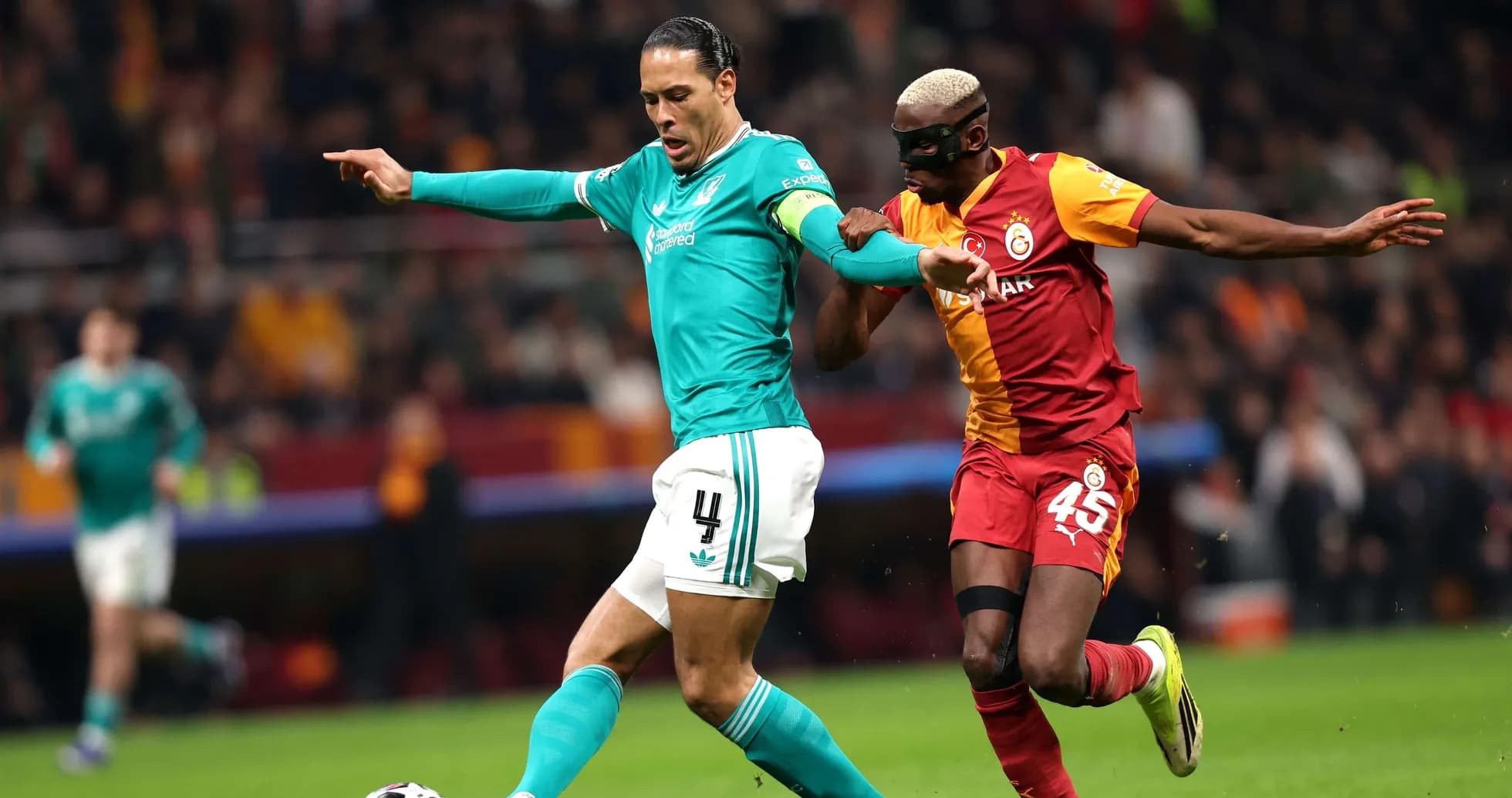
That away fragility is the crack Liverpool will try to drive a wedge into. But Galatasaray’s recent head-to-head record gives them belief: two straight 1-0 wins over Liverpool in this competition, both built on organisation, discipline and the ruthless edge of Victor Osimhen.
Key battles: Osimhen vs Anfield, Liverpool’s structure vs Galatasaray’s resilience
Victor Osimhen is the outstanding individual in this tie. For Galatasaray in the Champions League, he has 7 goals and 2 assists in 9 appearances, with a strong average rating and a staggering 25 shots on target from 35 attempts. He has also been flawless from the spot, converting 3 penalties out of 3, a 100% return that adds a layer of threat to every box entry and every transition.
Galatasaray’s attacking minute distribution underlines their danger throughout the game: they score early (4 goals between 0-15 minutes), they can reset after half-time (4 goals between 46-60), and they still carry a punch late on. For a Liverpool side that concedes more cards and intensity in the middle and later phases of games, that sustained threat is significant.
Liverpool, meanwhile, are defined more by collective patterns than one standout star in the data. Their most-used formation across all phases is 4-2-3-1 (6 times), with occasional switches to 4-4-2, 4-3-1-2 and 4-2-2-2. That flexibility hints at a coach willing to adjust structure to game state – vital when chasing a 1-goal deficit.
Offensively, Liverpool have been explosive at home: their biggest win is a 6-0 at Anfield, and they have also produced a 1-5 away demolition. Defensively, they have 4 clean sheets across all phases, and at home they have failed to score in 0 matches – every Anfield night in this campaign has produced at least one Liverpool goal.
That last stat is crucial. If Liverpool score, the tie changes shape instantly. If they score early, Galatasaray’s compact 4-2-3-1 may be forced into a more stretched version, opening lanes for Liverpool’s attacking midfielders and full-backs.
Injuries, suspensions and squad depth
Liverpool’s squad is not at full strength. S. Bajcetic (hamstring injury), C. Bradley (knee injury), H. Davies (inactive), W. Endo (foot injury), A. Isak (broken leg), G. Leoni (knee injury) and R. Williams (inactive) are all listed as missing this fixture. The absence of W. Endo, in particular, removes an experienced defensive midfield option in a game where control of transitions will be critical.
For Galatasaray, the headline absentee is D. Sanchez, out due to yellow card accumulation, and M. Baltaci, suspended. C. Guner, G. Gurpuz and R. Nhaga are listed as inactive, while A. Unyay is out injured. Sanchez’s suspension could be a major blow: his presence in the defensive line or as a stopper is precisely the profile you want at Anfield under siege.
Galatasaray’s disciplinary profile across all phases is also telling: a heavy cluster of yellow cards between 76-90 minutes, and a red card in that same window. Under sustained pressure late on, they can be dragged into fouls and chaos – exactly the scenario Liverpool will try to create.
Tactical blueprint: how the game may look
Liverpool are likely to start on the front foot in a 4-2-3-1, pushing full-backs high and using the double pivot to recycle possession and counter-press. With no Endo, the balance of that pivot becomes vital: one sitter, one shuttler, both tasked with containing transitions towards Osimhen.
Expect Liverpool to:
- Attack down the flanks, using width to stretch Galatasaray’s compact block.
- Shoot often and early, testing a defence that concedes an average of 2.2 goals away.
- Use the crowd and tempo to create a high-intensity first 30 minutes, aiming to erase the 1-goal deficit quickly.
Galatasaray, in their preferred 4-2-3-1, will likely:
- Keep the lines tight, with the double pivot screening central spaces.
- Look for early balls into Osimhen’s channels, exploiting his duels (93 contested, 50 won).
- Target Liverpool’s most vulnerable minutes defensively, especially around the 61-75 zone where Galatasaray themselves both score and concede often.
If Galatasaray can survive the initial Anfield surge, the tie may settle into a tense chess match, with Liverpool’s need for goals gradually opening space for Turkish counters.
Verdict: Anfield to roar, but Osimhen keeps it on a knife edge
On paper, Liverpool’s home record, goal output and overall league-phase dominance make them favourites to win on the night. Galatasaray’s away numbers – 4 defeats from 5, 11 goals conceded – suggest they will suffer.
But this tie is not played on paper. Galatasaray have already shown twice that they can frustrate Liverpool and win 1-0. They have the outstanding striker in Osimhen, a flawless penalty record in this campaign, and a tactical structure that has repeatedly contained Liverpool’s attack.
Logical prediction: Liverpool to win the second leg, driven by Anfield and their attacking volume, but Galatasaray to make it agonising. Expect a narrow Liverpool victory that pushes the aggregate to the brink – with qualification for the Quarter-finals potentially decided by a single moment, a single duel, or a single Osimhen breakaway.
One thing feels certain: the 1-0 from Istanbul guarantees that Anfield will be on edge from the first whistle to the last.