Liverpool vs Ipswich: Premier League Tactical Analysis
Portman Road under the Friday night lights offered a sharp contrast in Premier League trajectories. Ipswich, 14th heading into this game with 3 points from 3 matches, had already discovered how unforgiving the top flight can be: 4 goals scored and 8 conceded overall, a goal difference of -4 that told of ambition outstripped by naivety. Liverpool arrived as early pace-setters of a different kind, unbeaten and sitting 6th with 5 points from 3, their overall tally of 6 goals for and 4 against giving them a goal difference of +2 and the look of a side still calibrating under Andoni Iraola, but rarely out of control.
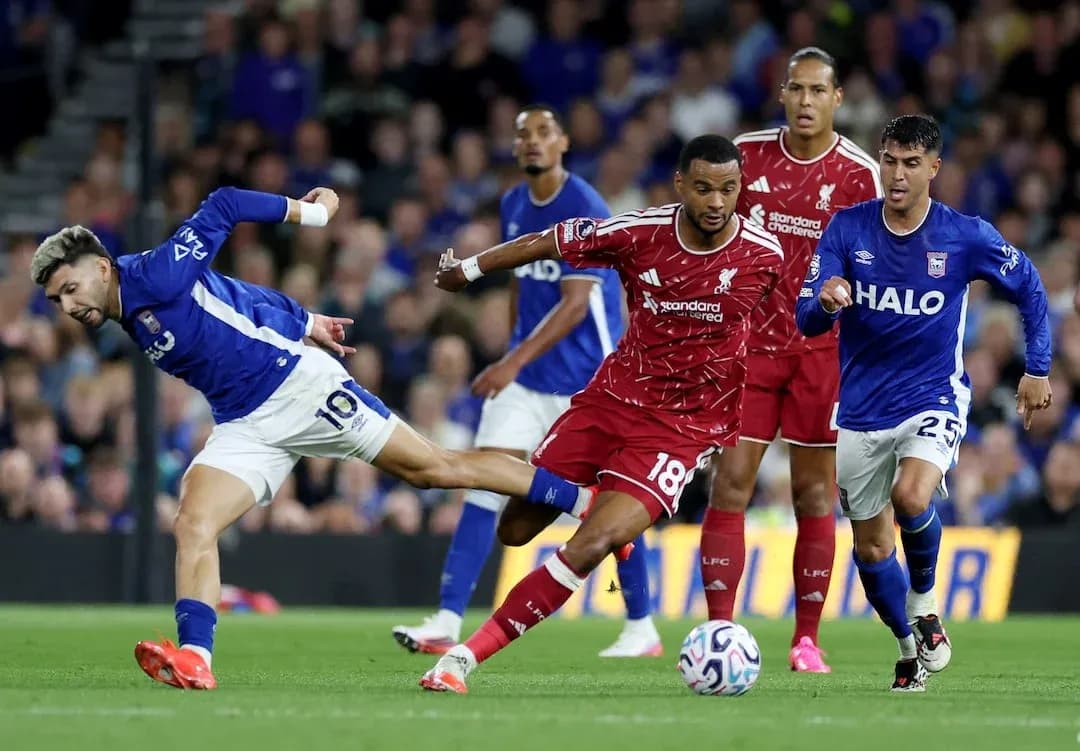
Both teams lined up in a 4-2-3-1, but the shared shape masked very different identities. For Ipswich, Gary O’Neil’s selection underlined a commitment to front-foot football even against elite opposition. K. Scherpen stood behind a back four of D. O’Shea, I. Diop, J. Greaves and L. Davis, a unit that in total had already conceded 8 goals this campaign and was still searching for its first clean sheet. Ahead of them, S. Lukić and E. Palacios formed the double pivot, with a high-energy, creative trio of A. Fatawu, J. Enciso and D. Maeda tasked with feeding Emersonn as the lone forward.
Liverpool mirrored the shape but not the risk profile. Alisson Becker anchored a back line of R. Araújo, J. Jacquet, V. van Dijk and M. Kerkez. In front of them, D. Szoboszlai and A. Mac Allister formed a technically gifted midfield base, releasing an attacking band of Víctor Muñoz, F. Wirtz and C. Gakpo behind central striker A. Isak – the league’s standout early-season finisher with 3 goals in 3 appearances and a 7.77 average rating.
The absences on both sides subtly re-drew the tactical map. Ipswich were stripped of ballast and invention in key zones: A. Matusiwa’s injury removed a natural ball-winner who might have helped Lukić cope with Liverpool’s rotations; J. Philogene’s absence robbed O’Neil of a direct wide threat; J. Taylor’s knee injury further thinned the options for late-game adjustments. For a side that had already failed to keep a single clean sheet at home and had failed to score in one of their three league matches overall, these were not cosmetic losses.
Liverpool’s missing contingent was deeper but better absorbed. C. Bradley, J. Gomez and G. Leoni were all unavailable, thinning Iraola’s defensive depth, while F. Chiesa and H. Ekitike – both out with significant injuries – removed two high-impact attacking alternatives. Yet the starting XI still brimmed with control and threat, a testament to squad depth: when you can leave R. Gravenberch and W. Endo on the bench and still field Szoboszlai, Mac Allister, Wirtz and Gakpo, you are not short of solutions.
Discipline was always likely to be a quiet but decisive subplot. Ipswich’s yellow-card pattern this season has been heavily front-loaded: 75.00% of their cautions have arrived between 31-45 minutes, with another 25.00% between 46-60. That mid-game spike hints at a young side struggling to manage emotional and physical intensity as matches settle into their tactical rhythm. Liverpool, by contrast, have spread their bookings more evenly, with 40.00% of their yellows coming between 46-60 minutes and 20.00% in each of the 16-30 and 76-90 windows. M. Kerkez, already on 2 yellow cards and also appearing among the top red-card profiles, embodies that edge: a proactive, sometimes overzealous left-back whose duels (29 in total, 13 won) can tilt either towards dominance or danger.
In the “Hunter vs Shield” duel, the numbers tilted Liverpool’s way even before a ball was kicked. On their travels, Iraola’s side had scored 4 goals in 2 matches, averaging 2.0 away goals per game, while conceding just 2 away – a defensive average of 1.0. Ipswich at home, by contrast, had scored only 2 goals in 2 games, an average of 1.0, while conceding 3, an average of 1.5. Overlay Isak’s ruthless efficiency – 7 shots in total this season, 5 on target, 3 goals – onto a back line that had already shipped 5 goals on their travels and 3 at home, and Liverpool’s centre-forward looked primed to exploit any hesitation.
Behind him, the creative engine was equally ominous. C. Gakpo arrived as both Liverpool’s top assister and a top scorer contributor: in total this campaign he had 1 goal and 3 assists, with 8 key passes and 84% passing accuracy. His ability to drift inside from the left and link with Wirtz and Isak offered Liverpool a multi-lane route into Ipswich’s box. On the other side of the ball, Ipswich’s brightest creative sparks were Enciso and Fatawu. Enciso, with 2 assists overall, 11 shots and 4 key passes, combined dribbling flair (15 attempts, 6 successful) with a willingness to work backwards – 2 tackles, 2 blocks and 3 interceptions in total. Fatawu brought similar duality: 1 assist, 7 key passes, 15 dribble attempts with 7 successes, and 7 tackles in total. Together, they gave Ipswich a genuine counter-punch, especially against Kerkez and Araújo, both of whom can be drawn into wide duels.
The “Engine Room” confrontation, though, was where Liverpool’s structural superiority truly showed. Szoboszlai and Mac Allister, even without individual stat lines listed here, formed a technical axis that could circulate under pressure and drag Ipswich’s double pivot into uncomfortable spaces. With Ipswich yet to keep a clean sheet in any context – 3 goals conceded at home, 5 away, 8 overall – the burden on Lukić and Palacios to screen Diop and Greaves was immense.
From a statistical prognosis standpoint, Liverpool’s profile is that of a side whose underlying balance should translate into consistent results. They have averaged 2.0 goals for both at home and away, while conceding 2.0 at home and 1.0 away, for an overall defensive average of 1.3 goals against. They have not failed to score in any of their three league matches and have already converted 1 penalty from 1, a perfect record from the spot so far. Ipswich, by contrast, have averaged 1.0 goals at home and 2.0 away, but their overall defensive average of 2.7 goals conceded per match – 1.5 at home, 5.0 away – underlines a structural fragility.
Layer the tactical shapes over those numbers, and the story of this fixture at Portman Road becomes clear. Ipswich’s 4-2-3-1 is built to play, not to hide, and with Enciso and Fatawu in the half-spaces they will always carry a puncher’s chance of breaking lines. But against a Liverpool side that can field Isak as the spearhead, Gakpo as the creative conduit, and a back four marshalled by Van Dijk, the margins are unforgiving.
In the end, Liverpool’s greater defensive solidity on their travels and superior firepower in the final third made them strong favourites to control territory, possession and shot quality. Ipswich’s path lay in chaos: quick transitions, set-piece moments, and emotional surges at Portman Road. On the evidence of the season so far, however, the balance of probability – and the balance of structure – tilted firmly towards Iraola’s Liverpool.