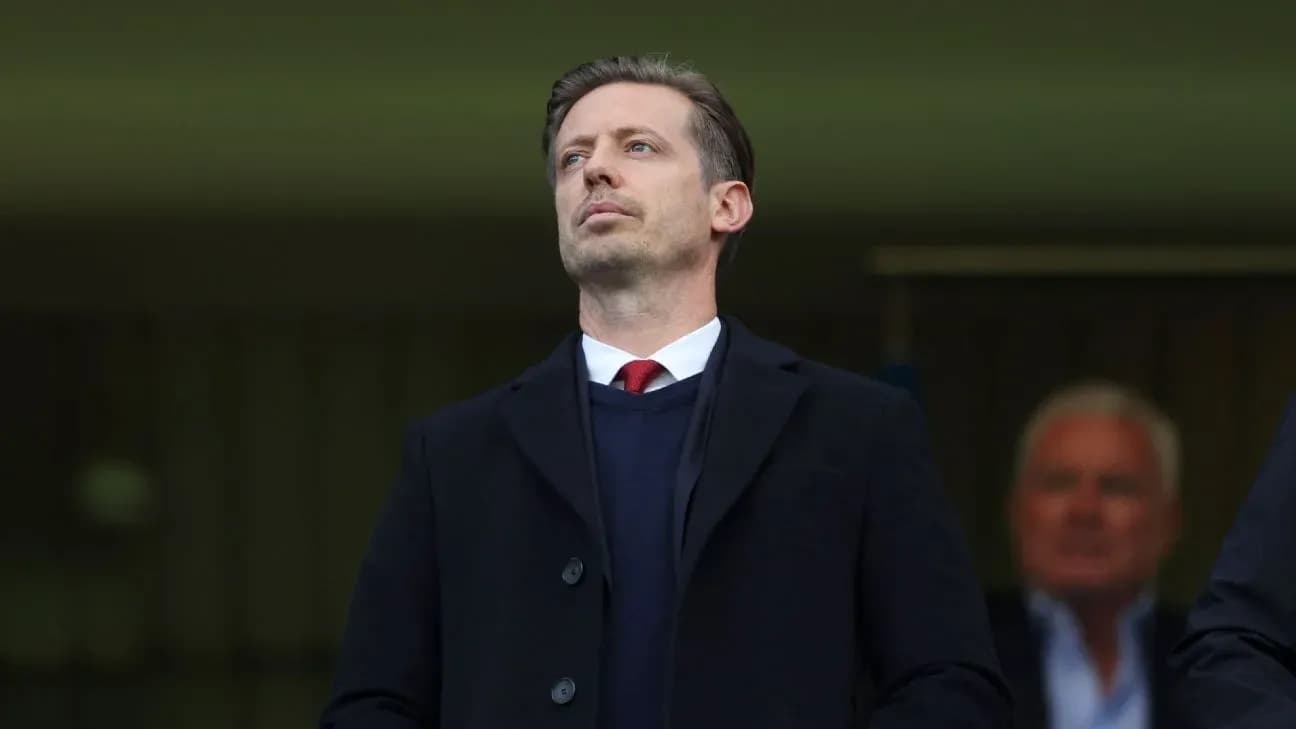
Liverpool Faces Uncertainty After Michael Edwards' Departure
Liverpool have been here before: a summer of change, questions swirling around Anfield, and a familiar name walking out of the door.
This time, it is Michael Edwards again — but under very different circumstances.
Edwards walks, FSG left exposed
Edwards, the architect of Liverpool’s modern recruitment era and now former chief executive officer of football for Fenway Sports Group, has resigned with immediate effect, a year before his contract was due to end.
He returned to FSG in 2024 not to rebuild Liverpool’s squad, but to build something bigger: a multi-club empire under the American ownership. His brief was clear. Identify, assess and help acquire a second club to sit alongside Liverpool in the FSG portfolio.
That project stalled. Then it stopped.
With no meaningful progress and FSG ultimately shelving plans to add another team earlier this year — despite looking at more than 20 possibilities, including Bordeaux and Málaga — Edwards has decided he has taken it as far as it can go. The frustration over that lack of movement, sources say, proved decisive.
FSG, for their part, tried to keep him. They failed.
Power shifts back to Boston
His exit leaves a vacuum at the top of Liverpool’s football structure at a time when the club can least afford drift. Into that space steps FSG president Mike Gordon, who is expected to resume a more hands-on role in the day-to-day running of Liverpool.
Gordon has long been the key link between Boston and Merseyside, the quiet figure behind the scenes during Liverpool’s climb back to the summit of English and European football. His re-emergence signals that ownership knows this is a delicate moment.
Publicly, FSG framed Edwards’ departure as “the culmination of a planned transition following the completion of key strategic priorities.” Privately, the story is more jagged: an ambitious multi-club plan that never quite left the runway, and a senior executive unwilling to sit through another holding pattern.
A club in transition on every front
On the pitch, Liverpool are already in flux. The dugout has changed hands again, with Arne Slot gone and former AFC Bournemouth manager Andoni Iraola now installed as head coach.
Above him, uncertainty lingers. Sporting director Richard Hughes — the man who appointed Iraola and whose contract runs until 2027 — is being linked with Saudi Pro League side Al Hilal. His long-term future at Anfield is no longer taken for granted.
Layer Edwards’ departure on top of that and the picture becomes clear: this is not a tweak to the model, it is a full reset of the football operation that helped deliver the Premier League title in 2025.
The machinery that once ran with ruthless efficiency is being stripped back and rebuilt while the club tries to remain competitive at the very top.
Edwards’ legacy and unfinished business
Edwards’ influence on Liverpool’s modern era is not in doubt. As sporting director under Jürgen Klopp until 2022, he helped reshape recruitment, data use and decision-making at Anfield, laying the groundwork for a side that could outthink and outspend more powerful rivals.
His second stint was supposed to be different: less about buying full-backs and forwards, more about buying entire clubs. That vision has not survived contact with reality.
In his parting statement, Edwards struck a measured tone. He called it “a privilege” to return to FSG and Liverpool “at such an important moment,” and insisted he leaves believing the club is “in a strong position, with outstanding people, a clear direction and the foundations in place for continued success.”
He also acknowledged the broader project “evolved differently” from the original plan, while expressing pride in the range of options his team had presented to ownership.
It was a polite way of saying the ideas were there. The deals weren’t.
He signed off with thanks to Mike Gordon, John Henry, Tom Werner, everyone at FSG and Liverpool, and, pointedly, the supporters “whose passion makes this club so special.” He will, he said, “always be grateful to have been part of its story.”
What comes next?
The immediate question is simple: who now shapes Liverpool’s long-term football strategy?
With Gordon stepping in, Iraola settling, Hughes’ future in the air and the multi-club vision mothballed, Liverpool find themselves at a crossroads not of tactics or transfers, but of identity at boardroom level.
They have navigated turbulence before and found a way to turn it into trophies. The difference this time? The man who once helped them chart that course has chosen to step off the ship.
Anfield will soon reveal whether the foundations Edwards talks about are as solid as he believes, or whether this is the first crack in a model that once looked unbreakable.