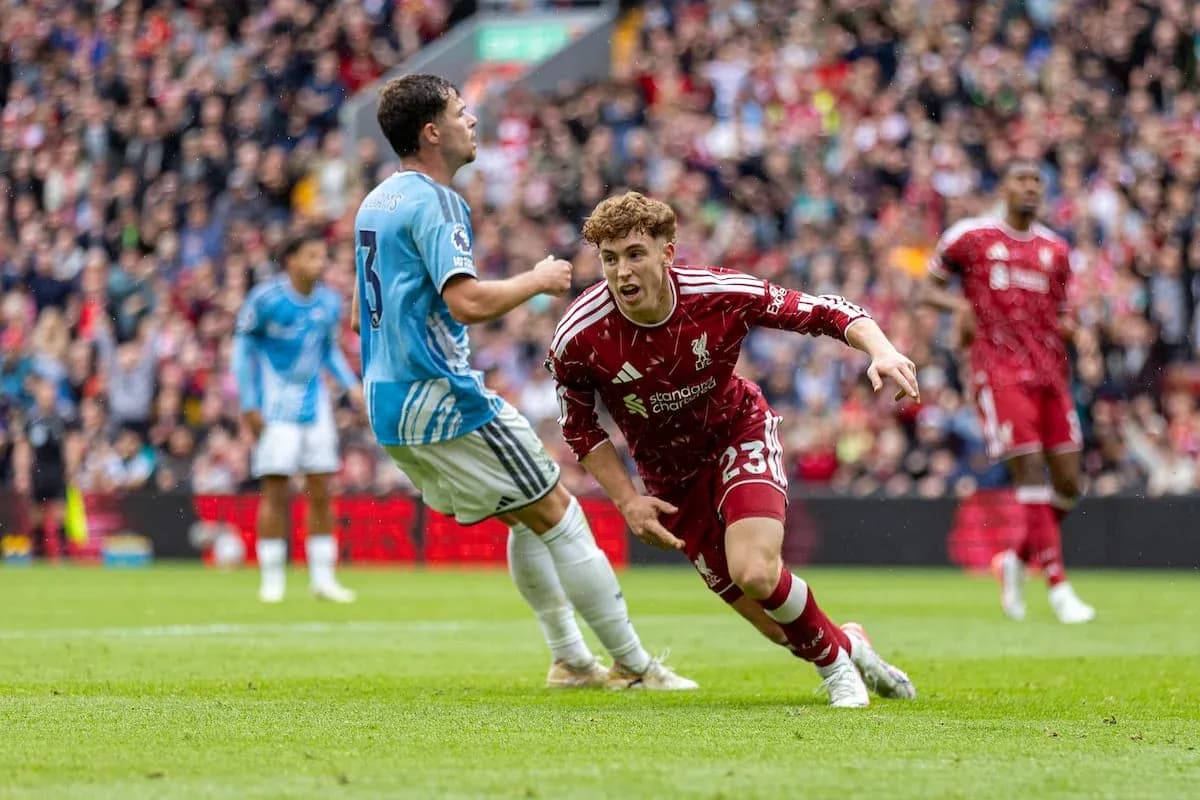
Liverpool and Nottingham Forest Draw 2-2: Tactical Insights
The afternoon at Anfield closed with a 2–2 draw that felt less like a settled argument and more like the opening chapter of two evolving stories. After two rounds of the Premier League’s 2026 season, Liverpool sit 13th with 2 points, Nottingham Forest 15th with 1, both winless but already revealing clear tactical identities.
I. The Big Picture – Systems, rhythm and early-season DNA
Andoni Iraola has wasted no time imprinting his 4-2-3-1 on Liverpool. Across their 2 league matches so far, Liverpool have drawn both, scoring 4 and conceding 4 overall. At Anfield they have played 1, drawn 1, with 2 goals scored and 2 conceded. The goal difference is perfectly balanced at 0, but the performances hint at a side committed to front‑foot football, even if the structure behind the ball is still bedding in.
The line-up against Forest crystallised that intent. Alisson behind a back four of Jeremie Frimpong, J. Jacquet, Virgil van Dijk and Milos Kerkez gave Liverpool pace and aggression on the flanks, with Van Dijk as the stabilising reference point. Ahead of them, Dominik Szoboszlai and Alexis Mac Allister formed a double pivot tasked with both progression and counter-press, while an attacking three of Cody Gakpo, Florian Wirtz and Víctor Muñoz floated behind Alexander Isak.
Forest, under Oliver Glasner, arrived in their now-familiar 3-4-2-1, a shape designed to compress space centrally and spring quickly into the channels. Their league numbers underline the balancing act they are still trying to master: in total this campaign they have played 2, lost 1 and drawn 1, with 2 goals scored and 3 conceded overall. At home they have played 1, lost 1, scoring 0 and conceding 1; on their travels they have played 1, drawn 1, scoring 2 and conceding 2. The overall goal difference stands at -1 (2 for, 3 against), a narrow deficit that reflects a side competitive in every phase but not yet ruthless.
II. Tactical Voids – Absences and discipline
Both managers were forced to navigate notable absences. Liverpool’s injury list is already long: Stefan Bajcetic (hamstring), Conor Bradley (knee), Federico Chiesa (back), Hugo Ekitike (Achilles), Joe Gomez (injury) and G. Leoni (knee) all missed out, while Harvey Elliott was omitted by coach’s decision. The cumulative effect is significant. Without Chiesa and Ekitike, Iraola’s bench lacks a proven wide scorer and an alternative penalty-box presence, which in turn raises the creative burden on Gakpo and Wirtz and the physical load on Isak.
Forest travelled without Ibrahima Sangaré (calf) and N. Savona (knee). Sangaré’s absence is particularly acute in a midfield built to duel and disrupt. In a system that leans heavily on the double pivot to shield a back three, losing that kind of ball-winner forces Glasner to lean harder on Xaver Schlager and James McAtee for defensive work, potentially diluting their ability to support transitions.
Disciplinary trends add another layer. Liverpool’s season card map shows a spread of yellow cards through the middle and late phases of matches: 28.57% between 16–30 minutes, 28.57% between 46–60, 14.29% between 61–75 and another 28.57% between 76–90. That late‑game cluster hints at a team that continues to press aggressively deep into matches, risking bookings to sustain tempo. Forest’s yellows are front‑loaded: 25.00% in 16–30, 25.00% in 31–45, and 50.00% in 46–60. Glasner’s side often starts and restarts halves on the edge, which can be a weapon in intensity but a liability in game management.
Individually, Ola Aina embodies Forest’s edge. Across the season he has 2 yellow cards in 2 appearances, operating as a high‑impact wing‑back who engages duels early and often. For Liverpool, a cluster of defenders already on one yellow – Frimpong, Kerkez and Ronald Araújo – suggests a back line that defends on the front foot, happy to step in and accept risk.
III. Key Matchups – Hunter vs Shield, the engine room, and the flanks
The “Hunter vs Shield” duel here is layered rather than singular. Liverpool’s attack has produced 4 goals in total across 2 league games, with an average of 2.0 goals per match both at home and overall. Isak, Gakpo and Muñoz each have 1 league goal so far, while Wirtz and Ryan Gravenberch have already contributed assists. This is not a one‑man attack; it is a rotating carousel of threats.
Forest’s shield has been mixed. They have conceded 3 in total, 1.0 per game at home and 2.0 per game away. The back three of Murillo, Nikola Milenkovic and Cunha is physically imposing, but the system naturally invites pressure into the half‑spaces, where Liverpool’s trio between the lines thrive. Gakpo, with 1 goal and 1 assist in the league and 5 key passes, will repeatedly test the channels either side of Milenkovic, dragging the Forest line into uncomfortable lateral movements.
In the engine room, Szoboszlai and Mac Allister faced Schlager and McAtee. Szoboszlai’s role as a vertical passer and late runner intersects with Forest’s tendency to pick up yellows between 46–60 minutes – the period when his surges can force tired legs into desperate challenges. Schlager’s job is to disrupt those rhythms, while McAtee must balance his own forward impulses with the need to track Wirtz, who has already provided 1 assist and 2 shots on target this season.
Further ahead, Morgan Gibbs‑White is Forest’s creative axis. With 1 goal, 1 assist, 4 shots and 8 successful dribbles in the league, he is the visitor most capable of unpicking Liverpool’s structure. His duel with Van Dijk is as much about space as contact: if Gibbs‑White can draw Liverpool’s captain into wide or higher zones, lanes may open for Dan Ndoye and Igor Jesus to attack the inside channels behind the full-backs.
Out wide, Aina versus Kerkez offers one of the game’s most combustible matchups. Aina’s 7 dribble attempts and 4 successes so far show his willingness to attack aggressively; Kerkez, who has already blocked 3 shots and made 4 tackles this season, responds with his own brand of combative defending. On the opposite flank, Frimpong’s overlapping energy and 4 key passes in the league will test Neco Williams’ defensive concentration and fitness.
IV. Statistical Prognosis – Where this draw leaves them
Following this result, Liverpool’s season picture remains one of controlled chaos: 2 draws from 2, 4 goals scored and 4 conceded in total, no clean sheets and no matches without scoring. Their penalty record is pristine so far – 1 taken, 1 scored in total – underscoring technical composure in key moments. The structure is not watertight, but the attacking mechanisms are already humming.
Forest leave Anfield with a point that fits their statistical profile: competitive, dangerous, but still conceding slightly more than they score. In total this campaign they have failed to keep a clean sheet and have yet to win, but they have also scored 2 in their only away outing, matching the 2 they conceded. Their own penalty record stands at 1 taken, 1 scored in total, a reminder that Gibbs‑White and company can punish rash defending in the box.
Tactically, the draw underlines the trajectory of both sides. Liverpool look like a high‑ceiling project still learning its defensive distances but already bristling with multi‑layered attacking threats. Forest appear as a well‑drilled, tactically coherent unit whose back three and double pivot can frustrate elite opposition, but who must tighten their away defending if they are to turn gritty performances into wins.
The story of this 2–2, then, is not of two mid‑table sides cancelling each other out, but of two evolving systems crossing paths early in the season – Liverpool’s expansive 4‑2‑3‑1 probing the seams of Forest’s 3‑4‑2‑1, and both leaving with enough encouragement, and enough warning signs, to shape the weeks ahead.