Manchester City’s Tactical Mastery Over Coventry in 1-0 Victory
Etihad Stadium felt less like a battleground and more like a laboratory for control as Manchester City edged Coventry 1–0, a scoreline that flattered the visitors but underlined the champions’ evolving, almost minimalist dominance. Following this result, City sit top of the Premier League with 9 points from 3 matches, their overall goal difference of +5 built on 7 goals for and 2 against. Coventry remain bottom with 0 points from 3, a stark overall goal difference of -5 after failing to score in any of their league outings.
I. The Big Picture – City’s new spine, Coventry’s survival blueprint
City’s season-long profile is already clear. Overall, they have won all 3 fixtures, scoring 2.3 goals per game while conceding only 0.7. At home, the numbers are more restrained but still commanding: 3 goals scored and 1 conceded across 2 matches, an average of 1.5 scored and 0.5 conceded. It speaks to a side happy to suffocate rather than overwhelm when required.
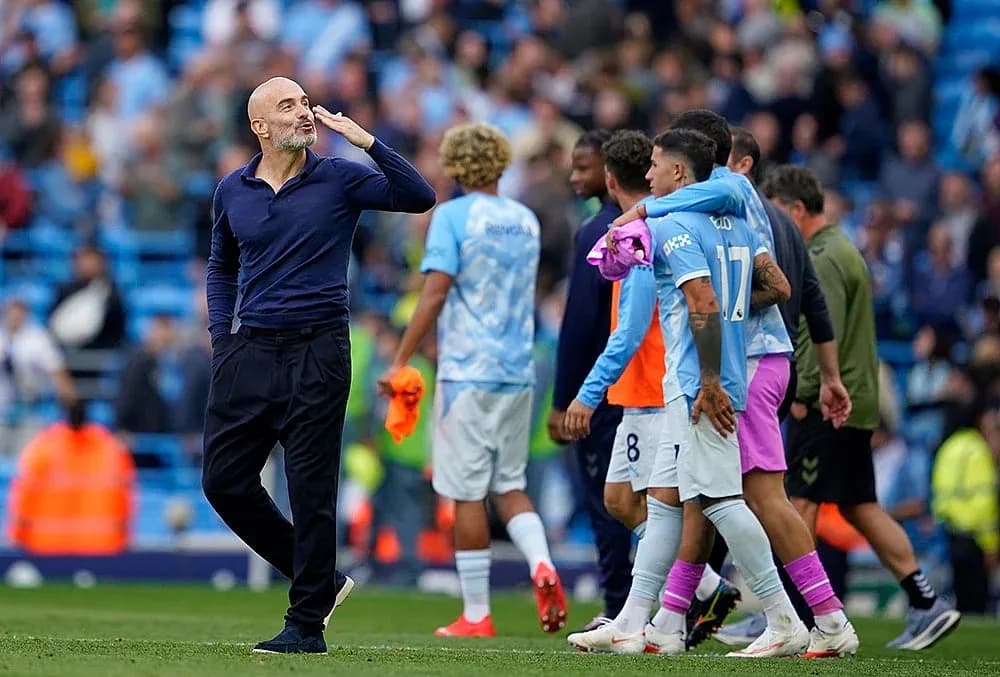
Enzo Maresca’s 4-2-3-1 here crystallised that identity. G. Donnarumma anchored a back four of A. Khusanov, Rúben Dias, M. Guéhi and J. Gvardiol – a defensive line built for both duels and distribution. Ahead of them, E. Fernández and E. Anderson formed a double pivot designed to keep City’s rest defence intact while feeding an aggressive second line of A. Semenyo, R. Cherki and I. Ndiaye behind E. Haaland.
Coventry arrived at the Etihad with no goals and 5 conceded overall, averaging 0.0 scored and 1.7 conceded per game, and yet their away pattern is even starker: 0 goals scored and 4 conceded across 2 trips, an away average of 0.0 for and 2.0 against. Frank Lampard’s response was pragmatic. The 3-4-2-1 – with C. Rushworth behind a back three of A. Amenda, B. Thomas and E. Pinnock – was less about front-foot pressing and more about compressing the central lane. M. van Ewijk and J. Dasilva were tasked with shuttling wide, while the central band of F. Onyeka and M. Grimes screened in front of the defence. J. Rudoni and E. Mason-Clark floated behind T. Awoniyi, whose job was to turn rare clearances into relief.
II. Tactical Voids – Absences and discipline
Both managers had to navigate key absences. For City, J. Doku’s calf injury removed the most direct wide dribbler from Maresca’s options, nudging the team further towards an interior-heavy structure where Semenyo and Ndiaye tucked in rather than hugging the touchline. The knock-on effect was a heavier creative burden on Cherki between the lines.
Coventry’s list of missing players was longer and more structurally damaging. Y. Gboho (transfer negotiations), K. Kesler-Hayden (muscle injury), S. Mfuni (loan agreement), L. Woolfenden (knee injury) and H. Wright (muscle injury) stripped Lampard of depth in defence and attack. Woolfenden’s absence, in particular, meant the back three leaned heavily on E. Pinnock’s experience, while the lack of Wright’s running power limited Coventry’s ability to transition quickly when they did win the ball.
Disciplinary trends framed the risk profile. Heading into this game, City’s yellow cards were spread late – 25.00% of their cautions arriving in each of the 31–45, 46–60, 76–90 and 91–105 minute ranges – a sign of a side that rarely panics early but is willing to break rhythm to protect a lead. Coventry’s bookings were more front-loaded: 50.00% of their yellows came in the 16–30 minute window, with another 25.00% between 76–90 and 25.00% from 91–105, suggesting emotional spikes when the game either starts to run away or reaches its tense closing stages. Neither side had seen a red card in the league, and neither had taken – or missed – a penalty, so there was no spot-kick narrative to lean on.
III. Key Matchups – Hunter vs Shield, Engine Room battles
The headline duel was always going to be E. Haaland against Coventry’s defensive shield. Haaland’s league profile is brutal: 3 goals from 3 appearances, with 13 shots and 8 on target, averaging more than 4 shots per match and winning half of his 20 duels. He is less a striker than a gravitational force. Coventry’s entire plan revolved around shrinking his space.
The back three, led by E. Pinnock, tried to compress the box and push Haaland away from the six-yard line. But the problem with focusing on the “hunter” is that City’s creators thrive in the vacuum. R. Cherki, already on 2 goals and 2 assists this season with 10 key passes and a 92% pass accuracy, drifted into pockets between Coventry’s midfield four and back three, constantly asking whether Onyeka and Grimes could track him without leaving Fernández free.
On the flanks, the “engine room” extended beyond the centre. A. Semenyo, who has 2 assists and 6 key passes in the league, operated as a hybrid winger–interior runner, repeatedly attacking the half-space outside B. Thomas. His 15 dribble attempts this season show his willingness to carry City up the pitch, and his 36 duels overall underline how much of the dirty work he does without the ball.
Behind them, Gvardiol’s role was quietly decisive. With 1 goal, 1 assist, 174 passes and 7 tackles this season, plus 1 blocked shot, he is as much a deep playmaker as a defender. His diagonal balls into Semenyo and switches into Ndiaye stretched Coventry’s compact block sideways, forcing their wing-backs to choose between pressing high or protecting the back post.
For Coventry, the counterpunch had to come through E. Mason-Clark and J. Rudoni finding Awoniyi early. But with no league goals overall and having failed to score in all 3 matches, Coventry’s forwards have been starved of both service and confidence. Against a City side that has kept 1 clean sheet at home and concedes only 0.5 goals per game at the Etihad, the margin for error was almost non-existent.
IV. Statistical Prognosis – City’s controlled strangulation
From a statistical lens, this fixture always leaned heavily towards a City win, but the nature of that win was telling. City’s overall attacking average of 2.3 goals per game suggested they could have run away with it; Coventry’s overall defensive record of 1.7 goals conceded per game and 2.0 on their travels pointed to vulnerability. Yet the 1–0 scoreline spoke to City’s preference under Maresca for territorial and emotional control rather than chaos.
Coventry’s inability to score – 0.0 goals per game overall, 0.0 at home and 0.0 on their travels – meant that once City found a breakthrough, the contest became a question of game management rather than risk. City’s structured 4-2-3-1, with Cherki orchestrating, Semenyo and Ndiaye rotating, and Haaland pinning the back line, created enough pressure to justify the lead without overextending.
Following this result, the trajectories feel brutally divergent. City look every inch a side built for a long title defence, their numbers hinting at an attack that can still climb a gear and a defence already operating at near-elite levels. Coventry, rooted to 20th with 0 points and no goals, must turn their defensive grit into something more ambitious or risk spending the season surviving rather than competing. At the Etihad, they survived the scoreline; the deeper numbers suggest that, for now, that is the best they can hope for against a machine as finely tuned as Manchester City.