Manchester City Faces Uncertain Future After Rodri's Surgery
Manchester City stand at a crossroads.
Ten years of Pep Guardiola have gone, the treble glow has faded, and the squad that defined an era is being quietly dismantled. This is no gentle refresh. It is surgery.
Four starters from that 2022-23 treble-winning side – Manuel Akanji, Nathan Ake, Bernardo Silva and John Stones – have departed this summer. In their place, City have pushed £116m across the table for Elliot Anderson and handed a pathway to 17-year-old Jeremy Monga. The faces are changing. The ideas are changing. The stakes are not.
And hanging over all of it is Rodri.
Rodri: centrepiece under the knife
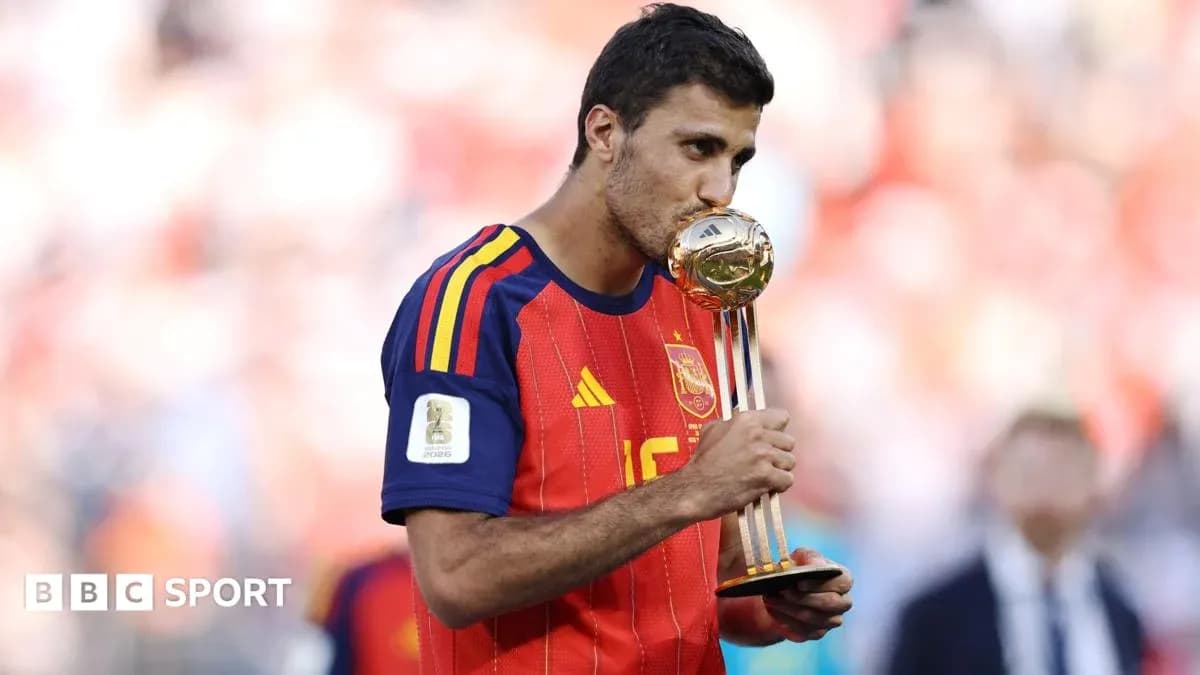
Fresh from lifting the World Cup as Spain’s captain and taking home the Golden Ball, the 30-year-old now heads for back surgery on Monday with only a year left on his contract and a storm of speculation swirling around him.
No-one at City is quite sure how long he will be out. What is clear is how Enzo Maresca views him. In his first news conference as City manager, he did not bother to dress it up.
“I think every manager wants to have Rodri because he is a top player,” he said. “But now, surgery on Monday... he needs a holiday... he needs to rest and recover and then he will be back with us.”
That is the plan. Keep him. Build around him. Treat one of the best players in world football as non-negotiable.
But outside the walls of the training ground, the noise is different. Reports in Spain suggest Real Madrid are “operating on the basis” that Rodri will join them. The question for City is brutally simple: do they cash in when he returns to fitness, or do they dig in and follow Maresca’s line?
The answer will shape not just the midfield, but the entire identity of this new City.
Life with Rodri – and without him
When Rodri came back from his anterior cruciate ligament injury last season, there were doubts. Could he really return to the Ballon d’Or-winning standards of his peak? Guardiola never flinched. Last October, the man Maresca has now replaced said: “In the World Cup, he will be the best Rodri, and next season he will be the best Rodri.”
He was right on the first part. Rodri dominated the World Cup, orchestrated Spain’s triumph and walked away with the Golden Ball. He did it playing the game that Maresca now wants to refine: positional play at its most ruthless.
Maresca sees football like chess. He talks about it that way.
“The most important is positional play and strategy,” he said. “For a coach, it’s important to have the mentality of a chess player: develop a plan, study counter-moves, choose the arrangement of the pieces.”
His preferred on-the-ball shape is a 3-2-2-3. That structure lives or dies on players who understand space, risk and timing. This is where Rodri becomes more than a holding midfielder. He becomes the hinge.
During the World Cup, he dropped into the backline when Aymeric Laporte stepped forward, sliding seamlessly between centre-back and pivot. Most of the time he anchored the midfield. When space opened, he strode into it. He didn’t just occupy zones; he manipulated them.
City under Maresca with Rodri is one thing. Without him, it is something else entirely.
Maresca’s moving pieces
Maresca’s sides breathe through rotations. The 3-2-2-3 is the end picture, not the starting point. His innovation lies in how he gets there.
In City’s treble season, when Maresca worked as Guardiola’s assistant, John Stones was the key twist. City defended as a 4-4-2, then morphed on the ball as Stones stepped out from centre-back to join Rodri in a double pivot. From there, the whole structure unfolded.
At Chelsea, Maresca experimented again. Moises Caicedo started on the teamsheet as a right-back, defended in a conventional back four, then slid into one of the holding midfield roles when Chelsea attacked in that familiar 3-2-2-3. Same picture. Different route. Different piece.
He has done it repeatedly: Stones into holding midfield, Caicedo into full-back, Marc Cucurella into attacking midfield. He spots roles players can fill before they realise it themselves.
This is where Elliot Anderson and potential recruits like Ayyoub Bouaddi enter the frame. Anderson, signed for a huge fee, is one contingency. Bouaddi, the 18-year-old Lille midfielder who impressed for Morocco at the World Cup and is being monitored by City, could be another future piece.
None of them, at this stage, offer Rodri’s blend of positioning, tempo control and risk management. Few players on the planet do. It took Rodri years, under Fernandinho’s guidance, to fully master that environment. Expecting Anderson or a teenager like Bouaddi to replicate it immediately would be fantasy.
But Maresca does not need clones. He needs players who can be moved, redefined, repurposed.
Bigger squad, new philosophy
One of the quiet revolutions under Maresca will be numbers. Guardiola preferred a tight group, a smaller squad he could trust and drill to perfection. Maresca looks more like a coach who wants options, more pieces on the board, more ways to form that 3-2-2-3 from different starting points.
That approach gains power if Rodri stays. With him, City have a conductor who understands every nuance of positional play, someone who can anchor the structure while others learn it. Without him, the learning curve steepens, but the coach’s track record of reimagining players offers some protection.
The reality is stark. City will look better with Rodri. They will look more coherent, more controlled, more like the side that has dominated England and Europe. But this summer has already shown that nothing at the Etihad is untouchable anymore.
The treble team has been broken up. A new manager, a new model and a new squad are taking shape. Whether Rodri stands at the centre of that board, or Madrid prise him away, will tell us how radical this new era is willing to be – and how quickly Maresca can turn theory into another winning machine.