Manchester City: Navigating a New Era with Rodri's Future at Stake
Manchester City stand at a crossroads.
Changing a manager after a decade would be seismic in any circumstances. Doing it while ripping out the spine of a Treble-winning side turns it into open‑heart surgery.
Four pillars of that 2022-23 triumph – Manuel Akanji, Nathan Ake, Bernardo Silva and John Stones – have gone. In their place, City have pushed £116m on to the table for Elliot Anderson and handed the keys to part of their future to 17-year-old Jeremy Monga. This is not a gentle refresh. It is a reset.
And the most important decision of all may not even have been made yet.
Rodri: centrepiece or final cash-out?
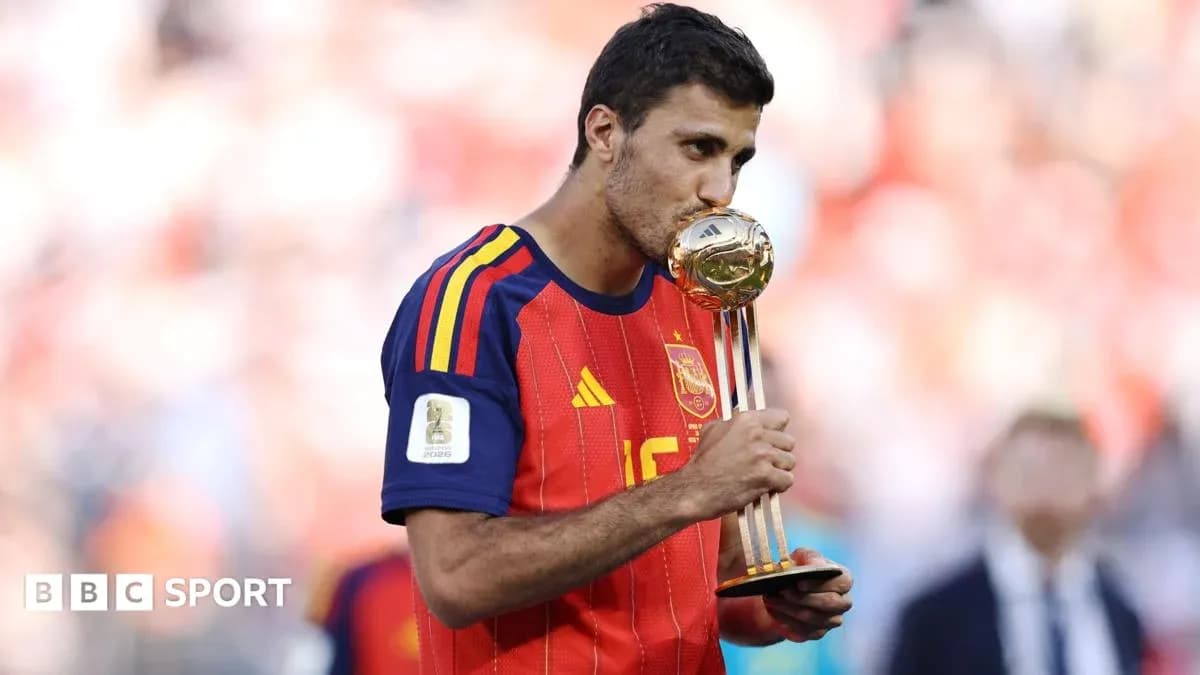
On Monday, Rodri goes under the knife for back surgery, fresh from captaining Spain to World Cup glory and collecting the Golden Ball as the tournament’s outstanding player. He does so with only a year left on his contract and a storm of noise around his future.
Real Madrid are reported to be “operating on the basis” that he will join them. City, publicly at least, are not playing that game.
Enzo Maresca, sitting in front of the cameras for the first time as City manager, did not dance around the subject.
“I think every manager wants to have Rodri because he is a top player,” he said. “But now, surgery on Monday... he needs a holiday... he needs to rest and recover and then he will be back with us.”
That line was as clear as managers tend to get. The plan, from Maresca’s side, is simple: keep Rodri, build around him, and let others adapt to the new world.
But plans in modern football live and die on contract lengths and transfer strategies. With a year left on his deal and Madrid circling, City face a brutal calculation. Cash in when he returns to fitness and avoid losing an asset of this size for nothing, or back Maresca’s stance and trust that the player who has become the game’s most complete holding midfielder will commit to a new project.
The sporting argument is obvious. There is no like-for-like replacement for Rodri on the market. There may not be one in the sport.
Maresca’s board, Rodri’s brain
To understand why Maresca is so keen to keep him, you have to understand the way he sees the game.
He is a disciple of positional play, a coach who talks about football like a grandmaster talks about chess.
“There are a lot of similarities,” he has said. “The most important is positional play and strategy. For a coach, it's important to have the mentality of a chess player: develop a plan, study counter-moves, choose the arrangement of the pieces.”
On the board he lays out, the picture is familiar but subtly different. Maresca’s teams typically morph into a 3-2-2-3 with the ball, using rotations and clever movements to arrive in that structure in unexpected ways. The shape is the same; the routes into it are not.
In that system, Rodri is not just a holding midfielder. He is the hinge.
During the World Cup, he repeatedly dropped into the back line when Aymeric Laporte stepped out with the ball, then slid back into midfield once Spain had established control. His default zone was in front of the defence, but when space opened up he stepped into it, dictated tempo and killed games with positioning as much as passing.
Maresca has already seen the power of that profile up close. In City’s Treble season, when he worked as Pep Guardiola’s assistant, it was Stones who stepped from centre-back into midfield alongside Rodri, turning a defensive 4-4-2 into that now-familiar 3-2-2-3 in possession. The idea was simple: get an extra brain next to Rodri, then let them rule the middle of the pitch.
At Chelsea, Maresca tweaked the idea again. Moises Caicedo started at right-back in a back four out of possession, then slid into one of the two holding roles when they attacked. The pattern stayed; the names on the board changed.
That is why Rodri matters so much. He reads space, speed and risk at a level Anderson and any future signings will need time to reach. It took him seasons under Fernandinho’s guidance to fully master the demands of Guardiola’s system. He is now the one other players learn from.
Remove that from Maresca’s board and you do not just lose a world-class midfielder. You lose the reference point for everyone around him.
Anderson, Bouaddi and the contingency plan
City know they cannot walk into a new era without safety nets. One of them is already in the building.
Anderson arrives with a hefty price tag and the expectation that he can, in time, anchor or at least share responsibility in that double pivot. Another potential piece is Ayyoub Bouaddi, the 18-year-old Lille midfielder City are monitoring after an eye-catching World Cup with Morocco.
If Rodri stays, Anderson and any new arrival can be eased in around him, learning the geometry of Maresca’s football from the man who sees it most clearly. If he goes, the process accelerates overnight.
Maresca has shown he can improvise. He has a track record of seeing roles in players that others have not yet explored: Stones into holding midfield, Caicedo into full-back, Marc Cucurella pushed into attacking midfield. He is not afraid to redraw a player’s career on a tactics board.
That adaptability will be vital if City are forced into a post-Rodri world. The shape will remain a 3-2-2-3 with the ball, the rotations will still spin, but the identities of those two at the base – the ones who must sense danger before it appears – would change.
City would look different. They might even look more chaotic for a while. But they would not be without ideas.
Bigger squad, new era
One clear departure from the Guardiola years is already emerging. Maresca wants more pieces on his board.
Where Guardiola often preferred a smaller, tightly-knit squad, trusting a core of players to absorb huge minutes, the new manager is open to a broader group. That approach, whether Rodri stays or goes, should give him more combinations to test, more partnerships to trial, more chances to land on a formula that works.
City are in flux, but not in freefall. They have lost experience, certainty and some of the most reliable performers of the club’s modern history. In return, they have gained a manager with a clear blueprint and the courage to move players into uncomfortable, transformative roles.
The biggest question now is whether that blueprint will still be built around the quiet Spaniard who has come to define control in midfield – or whether Maresca’s first great act at Manchester City will be to rebuild his team’s brain from scratch.