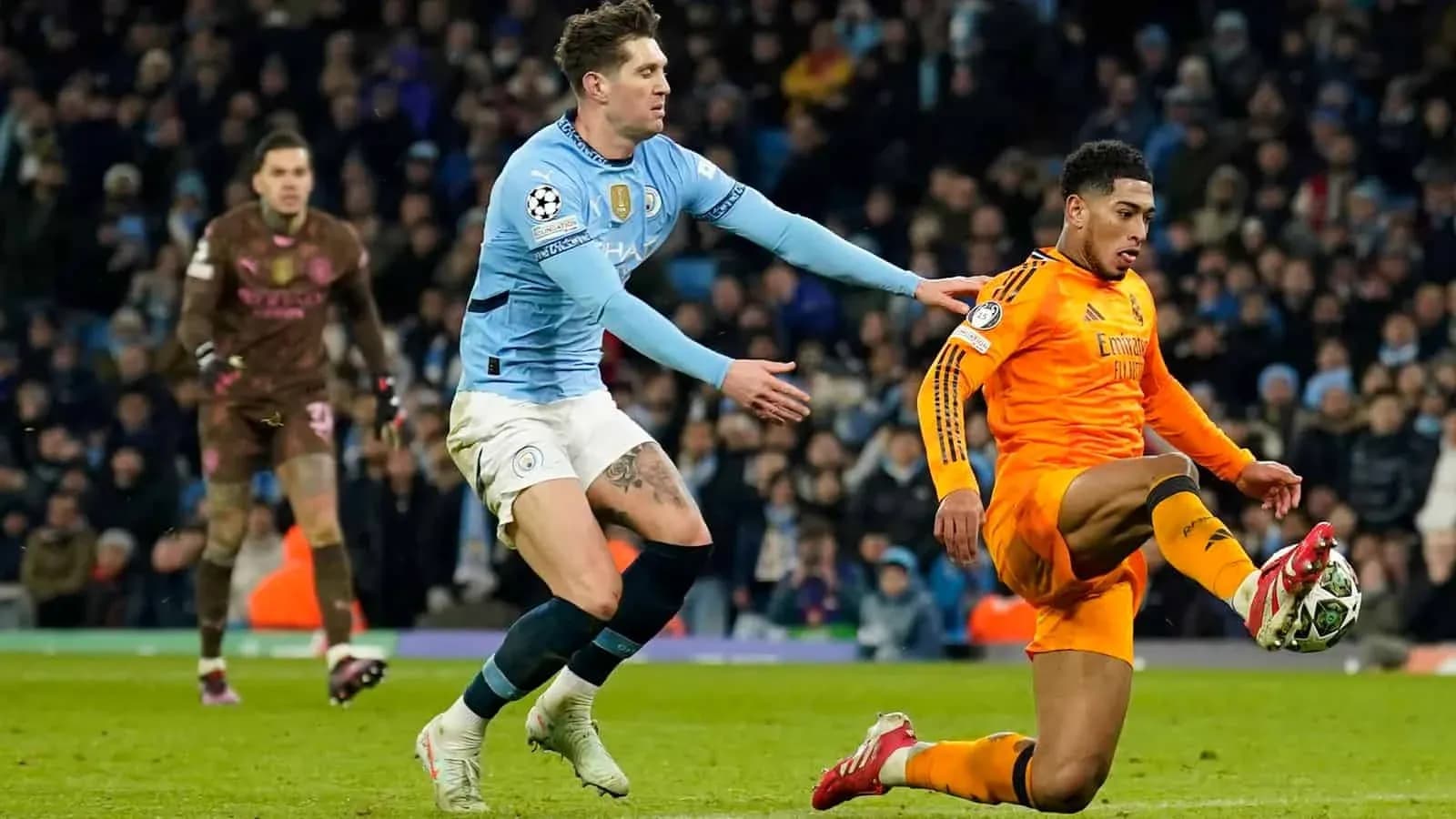
Manchester City vs Real Madrid: UEFA Champions League Tactical Analysis
Etihad Stadium, Manchester – Squad analysis review of a UEFA Champions League 1/8 final second leg between 8th-ranked Manchester City and 9th-ranked Real Madrid, finished 1–2 in regular time (1–1 at the break).
1. Tactical setups and on‑pitch structure
Manchester City (4-2-3-1)
Starters:
- GK: Gianluigi Donnarumma (25)
- Back four: Rayan Aït-Nouri (LB, 21), Rúben Dias (LCB, 3), Abdukodir Khusanov (RCB, 45), Matheus Nunes (RB, 27)
- Double pivot: Rodri (16), Bernardo Silva (20)
- Line of three: Jérémy Doku (left, 11), Tijjani Reijnders (central, 4), Rayan Cherki (right, 10)
- Striker: Erling Haaland (9)
City’s 4-2-3-1 here is one of several shapes they have used overall this season (4-1-4-1 is still their most common, played 4 times; 4-3-3 three times; 4-2-3-1 twice before this match). The structure emphasises:
- Build-up: Rodri as the primary outlet from the back, Bernardo dropping alongside to create a 2+2 base with the centre-backs.
- Width: Doku and Cherki holding wide positions to isolate full-backs, with Aït-Nouri overlapping on the left and Nunes tucking or overlapping on the right.
- Central occupation: Reijnders between the lines to connect into Haaland, who mainly pins the centre-backs.
Defensively, City rely on a medium-to-high block with the double pivot screening. With 14 goals conceded overall this season in 10 Champions League games (average 1.4 per match), they are solid but not elite at this level, particularly away from home (9 conceded in 5 away games).
Real Madrid (4-4-2)
Starters:
- GK: Thibaut Courtois (1)
- Back four: Fran García (LB, 20), Dean Huijsen (LCB, 24), Antonio Rüdiger (RCB, 22), Trent Alexander-Arnold (RB, 12)
- Midfield four: Arda Güler (LM, 15), Aurélien Tchouaméni (LCM, 14), Thiago Pitarch (RCM, 45), Federico Valverde (RM, 8)
- Front two: Vinicius Júnior (7), Brahim Díaz (21)
Madrid’s 4-4-2 has been their most used structure overall this season (5 games in this shape, ahead of 4-2-3-1 and 4-3-3 with 3 games each). Key traits:
- Out of possession: Two compact banks of four, with Tchouaméni anchoring and Valverde/Güler shuttling wide-to-central.
- In possession: Often morphs into a 4-2-3-1/4-3-3: Valverde steps inside as a third midfielder, Vinicius pulls wide left, Brahim drifts off the front line.
- Transition threat: With 29 goals scored overall this season in 12 games (2.4 per match), Madrid are one of the most dangerous transition teams in the competition.
Defensively they match City in overall goals conceded (14 in 12 games, 1.2 per match), but with a slightly stronger home record and similar away vulnerability (9 conceded away).
2. Overall season profile and squad balance
Manchester City – overall this season (Champions League)
- Games: 10 (5 wins, 1 draw, 4 losses)
- Goals scored: 16 (1.6 per game)
- Home: 9 in 5 (1.8 per game)
- Away: 7 in 5 (1.4 per game)
- Goals conceded: 14 (1.4 per game)
- Home: 5 in 5 (1.0 per game)
- Away: 9 in 5 (1.8 per game)
- Clean sheets: 3
- Failed to score: 2
- Penalties: 1 taken, 1 scored (1 successful penalty)
City’s season picture is of a side that still dominates phases of play but has lost some defensive control away from home. The best home result (4–1) shows their ceiling when the structure clicks; the worst away defeat (3–0) underlines how exposed they can become when the press is broken.
Discipline:
- Yellow cards skew heavily towards late phases: 38.89% of their yellows arrive between 76–90 minutes, another 27.78% between 46–75 minutes.
- Red cards: 2 overall this season, with one of them belonging to Bernardo Silva in the competition.
This pattern suggests late-game stress and tactical fouling when chasing or protecting results.
Real Madrid – overall this season (Champions League)
- Games: 12 (9 wins, 0 draws, 3 losses)
- Goals scored: 29 (2.4 per game)
- Home: 15 in 6 (2.5 per game)
- Away: 14 in 6 (2.3 per game)
- Goals conceded: 14 (1.2 per game)
- Home: 5 in 6 (0.8 per game)
- Away: 9 in 6 (1.5 per game)
- Clean sheets: 4
- Failed to score: 1
Madrid combine one of the most prolific attacks in the tournament with a defence that is solid, especially at home. Their biggest home win (6–1) and away win (0–5) underline the ceiling of this squad when the front line is ruthless.
Discipline:
- Yellow cards: heaviest concentration between 46–60 minutes (25.93%) and in added time 91–105 (22.22%), suggesting increased aggression just after the break and in closing stages.
- Red cards: 3 overall, with a notable late-game pattern (one between 61–75, two between 91–105).
Compared to City, Madrid play on a thinner disciplinary edge but have largely managed to keep 11 men on the pitch in this tie.
3. Standings context and form
From the standings:
- Manchester City: 8th in the overall Champions League table, 16 points, goal difference +6 (15 scored, 9 conceded in that table snapshot). Description: “Promotion – Champions League (Play Offs: 1/8-finals)”.
- Real Madrid: 9th, 15 points, goal difference +9 (21 scored, 12 conceded). Description: “Promotion – Champions League (Play Offs: 1/16-finals)”.
City arrive as a high-ranking side with a strong group-phase output, but their overall this season numbers (16 scored, 14 conceded) show that knockout rounds have been more turbulent. Madrid’s standings data (21–12) and overall season data (29–14) both confirm a more explosive attack with a similar defensive record to City.
Recent form:
- City overall this season: “WDWWLWLWLL” – a run that includes both short winning streaks and back-to-back defeats, reflecting inconsistency.
- Madrid overall this season: “WWWLWLWLWWWW” – four straight wins coming into this phase, with only three losses in 12, showing resilience and a high floor of performance.
4. Key individual profiles and “Battle 1: Top scorer vs defence”
Real Madrid – Kylian Mbappé vs City’s defence
Kylian Mbappé is the competition’s top scorer:
- 13 goals, 1 assist in 9 appearances (8 starts), rating 8.03.
- 35 shots, 24 on target – high-volume, high-accuracy output.
- 3 successful penalties (no misses), plus 26 key passes and 40 dribble attempts (17 successful).
He did not start this game but was available on the bench. His presence in the squad fundamentally shapes City’s defensive plan, even if he is introduced late.
Against him stands a City defence that has:
- Conceded 14 goals overall this season (1.4 per game).
- Shown clear home vs away split in stability.
- Relies heavily on Rúben Dias as organiser, with Donnarumma as the last line.
In pure numbers, Mbappé’s 13-goal haul on his own is close to City’s entire Champions League goal tally (16). Any minutes he plays tilt the matchup in Madrid’s favour, especially against a City back line that has not been truly watertight in this campaign.
Manchester City – Erling Haaland vs Madrid’s defence
Erling Haaland:
- 8 goals in 10 appearances (9 starts), rating 7.3.
- 33 shots, 20 on target – similarly high volume to Mbappé, with slightly less efficiency.
- 1 successful penalty (no misses).
- Limited creative load (4 key passes, 0 assists), but elite penalty-box presence.
He faces a Madrid defence that:
- Has conceded 14 goals overall this season (1.2 per game), marginally better than City’s.
- Keeps a strong home defensive record but is more open away (9 conceded in 6).
In this match, Madrid’s centre-back pairing of Rüdiger and Huijsen, shielded by Tchouaméni, is built to contest Haaland physically and aerially. Over the whole season, Madrid’s defensive numbers and clean-sheet count (4 vs City’s 3) indicate a slightly more robust structure, and that edge was reflected in limiting City to a single goal on the night.
Battle 1 verdict: Mbappé, as top scorer of the competition, plus Vinicius and Brahim, represent a more diversified and explosive threat than City’s reliance on Haaland. Against defences that have conceded the same total (14), Madrid’s attack has clearly extracted more value. The statistical edge in this battle lies with Real Madrid.
5. “Battle 2: Playmaker vs Enforcer”
Here we contrast Real Madrid’s creative hub with the main disciplinary risk on the other side.
Madrid’s playmaking axis: Vinicius Júnior, Federico Valverde, Arda Güler
Vinicius Júnior (also the league’s top assist provider in this dataset):
- 5 goals, 4 assists in 12 appearances (11 starts), rating 7.38.
- 374 passes, 20 key passes, 80% accuracy.
- 43 dribbles attempted, 22 successful.
- Draws 21 fouls – a magnet for contact in advanced zones.
- 2 yellow cards, 1 penalty scored, 1 penalty missed (so 1 successful penalty from the spot).
Federico Valverde:
- 3 goals, 4 assists in 11 appearances (all starts), rating 7.3.
- 600 passes, 19 key passes, 89% accuracy.
- Strong defensive contribution: 17 tackles, 3 blocks, 12 interceptions.
- No yellow or red cards.
Arda Güler:
- 0 goals, 4 assists in 12 appearances (11 starts).
- 534 passes, 30 key passes, 88% accuracy.
- 13 tackles, 5 interceptions.
- 1 yellow card.
Collectively, this trio provides:
- 12 assists between them.
- High-volume, high-accuracy passing from midfield and wide areas.
- Dual-threat profiles (Valverde and Güler both contribute significantly off the ball).
City’s enforcer: Bernardo Silva and the wider card profile
Bernardo Silva stands out in the red-card table:
- 1 goal, 0 assists in 8 appearances (7 starts).
- 377 passes, 8 key passes, 92% accuracy – technically excellent.
- 13 tackles, 1 block, 4 interceptions.
- Disciplinary: 3 yellow cards and 1 red card overall this season in the competition.
City overall show:
- Yellow cards heavily concentrated late in games.
- 2 red cards in the competition, indicating a tendency to cross the line when under pressure.
Madrid’s own top card-holder in this dataset is Álvaro Fernández (Álvaro Carreras), with:
- 4 yellow cards in 8 appearances, but no reds.
- Strong defensive stats (23 tackles, 4 blocks, 9 interceptions), showing he is an aggressive but largely controlled defender.
Battle 2 verdict: Madrid’s playmaking unit (Vinicius–Valverde–Güler) combines creativity, ball retention and work rate at elite levels, underpinning their 29 goals overall this season. City’s main “enforcer” figure in the data, Bernardo Silva, walks a fine disciplinary line, with 4 cards including a red, even though his technical output is high. Statistically, Madrid hold the edge: they gain more from their creative trio than City gain from their primary disruptor, while managing to keep their own key creators (Vinicius, Valverde, Güler) relatively clear of red cards.
6. “Battle 3: The Void” – Injuries and their replacements
This tie was shaped by notable absences on both sides.
Manchester City absences
- J. Gvardiol – Missing Fixture (Broken Leg)
- S. Nypan – Missing Fixture (Inactive)
- R. Lewis – Questionable (Ankle Injury), but named on the bench.
Impact:
- Gvardiol’s absence removes a left-footed, ball-playing defender who would naturally complement Rúben Dias. In his place, City fielded Abdukodir Khusanov alongside Dias, with Aït-Nouri at left-back.
- Without Gvardiol’s progressive passing and defensive presence, City rely more heavily on Dias and Rodri to initiate build-up and cover transitions. That slightly reduces their margin for error against Madrid’s counter-attacks.
- Rico Lewis, though on the bench and listed as questionable, is often used as an inverted full-back to help central overloads; his uncertain status limits City’s in-game flexibility from the bench in those roles.
Given City’s overall this season defensive record (14 conceded, including a 3–0 away defeat), the absence of Gvardiol is a non-trivial downgrade in both defensive stability and first-phase build-up.
Real Madrid absences
- R. Asencio – Missing Fixture (Muscle Injury)
- D. Ceballos – Missing Fixture (Muscle Injury)
- Éder Militão – Missing Fixture (Hamstring Injury)
- F. Mendy – Missing Fixture (Hamstring Injury)
- Rodrygo – Missing Fixture (Knee Injury)
Impact:
- Militão and Mendy: two key defensive pieces. Their absence forces Madrid into a Rüdiger–Huijsen centre-back partnership and Fran García at left-back.
- Rüdiger is proven at this level; Huijsen is less experienced but offers aerial presence.
- Fran García provides attacking thrust but is more aggressive and less conservative than Mendy.
- Rodrygo: a major attacking loss. He is usually part of the first-choice front line and offers goals, pressing and off-ball movement. In his absence, Madrid start Brahim Díaz and Vinicius up front, with Mbappé held in reserve on the bench.
- Ceballos and Asencio: useful rotation and creative depth, but not automatic starters in this competition; their absence compresses midfield rotation options.
The Void comparison:
- City lose a starting-calibre centre-back (Gvardiol) and some tactical flexibility (Rico Lewis’ questionable status).
- Madrid lose a starting-calibre centre-back (Militão), a first-choice left-back (Mendy) and a starting forward (Rodrygo).
Despite the heavier numerical losses on Madrid’s side, their overall this season output (29 goals scored, 9 wins in 12) suggests that the replacements – Rüdiger, Huijsen, Fran García, Brahim Díaz – have maintained a very high performance level. The “void” created by Rodrygo and Militão has been filled more effectively by Madrid than City have replaced Gvardiol’s profile.
7. Squad depth and bench options
Manchester City bench
- Defenders: Nathan Aké, Marc Guéhi, Rico Lewis, John Stones.
- Midfielders: Nico González, Nico O’Reilly, Mateo Kovačić, Phil Foden.
- Forwards: Omar Marmoush, Antoine Semenyo, Savinho.
- GK: James Trafford.
City’s bench offers:
- Multiple centre-back options (Aké, Guéhi, Stones) to switch to a back three or refresh the back line.
- High-quality midfield rotation (Kovačić, Foden, Nico González).
- Direct pace and dribbling from Savinho, Marmoush, Semenyo.
This is a deep bench, but its most explosive attacking piece is probably Foden, who is more of a creator/second forward than a pure finisher, meaning City still lean heavily on Haaland for goals.
Real Madrid bench
- GK: Andriy Lunin.
- Defenders: Dani Carvajal, Diego Aguado, David Alaba, Álvaro Carreras.
- Midfielders: Eduardo Camavinga, Manuel Ángel Morán, Jorge Cestero, César Palacios.
- Forwards: Kylian Mbappé, Gonzalo García, Franco Mastantuono.
Madrid’s bench is stacked with:
- Elite full-back depth (Carvajal, Álvaro Carreras, Alaba).
- High-ceiling midfielders (Camavinga).
- The competition’s top scorer, Mbappé, as a potential game-breaker from the bench.
Even with Rodrygo out, Madrid can introduce Mbappé to completely change the attacking dynamic. Statistically, this is a decisive depth advantage in the final third.
8. Disciplinary balance in the tie
While specific match cards are not listed in the JSON, the season-long card data is clear:
- City:
- Yellow cards peak in the final quarter of normal time (76–90) and in the 46–75 window.
- 2 red cards overall this season, including one for Bernardo Silva.
- Madrid:
- Yellow cards peak just after half-time (46–60) and in added time (91–105).
- 3 red cards overall this season, with two in added time (91–105) and one between 61–75.
Any narrative on this match must recognise that both teams carry disciplinary risk; neither side is notably cleaner than the other in the competition. The difference is that Madrid’s attacking output has often compensated for these risks, whereas City’s slimmer margins make every card more costly.
9. Statistical verdict and edge
Taking all available data together:
- Attack:
- City: 16 goals overall this season in 10 games (1.6 per match).
- Madrid: 29 goals overall this season in 12 games (2.4 per match).
- Individual firepower: Mbappé (13), Vinicius (5+4), Brahim plus depth vs Haaland (8) and a more modest supporting cast.
- Edge: Real Madrid, clearly.
- Defence:
- Both teams have conceded 14 goals overall this season, but:
- City: 1.4 per game, with worse away numbers (1.8 per game).
- Madrid: 1.2 per game, with stronger home numbers and similar away vulnerability.
- Clean sheets: Madrid 4, City 3.
- Edge (slight): Real Madrid, due to marginally better averages and more clean sheets.
- Form and mentality:
- City’s “WDWWLWLWLL” shows volatility and a recent tendency to drop games.
- Madrid’s “WWWLWLWLWWWW” indicates they arrive in a sustained winning groove.
- Edge: Real Madrid.
- Squad depth:
- City have strong depth across the back line and midfield, but only one truly elite scorer (Haaland).
- Madrid can introduce Mbappé from the bench alongside Camavinga, Carvajal, Alaba and Álvaro Carreras, maintaining or even raising their level mid-game.
- Edge: Real Madrid, especially in decisive attacking substitutions.
- Injury adaptation (“The Void”):
- City miss Gvardiol and rely on a reconfigured back line.
- Madrid miss Militão, Mendy and Rodrygo yet still maintain a 29–14 goal record and 9 wins in 12.
- Edge: Real Madrid, for better absorption of key absences.
Overall statistical edge: Across attack, defence, form, depth and injury adaptation, Real Madrid hold the clear statistical advantage over Manchester City in this 1/8 final. City remain competitive, particularly at home and with Haaland’s presence, but Madrid’s numbers and squad profile explain why they were able to come to Etihad Stadium and emerge with a 2–1 away win after a 1–1 half-time scoreline.