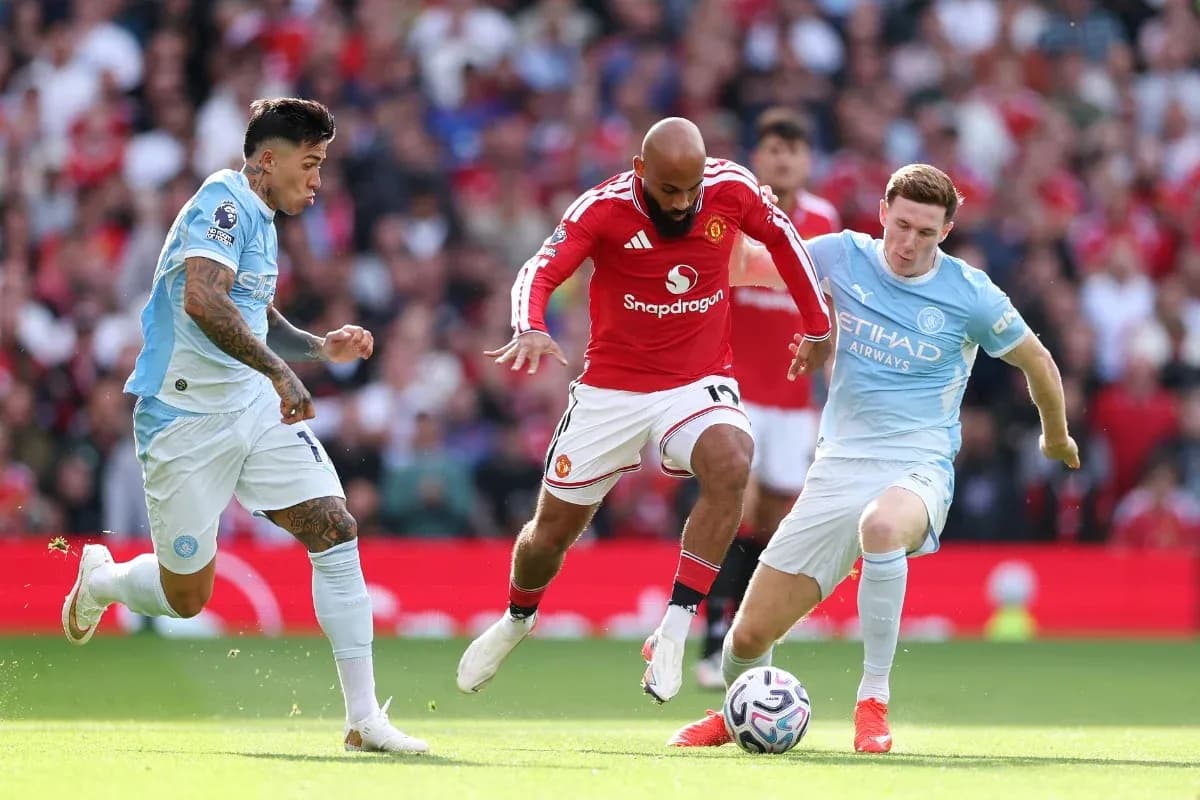
Manchester Derby Analysis: United vs City in 4-2-3-1 Showdown
Old Trafford under grey Manchester skies has rarely felt this starkly divided. On the pitch, the Premier League table told its own story: Manchester United arriving in Round 4 in 13th place with 4 points and a goal difference of 0, Manchester City in 2nd with 12 points and a goal difference of 6. By full time, the scoreboard read Manchester United 0–1 Manchester City, and the gulf in structure and clarity between these two 4-2-3-1 systems felt larger than the single goal.
I. The Big Picture – Two 4-2-3-1s, Two Different Realities
Both sides lined up in a mirrored 4-2-3-1, but the identities could not have been more different.
United, under M. Carrick, leaned into a technical, ball-playing core: S. Lammens in goal behind a back four of Diogo Dalot, H. Maguire, Lisandro Martínez and P. Dorgu. In front, Y. Tielemans and K. Mainoo formed the double pivot, with a high-usage creative line of B. Mbeumo, Bruno Fernandes and M. Rashford supporting Matheus Cunha.
Heading into this game, United’s season had been volatile. Overall they had scored 7 and conceded 7 in 4 league matches, with that goal difference of 0 reflecting a side capable of both cutting loose and collapsing. At Old Trafford they had been more expansive: 5 goals for and 3 against in 2 home games, an average of 2.5 goals scored and 1.5 conceded at home. Yet they had not kept a single clean sheet all campaign, and had already failed to score in 2 of their 4 matches overall. The 4-2-3-1 was clearly their default, used in all 4 league fixtures, but it remained a system still searching for balance.
City, by contrast, arrived as a fully formed machine under E. Maresca. They also used 4-2-3-1, with G. Donnarumma in goal, a back four of Matheus Nunes, M. Guéhi, Rúben Dias and J. Gvardiol, and a double pivot of E. Fernández and E. Anderson. Ahead of them, P. Foden, R. Cherki and A. Semenyo buzzed behind E. Haaland.
Heading into this game, City’s numbers were ruthless: 4 wins from 4, 8 goals scored and only 2 conceded overall. On their travels they had 2 wins from 2, with 5 goals scored and just 1 conceded, averaging 2.5 goals for and 0.5 against away from home. Two clean sheets overall, zero games without scoring. It is the statistical profile of a side that not only dominates but controls the margins.
II. Tactical Voids – Absences and Discipline
United’s squad was stretched in the spine and on the flanks. C. Baleba (ankle), A. Diallo, T. Heaton, L. Shaw, M. Ugarte and M. de Ligt were all ruled out. The absence of Shaw and de Ligt in particular reshaped the defensive picture: Dorgu was trusted at left-back, while Maguire–Martínez became the centre-back pairing. Without Ugarte, United lost a natural destroyer at the base of midfield, pushing Tielemans and Mainoo into a more defensively responsible role than ideal.
City’s only listed absentee was J. Doku with a calf injury. That limited Maresca’s option for raw, touchline-hugging pace but did not damage the structural core of his side.
Disciplinary trends added another layer. United’s yellow cards this season have clustered late: 50.00% of their cautions have come between 76–90 minutes, with further bookings in the 31–45 and 61–75 ranges. It paints a picture of a team that tires and starts arriving late into duels as games stretch. City, meanwhile, have spread their yellows more evenly, but with a pronounced spike late as well: 42.86% of their yellows have come between 76–90 minutes, with additional flashes between 31–45 and 46–60. Crucially, City have already seen red once this season through P. Foden, underlining both his combative edge and the risk baked into his role between the lines.
III. Key Matchups – Hunter vs Shield, and the Engine Room
The headline duel was always going to be E. Haaland against United’s central defence. Haaland entered this match as the league’s leading scorer, with 4 goals in 4 appearances, 15 shots and 9 on target, and an average rating of 7.91. He is not just prolific; he is relentlessly involved, winning 17 of 30 duels and attempting 8 dribbles. For Maguire and Martínez, that meant a constant physical and positional examination.
Maguire’s profile tells its own story: 4 starts, 360 minutes, 2 yellow cards, 34 duels contested and 21 won, plus 1 successful blocked shot. He is aggressive in stepping out, but that aggression is a double-edged sword against a striker who thrives on exploiting the space behind. With United conceding an average of 1.8 goals both overall and at home, the question was whether Maguire and Martínez could compress the box tightly enough to deny Haaland the penalty-area touches he lives on.
In the engine room, the battle between Bruno Fernandes and City’s double pivot plus No.10s shaped the tempo. Bruno arrived as both United’s top scorer and chief creator: 3 goals and 1 assist in 4 games, 262 completed passes at 85% accuracy, 9 key passes and 8 shots (5 on target). He had also scored United’s only penalty of the campaign, converting 1 from 1. Everything United do with the ball tends to funnel through him.
City’s answer was layered. E. Fernández and E. Anderson formed a platform, while R. Cherki and P. Foden provided the creative fire. Cherki’s numbers are elite: 2 goals, 2 assists, 10 key passes and 185 completed passes at 91% accuracy in just 220 minutes. He has also blocked 1 shot, showing a willingness to work against the ball. Foden, despite a modest rating of 6.35, remains a high-usage connector: 2 assists, 7 key passes, 128 passes at 87% accuracy, and a combative edge of 32 duels contested and 4 tackles. That combination meant Bruno was not just a playmaker but also a pressure target; every United build-up phase risked being funneled into City’s pressing traps around him.
Out wide, M. Rashford and B. Mbeumo were tasked with pinning City’s full-backs and attacking the space behind Matheus Nunes and J. Gvardiol. For City, A. Semenyo’s work without the ball was crucial. He came into this match with 47 duels contested and 4 tackles, plus 2 assists and 7 key passes – a two-way winger capable of both stretching United’s back line and doubling up defensively on their wide threats.
IV. Statistical Prognosis – xG Proxy and Defensive Solidity
Even without explicit xG values, the season data sketches a clear expected pattern. City’s overall average of 2.0 goals scored and 0.5 conceded per game, combined with their 2.5 scored and 0.5 conceded away, signals a side that consistently creates high-quality chances while allowing very little. Two clean sheets in four and zero games without scoring suggest that, on a typical day, City’s underlying chance quality would translate into at least one goal and a strong probability of shutting the opponent out.
United’s profile is more volatile. Overall averages of 1.8 goals scored and 1.8 conceded, combined with 2.5 scored and 1.5 conceded at Old Trafford, point to open, high-variance matches. The absence of any clean sheet and 2 games already without scoring underline their fragility at both ends. Against a City side that compresses space and rarely allows more than 1 clear chance away from home, United’s reliance on Bruno’s creativity and individual brilliance from Rashford or Mbeumo looks like a thin margin.
From a disciplinary and game-state perspective, the late yellow-card surges for both teams suggest that the final quarter of an hour is when control can slip. United’s tendency to pick up cautions late, combined with City’s ability to keep probing through Cherki, Foden and Semenyo, tilts the endgame toward the visitors, especially once fatigue sets into United’s already stretched defensive unit.
Following this result, the 1–0 scoreline at Old Trafford feels entirely in line with the statistical undercurrent. City’s defensive solidity, their multi-layered creative structure and Haaland’s penalty-box gravity make them the side whose performances most closely mirror a dominant xG profile. United, still searching for balance in a familiar 4-2-3-1, remain dependent on moments rather than mechanisms – and in this derby, that was never likely to be enough.