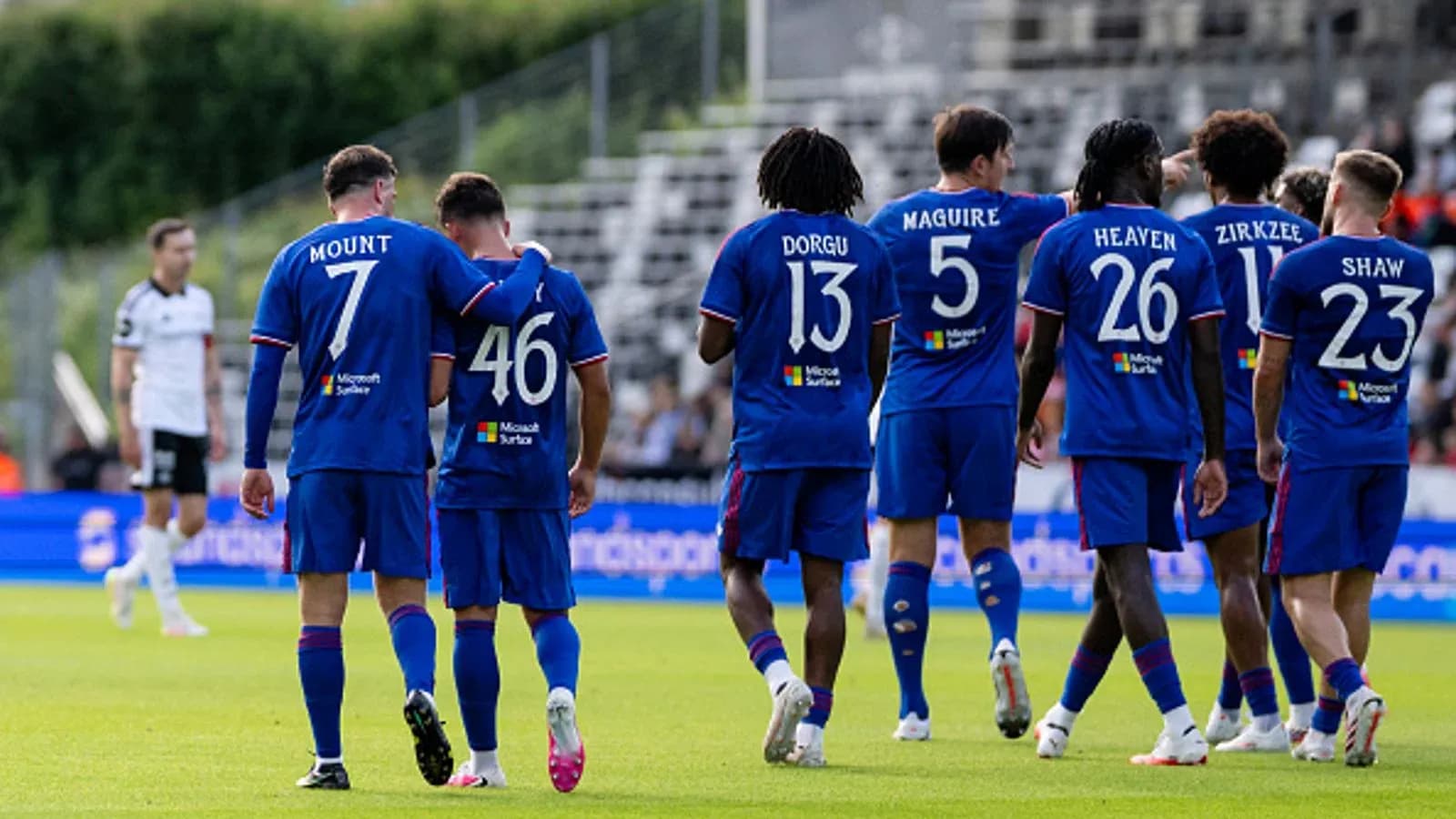
Manchester United's Evolution: Carrick-ball Shines in 5-0 Victory
Manchester United’s pre-season finally sparked into life in Trondheim, and it did so with a thump. A 5-0 win over Rosenborg brought goals, swagger and something more important than either: a clear sign that Michael Carrick’s United are evolving.
Six days after a flat defeat to Wrexham, this looked like a different team. Same manager, same principles, but a sharper, more controlled version of the side that had thrived on chaos last season.
Carrick-ball, upgraded
Carrick’s rescue job last term was built on transition football. United ran like a counter-attacking machine: Bryan Mbeumo and Patrick Dorgu tearing into space, Bruno Fernandes and Matheus Cunha threading passes into the gaps. From Carrick’s first game – that 2-0 win over Manchester City – to the end of the season, the numbers told the story: third in fast breaks per game, joint-top for goals from fast breaks, second in expected goals from those situations.
On the ball, they were far less convincing. Thirteenth in possession share, 11th in average possession duration. Old problems resurfaced whenever an opponent dropped into a low block. United would run out of ideas, run out of rhythm, and run into trouble.
On paper, Rosenborg should have exposed that again. Thirteen league games into their season, fitter, sharper, at home, they should have dictated the tempo and forced United back into their transition comfort zone.
They didn’t get close.
United, without Fernandes or Cunha, looked calm and composed in possession. They moved Rosenborg around, stretched them, then cut through them. The ball stuck in attack. It stuck because Joshua Zirkzee made it stick.
This wasn’t United abandoning their old strengths. The second and fourth goals came straight from the transition play Carrick has leaned on so heavily. But the balance was different. The passing patterns were more deliberate. The build-up had a patience and purpose that hasn’t often been associated with post-Ferguson United.
This is where Youri Tielemans comes in. A controller, a tempo-setter, a player who thrives when his team has the ball. Watching this performance, the logic behind that signing felt obvious. Carrick isn’t ripping up his blueprint; he’s adding new pages.
Zirkzee dazzles – but what does it change?
On the night, there was no debate about the standout performer. Zirkzee dominated the game in a way Old Trafford has rarely seen from him since his 2024 arrival.
He has always been a puzzle. Too silky to be a classic number nine, not sharp enough off the ball to dislodge Fernandes as a number 10. You see flashes – a touch, a turn, a pass – and the mind drifts to Dimitar Berbatov. Then the game passes him by, and the questions return.
In Norway, there were no questions. Just answers.
Zirkzee became a magnet for the ball, a sponge for pressure. He received it on the half-turn, rolled defenders, linked play. In his 60 minutes, he scored once, assisted once, and knitted United’s attacks together.
His goal was the moment that will live longest. A slick give-and-go with substitute Harry Amass opened the door. What followed was pure theatre: tight footwork to send two defenders the wrong way, another feint to leave the goalkeeper on the turf, then a simple finish into an empty net. A training-ground skill move, executed at full speed, in a crowded box.
It was breathtaking. It was also the kind of moment that lights up social media and fuels calls for a bigger role.
But here comes the cold edge of reality. The pace of this game suited him. Rosenborg, leggy and stretched, left spaces that do not exist on a cold afternoon away at Brentford. This performance does not erase the doubts about whether Zirkzee can cope with the intensity and physicality of the Premier League week after week.
Benjamin Sesko still looks the more natural candidate to lead the line when fit. What Zirkzee showed in Trondheim may be more instructive in another way: a glimpse of how Carrick might want to use Sesko, dropping into pockets, linking play, then arriving in the box at the right moment.
Zirkzee walked off to applause and acclaim. The bigger question is whether he walked into Carrick’s long-term plans, or simply underlined his value as a specialist option for certain games and game states.
Carrington’s kids step into the light
For all the tactical intrigue, this was also a night for the academy. Carrington’s influence ran right through the scoreline.
Shea Lacey, starting as a number 10, grew with every touch. United fans have seen flashes before – not least that almost-screamer in the 2-2 draw with Burnley – but this was his most complete senior outing. His finish for the opener was calm, almost casual, the kind of composed strike that makes a teenager look older than his years. Supporters voted him player of the match, and it was hard to argue.
The noise around Lacey has dipped over the last year. Once the standout name in the youth ranks, injuries and inconsistency nudged him out of the spotlight. Performances like this drag him right back into it. There is a player there who looks capable of playing a serious role in the first team if his development stays on track.
Amass, on at half-time, offered another reminder of why the club rate him so highly. His progress stalled in the second half of last season after a bright loan spell at Sheffield Wednesday, injuries halting his momentum. Here, he looked like he had never been away. His goal came from smart movement into a dangerous area from full-back, but it was his all-round display that impressed: secure on the ball, aggressive in his defending, assured on the left flank.
United want another left-back. That much is no secret. But performances like this raise an awkward, and important, question: if Amass can offer this now, should he be trusted as Luke Shaw’s long-term deputy instead of blocking his path with another signing?
Jacob Devaney and Ethan Williams also had their moments, each finding the net and banking memories they will carry for the rest of their careers. A first senior goal in United colours is never forgotten, regardless of the setting.
Yet the most intriguing young performance might have come from a player who didn’t score.
Jaydan Kamason, at right-back, was a blur. At 19, he is still learning the defensive craft and it showed at times, his positioning without the ball occasionally loose. But once United had possession, he came alive. Two assists, both from low, driven crosses that showed vision and precision. Footwork more typical of a winger than a full-back. Confidence to take players on, to commit defenders, to play on the front foot.
Carrick trusted him with more minutes than most of the other youngsters. That, more than anything, told its own story.
The JJ Gabriel wait
And then there was the name many fans had come to see.
JJ Gabriel, 15 years old and already branded United’s next wonderkid, travelled with the squad and instantly became a talking point. Social media buzzed with the idea of a teenage debut, a glimpse of the future.
It never came.
Gabriel stayed on the bench, fluorescent bib on, unused. The cameras panned to him. The fans waited. The chance didn’t arrive.
Does that mean expectations should be dialled down? Not necessarily. Carrick spoke before the game and hinted that Gabriel would get minutes across the pre-season schedule. The staff know his age, his stage of development, and the risks of overexposure. One night on the bench in Norway says more about timing than talent.
What it does underline is the depth of the youth pipeline Carrick can draw from. Lacey, Amass, Kamason, Devaney, Williams – and Gabriel still to come. The academy is not just alive; it’s feeding directly into a first team that finally looks like it has a coherent plan.
A 5-0 win over Rosenborg will not define United’s season. It won’t decide titles, or even guarantee a strong start in August. But it did something subtler, and perhaps more significant: it showed a team learning to control games, not just chase them, and a manager willing to bend his own blueprint to get there.
If this is the next phase of Carrick-ball, how far can it take them when the real football starts?