Manchester United 5–2 Ipswich: A Tactical Breakdown
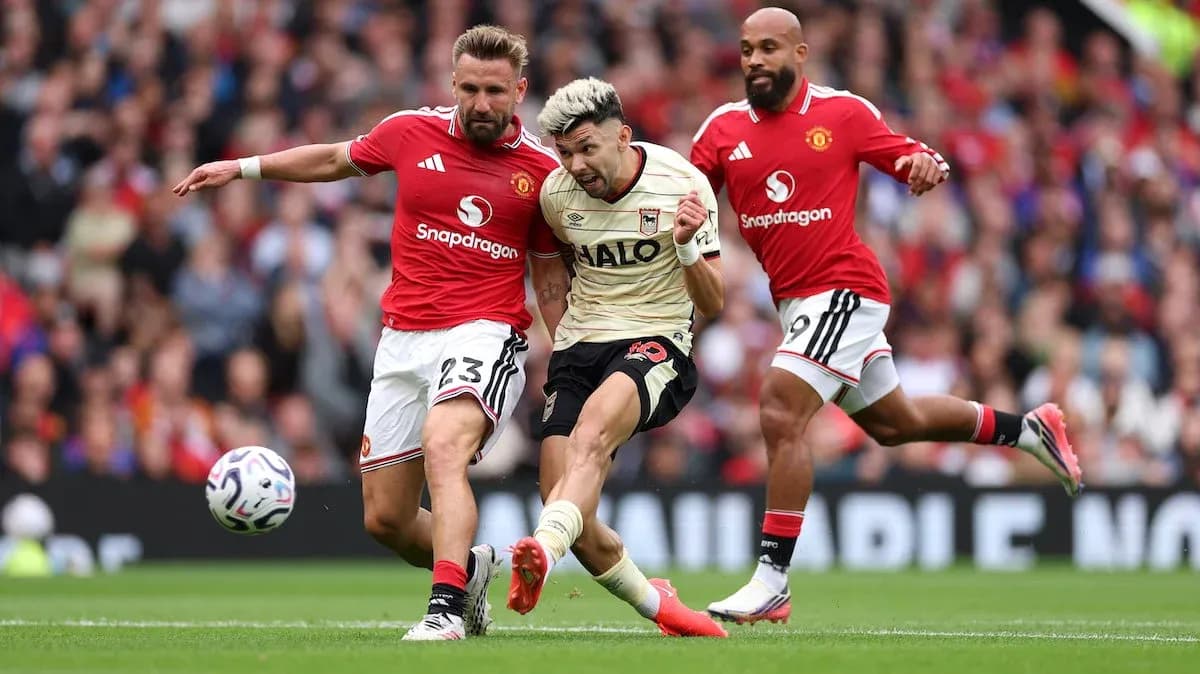
Old Trafford had already delivered its verdict: a 5–2 Manchester United win over Ipswich, a scoreline that felt as much like a manifesto as a result. This was Premier League, Regular Season - 2, and by the final whistle Craig Pawson had overseen a performance that clarified the early-season identities of both sides.
Following this result, Manchester United sit 10th with 3 points from 2 matches, their overall goal difference at +1, built from 5 goals scored and 4 conceded. At home they have been explosive: 1 match played, 1 win, 5 goals for and 2 against. Ipswich, 12th with 3 points, carry an overall goal difference of -2, scoring 4 and conceding 6 across 2 games. On their travels, the story is harsher: 1 away match, 2 goals scored and 5 conceded.
I. The Big Picture – Carrick’s Structure, O’Neil’s Gamble
Both managers mirrored each other on the whiteboard: 4-2-3-1 against 4-2-3-1. But the shapes told different stories once the game breathed.
Michael Carrick’s United were anchored by S. Lammens in goal, protected by a back four of D. Dalot, H. Maguire, L. Martinez and L. Shaw. In front, the double pivot of Y. Tielemans and K. Mainoo set the rhythm, freeing an aggressive line of three – B. Mbeumo wide right, B. Fernandes central, M. Rashford from the left – behind lone forward M. Cunha.
Gary O’Neil’s Ipswich built from K. Scherpen, with D. O’Shea and I. Diop as the central pairing, flanked by J. Greaves and L. Davis. The midfield hinge was S. Lukic and M. Nunez, with I. Fatawu and D. Maeda stretching the flanks, J. Enciso knitting play between the lines and Emersonn leading the line.
The 1–1 half-time score hinted at balance, but United’s season data had already foreshadowed what would come. At home this campaign, they average 5.0 goals scored and 2.0 conceded; Ipswich, away, are leaking 5.0 goals per game while scoring 2.0. The script was written in the numbers before it unfolded on the grass.
II. Tactical Voids – Injuries and Absences
United’s bench carried its own story of absentees. C. Baleba (ankle injury), A. Diallo, T. Heaton, M. Mount (foot injury), M. Ugarte (knee injury) and M. de Ligt (back injury) all missed the fixture. That stripped Carrick of a natural ball-winner like Ugarte and a high-tempo connector like Mount, forcing him to lean heavily on Mainoo’s maturity and Tielemans’ distribution in the double pivot.
For Ipswich, Florentino (inactive), A. Matusiwa, J. Philogene and J. Taylor (knee injury) were all unavailable. The absence of Matusiwa in particular left O’Neil without a pure destroyer at the base of midfield, placing significant defensive responsibility on Lukic and Nunez against one of the league’s most in-form creators.
Discipline-wise, the trends from the season’s early card distribution framed the contest’s edge. United’s yellow cards this campaign have been split evenly between 31–45 minutes and 91–105 minutes, each period accounting for 50.00% of their cautions. Ipswich’s yellows cluster earlier: 66.67% between 31–45 minutes and 33.33% between 46–60 minutes. That pattern suggests a visiting side that often has to foul to halt momentum just as matches tilt into their most chaotic phase.
III. Key Matchups – Hunter vs Shield, the Engine Room
The headline duel was always going to orbit Bruno Fernandes. Heading into this game, he led the league’s scoring charts with 3 goals and 1 assist in 2 appearances, averaging an 8.65 rating. His 151 passes overall at 84% accuracy and 6 key passes show a player both conductor and finisher. Ipswich arrived with an overall defensive record of 6 goals conceded in 2 games, including 5 away; the “shield” was already dented.
Behind Bruno, United’s supporting cast sharpened the blade. Rashford’s starting berth from the left, with Mbeumo on the opposite flank, stretched Ipswich’s full-backs laterally, isolating J. Greaves and L. Davis in repeated 1v1s. Cunha’s role was less about penalty-box poaching and more about dragging I. Diop and D. O’Shea into uncomfortable spaces, opening the half-spaces for Bruno’s late arrivals.
In response, O’Neil leaned on his own creative hub: J. Enciso. With 2 assists in 2 games and 47 passes at 85% accuracy, he is Ipswich’s most reliable connector, combining with the direct threat of Emersonn and the dribbling of Fatawu. Emersonn’s 1 goal, 3 shots and 3 key passes across the season underline his dual threat as both finisher and facilitator.
The real battle, however, lay in the engine room. Mainoo and Tielemans versus Lukic and Nunez determined whether Ipswich’s transitions would ever breathe. Tielemans’ calm distribution allowed United to recycle pressure, while Mainoo’s mobility covered for United’s lack of a pure holding midfielder, compensating for Ugarte’s absence. On the other side, Lukic and Nunez were asked to be both screen and springboard – a difficult double role against a side that, at home, has yet to fail to score and has already produced their biggest win as 5–2.
Wide, the duel between Fatawu and Shaw was instructive. Fatawu’s season numbers – 5 tackles, 1 interception, 12 dribbles attempted with 6 successful – show a winger willing to work both ways. Yet Ipswich’s defensive minute distribution tells a harsher truth: 40.00% of their goals conceded arrive between 31–45 minutes, another 40.00% between 61–75 minutes, and 20.00% from 76–90. Their defensive line repeatedly cracks just as opponents raise the tempo – precisely when United’s attacking structure, led by Bruno, tends to surge.
IV. Statistical Prognosis – What This Result Says
United’s early-season profile is clear: high-event football. Overall they average 2.5 goals scored and 2.0 conceded per game, with no clean sheets and no failures to score at home. Their only penalty of the campaign has been converted, maintaining a 100.00% record from the spot with no misses. Their biggest win so far is this very 5–2 at Old Trafford.
Ipswich, meanwhile, live on the knife-edge of transition. Overall they average 2.0 goals scored and 3.0 conceded per game, with no clean sheets but also no failures to score. Their goals come in bursts – 40.00% between 16–30 minutes and another 40.00% in the 76–90 window – but their defensive frailty in the same late phases is costly. On their travels, conceding 5.0 goals per game is unsustainable, however vibrant their front line.
Put together, the 5–2 scoreline feels less like an anomaly and more like the logical intersection of two statistical profiles: a United side that overwhelms at home, and an Ipswich team that can trade punches but cannot yet protect itself when the game opens up. As the season stretches ahead, Carrick’s task will be to harden the defensive core without blunting the attacking fluency, while O’Neil must turn Enciso, Emersonn and Fatawu’s bright flourishes into points by tightening the shield behind them.