Manchester United Women: Defying the Odds in 2025-26 Season
“Defy the odds.”
It was meant to be a rallying cry. Instead, it has become a mirror.
Manchester United Women launched their 2025-26 season with that slogan, a punchy directive conceived high up in the club’s hierarchy. It was supposed to encapsulate a pivotal year: a first European campaign, a push to cement themselves among the Women’s Super League elite, a battle with the established powers of Arsenal, Chelsea and Manchester City.
Inside the dressing room and around it, the phrase has taken on a different edge. The odds they are told to defy, some feel, are not just imposed by opponents or circumstance. They are, in part, created by the club whose badge they wear.
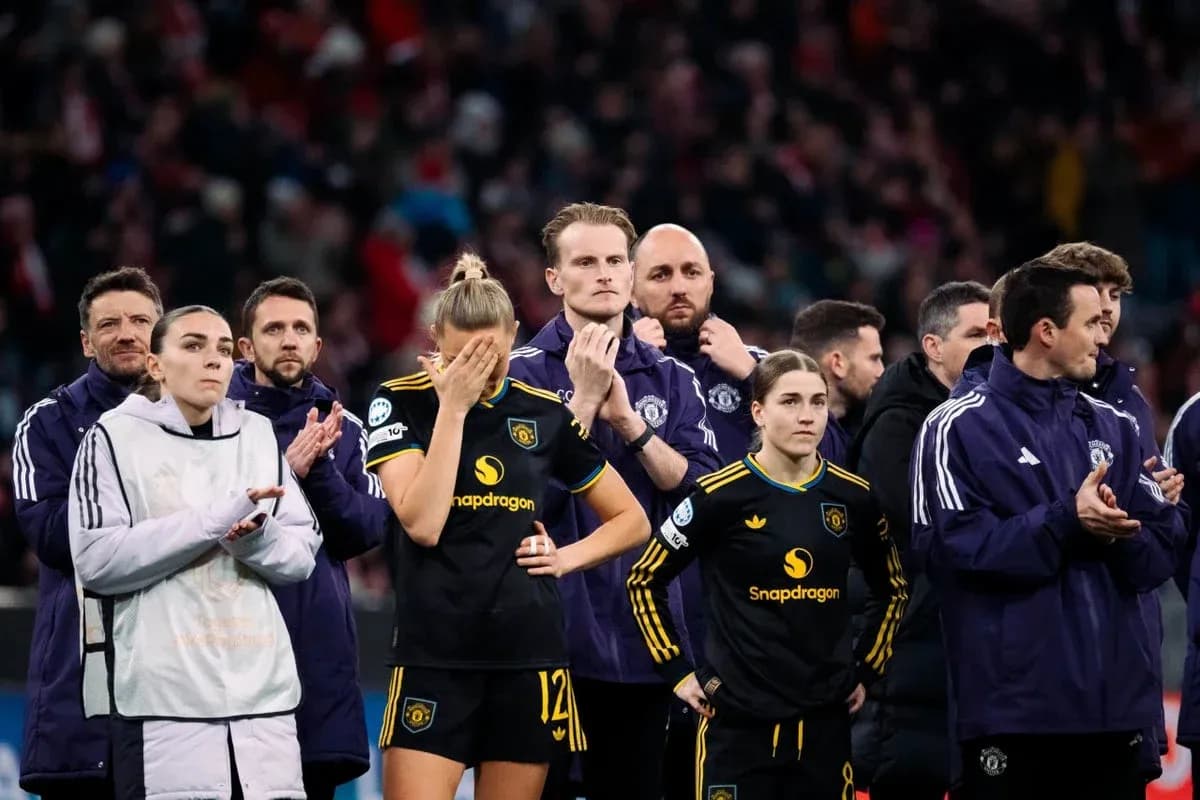
“Players deserve better.” The line has echoed around the women’s setup for years, but this season it has grown louder. United’s squad has long punched above its weight, building a tight-knit spirit from the shared knowledge that they are operating on the margins. That resilience almost carried them to the Champions League semi-finals on Wednesday night.
For 79 minutes in Munich, the impossible felt within reach.
Melvine Malard’s early goal dragged the tie level at 3-3 on aggregate against Bayern Munich, an eight-time quarter-finalist in this competition. United, patched up and running on fumes, went toe-to-toe in the first half: six shots, four on target, territory gained, belief swelling.
Then the second half began, and the familiar fault lines reappeared.
United emerged with a deeper midfield and a visibly drained team. They had just four outfield players on the bench, one of them 18-year-old Jess Anderson, who only made her WSL debut at the weekend. Bayern, by contrast, came out with renewed attacking intent and the depth to sustain it.
United mustered one shot after the break. Zero expected goals. Twenty-four per cent possession. Bayern registered nine efforts, worth 1.45 xG, and turned the screw relentlessly from set pieces.
Corner followed corner. By the time Bayern scored from their 12th and 13th of the night, both in the final 10 minutes, United’s resistance had finally snapped. A 5-3 aggregate defeat, and a brutal reminder of a season-long vulnerability at dead balls.
There is only so long you can hold the line. Only so long you can be asked to defy it.
A season stretched to breaking point
United Women are now out of Europe. Out of the FA Cup. Beaten by Chelsea in the League Cup final. With three league matches left, they are fighting just to get back into the Champions League places.
Inside the club, a question has hung over this season: what is the plan to ensure they are not constantly scrambling against the odds, but built to compete with them?
Senior figures in the women’s department and members of the wider executive team have wrestled with that all year. United added Jess Park, Fridolina Rolfo and Julia Zigiotti Olme last summer but were outbid on two other targets. That shortfall sparked internal discussions about how to inject more money into the women’s side, including the possibility of external investment.
The need to explore new funding streams has been recognised since INEOS bought a minority stake in December 2024. The pace, though, has been slow. Sir Jim Ratcliffe has openly said his focus on the men’s operation and finances has limited his involvement with the women’s project so far.
This season’s strain has made the gap impossible to ignore. Competing on multiple fronts with a thin squad has exposed United to the full force of Europe’s rising standards and the WSL’s escalating arms race.
A March meeting was earmarked as a key moment: senior women’s staff and club executives were due to sit down with decision-makers to examine investment options, including selling a stake in the women’s team. According to club sources, the idea of external investment was quickly dismissed. No concrete structure has emerged.
Yet conversations have not gone away. Multiple people familiar with the talks say internal discussions continue, with recommendations still to be finalised for the board and owners. A subtle rebrand of the women’s team has even been floated in some of those meetings, though senior leadership has no current plans to pursue it.
United are hardly alone in searching for new money. Chelsea Women sold roughly 10 per cent to Alexis Ohanian for £20million last May, valuing the team at over £200m. Everton Women brought in Canadian-based GED Investments as a minority partner in December. Sunderland Women, as reported in March, are in advanced talks to sell a majority stake to U.S. firm Sixth Street via its Bay Collective women’s sport platform.
United’s internal debate sits squarely in that context but is driven by immediate need. Multiple people say the club have struggled to keep pace with rising wages and transfer fees because of budget constraints. Club sources argue that reflects a deliberate, sustainable model.
The tension between those positions plays out in recruitment. At least two signings completed in January were deals United had first tried to do in the previous summer window. One planned arrival for this coming summer remains unconfirmed because of uncertainty over the overall budget.
While the season has unfolded, staff have sent repeated messages up the chain. One included a screenshot of an injury-ravaged bench against a WSL rival, a visual plea for help.
The reality on the ground is stark. The injury list includes Dominique Janssen, Ellen Wangerheim, Anna Sandberg, Leah Galton, Elisabeth Terland and Ella Toone. On Wednesday in Munich, Simi Awujo limped off with what appeared to be a hamstring problem.
Training has been stripped back to tactical walkthroughs, video work and recovery, with coaches wary of pushing players into further muscle injuries. The squad is being asked to run a marathon at sprint pace.
Investment – but is it enough?
To say United have not invested at all would be false. Since Marc Skinner took charge five years ago, the club have made 37 signings. The women’s operating budget has more than doubled, from just under £5m in 2021-22 to £10.7m in 2024-25.
On paper, those numbers suggest a growing, structured project. Inside and outside the team, though, some voices draw a sharper line: there is a difference between investing sustainably and investing enough to genuinely compete at the top.
Last season, United spent £5.88m on wages. Arsenal spent £11.3m. Manchester City, who finished fourth, reported operating expenses of £14m, £4m more than United’s entire budget. Chelsea have yet to publish their 2024-25 accounts, but their previous season – a fifth straight WSL title, plus FA Cup and Champions League semi-finals – came with an operating budget of over £20m. Double United’s.
Within that financial frame, Skinner’s record is not negligible. United have finished fourth, second (a club high), fifth and third in the league under his watch. They have reached four major finals, winning one – the 4-0 FA Cup victory over Tottenham Hotspur in 2023-24 – and losing three to Chelsea by a combined score of 6-0.
Yet when the conversation turns to the clubs United aspire to hunt down, the numbers tighten. Across all competitions in the past two seasons, Skinner has managed three wins in 17 matches against Chelsea, Arsenal and City. Against Chelsea alone, United have one win in their last 19 attempts, that FA Cup semi-final in 2023-24. Skinner’s record versus the west London side reads one win, one draw and 13 defeats from 15 games.
Skinner, style and a squad caught in the middle
Skinner signed a new two-year deal last summer and retains the full support of the club. Even so, his methods divide opinion among those close to the team.
Some question his willingness to develop young talent, arguing he prefers established players with significant senior experience. The numbers lend weight to that concern. United rank bottom of the WSL for minutes given to players under 21. Before 16-year-old Layla Drury’s debut on February 15, Skinner had used an under-21 player for just 90 minutes in the league all season – Safia Middleton-Patel’s appearance in the 3-0 defeat by Manchester City in November, when the Wales goalkeeper deputised for the injured Phallon Tullis-Joyce.
Others criticise his in-game coaching. They say players receive limited tactical instruction from the touchline and are left to improvise attacking patterns. On the training pitch, Skinner is described as someone who rarely leads technical sessions, delegating to staff around him because of broader responsibilities. Some coaches, sources say, end up joining drills to make up numbers or acting as referees rather than actively coaching.
There is another side. People close to the squad praise Skinner’s readiness to absorb public pressure and shield players and staff. They argue he is more tactically astute than many give him credit for, particularly given the constraints he works under, and highlight his organisation of the team without the ball.
At 43, he is also regarded as an effective communicator, comfortable in public and private, regularly holding one-on-one meetings with players when time allows. Several have responded well to the freedom he grants them to express themselves on the pitch.
That freedom has a cost. Against Europe’s and England’s savviest sides, some players feel exposed. In Munich’s second half, with Bayern pinning United back, there were few obvious attacking solutions, few rehearsed patterns to relieve the pressure.
Set pieces have become a symbol of the wider unease. United’s defending from corners and free kicks has drawn criticism all season. Long-time goalkeeping coach Ian Willcock, who also oversaw defensive set pieces and helped the team set a WSL clean-sheet record in 2022-23, left last summer with several other staff. His replacement, Joe Potts, arrived from Liverpool Women.
The numbers since then are unforgiving. United lost 2-1 to Chelsea in the FA Cup fifth round to an extra-time goal from a corner. Bayern’s late double from corners finished their Champions League run.
“We were knocked out in all our games from a set piece, in the FA Cup and now here,” captain Maya Le Tissier told Disney after Thursday’s defeat. “It’s something we need to work on.”
Skinner’s positional choices have also been questioned. Terland, a striker by trade, has been used as a No 10, including in the League Cup final against Chelsea. Wangerheim, signed in January from Hammarby as a centre-forward, has often been deployed on the wing.
Speaking in February, Wangerheim said she had been told during negotiations she would play as a No 9. The club later added Lea Schuller from Bayern Munich. Wangerheim admitted she needed “some training sessions and games” to adapt to a wide role, but a congested fixture list has left little time for either her or Schuller to acclimatise away from competitive pressure. A club source maintains it was clear from the outset she would sometimes be used out wide.
The race to stay ahead – or be overtaken
United’s first Champions League adventure has ended with a sting. Emotionally, the exit will linger. The schedule offers no time to dwell.
Three league games remain. To return to Europe, United will almost certainly have to improve that one-win-in-19 record against Chelsea on the final day, while taking maximum points from Tottenham Hotspur, currently fifth, and Brighton & Hove Albion, in sixth.
The task is brutal in its simplicity: defy the odds, again.
Outside Old Trafford, others are watching closely. Senior figures at three clubs below United in the WSL have, in private conversations, identified United as the team they believe they can overhaul next season. They point not only to financial limitations in the transfer market but to what they see as gaps in the infrastructure around the women’s side.
Inside the club, there is pride and frustration in equal measure. Pride in what has been built in just eight years. Frustration at the ceiling they keep hitting.
“I’m incredibly proud of what my players are doing on resources we have,” Skinner said after the Bayern defeat. “Because we wear Manchester United’s badge, everybody expects us to be the very best team in the world. We have that expectation too. Yet we’ve got to grow because we’re eight years old.
“You (can) give me all the flack. That’s no problem, that’s my job. But if we want to compete at this latter stage, we’ve seen what we’ve got to do, as a club. And then it’s our choice now, isn’t it?”
The slogan on the wall says “Defy the odds”. The next move will show whether Manchester United choose to change those odds – or keep asking their players to fight them alone.