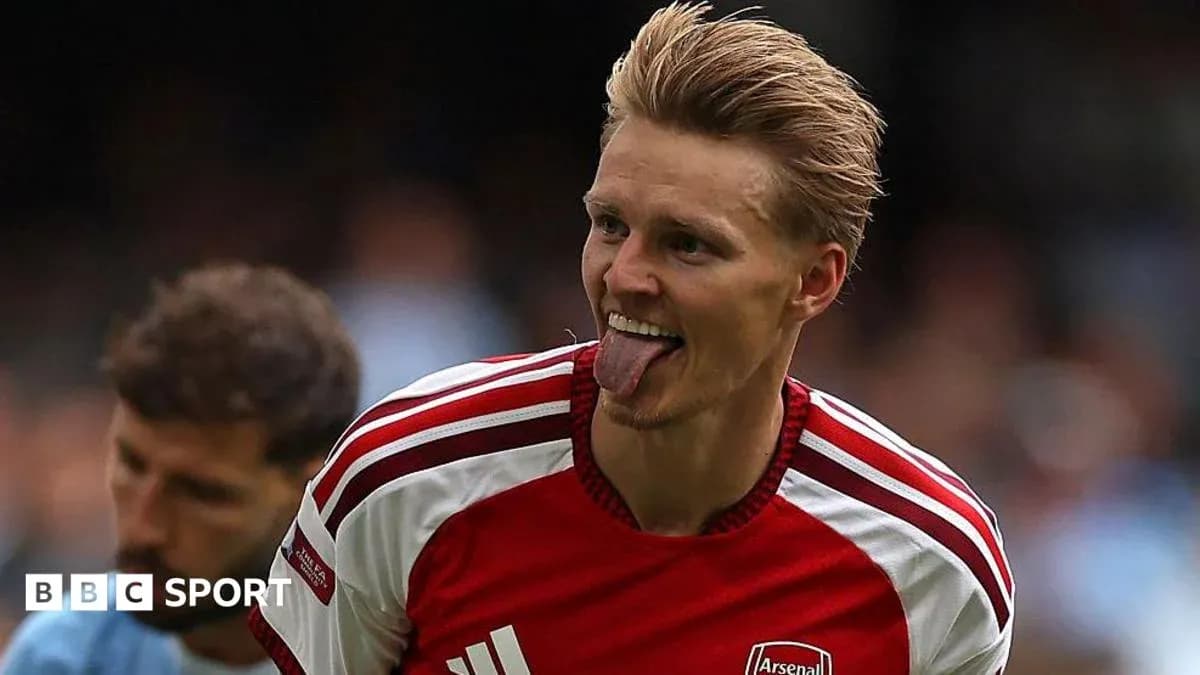
Martin Odegaard's Dominance in Arsenal's Midfield
Martin Odegaard did not just lift the Community Shield in Cardiff. He grabbed the afternoon by the collar and reminded Manchester City – and his own dressing room – exactly who runs Arsenal’s midfield.
In a 3-0 dismantling of the Premier League champions, the Norwegian was everywhere. Pressing. Drifting into pockets. Demanding the ball. And, at the end, humiliating Gianluigi Donnarumma with a feint so sharp the goalkeeper was left on the turf as Odegaard rolled in Arsenal’s third.
For a player who spent much of last season watching from the treatment room, it felt like a statement.
From frustration to control
Arsenal may have ended their 22-year wait for a league title last season, but it was a campaign that passed Odegaard by in painful slow motion. Knee and shoulder problems cut him down just as the club hit their stride. He started only 16 league games, his return of one goal and seven assists his leanest since making his move from Real Madrid permanent in 2021-22.
The numbers jarred because his quality has never really been up for debate. What did come under scrutiny, from former players and pundits, was whether a captain who could not stay on the pitch should keep the armband.
Cardiff did not settle that argument for good. It did, however, push it firmly in his favour.
Of all the Arsenal players on the pitch, Odegaard completed the most passes (55 of 58), the most dribbles (three out of three) and won possession back more than anyone else, nine times. Those are not just creative numbers; they are the figures of a player setting the tempo and leading the press.
He called last year “a big struggle with a lot of difficult moments”, the kind of season that gnaws at a professional. Weird injuries. Bad luck. Too many games watched in a tracksuit. The frustration was obvious.
So he turned the end of the campaign into a springboard. He finished the club season fit, then carried that rhythm into a standout World Cup with Norway, starting five of their six matches and supplying four assists. A title with Arsenal, a strong tournament, then a proper break. The reset he craved.
Now he looks like he has emptied all of that irritation into something far more dangerous: motivation.
A new engine room – and a familiar conductor
If Arsenal’s title win was the end of one chapter, Mikel Arteta has wasted no time writing the next. The midfield, already stacked, has been upgraded again with the £75m arrival of Bruno Guimaraes.
Inside the club, the competition is fierce enough for Mikel Merino to call Arsenal’s midfield options “probably the best in football”. Look at the names and it is hard to argue: Odegaard, Guimaraes, Myles Lewis-Skelly, Martin Zubimendi, Declan Rice, Eberechi Eze, Merino himself. It reads less like a depth chart and more like an all-star shortlist.
Pressure like that can crush or sharpen. On this evidence, it is sharpening Odegaard.
The captain and Guimaraes seemed to click immediately in their first start together. The Brazilian, on for 45 minutes, impressed with his range and bite. Odegaard knitted everything around him, playing as if the two had been sharing a midfield for years rather than minutes.
“Sometimes you are just in the flow. You need to find that on the pitch,” Odegaard said afterwards. He spoke about the whole team “flowing pretty good out there” and his determination to keep that feeling going. It sounded simple. It looked anything but.
Arteta, who built his first great Arsenal side with Odegaard as a central pillar, senses a different edge now. The manager did not hide how hard last season had been for his captain: five or six months lost to “different things”, no chance to build rhythm, no momentum. That can drain a player. Or it can ignite him.
Arteta is convinced it is the latter. He talked about a Martin who has “something else on the belly” this time, a need to prove and show more, for himself and because “the team needs it as well”.
Old doubts, new fire
The idea that Odegaard might feel like a “new signing” is an easy line. It might also be accurate.
This is the same left foot, the same vision, the same technical level that helped power Arsenal’s rise under Arteta in the first place. The difference now is the context. He is coming off his most difficult club season since arriving in north London, into a squad that has just hit the mountaintop and then been reinforced with elite competition in his own area of the pitch.
He cannot drift. He cannot coast. He has to dominate.
Against City, he did exactly that. He played like a man who has decided that last season was an aberration, not a trend. He played like a captain who has heard every doubt and filed it away as fuel.
If Arsenal can keep him fit – the big if that hung over all of last year – Arteta is convinced “we’re going to see a very different Martin”. The numbers in Cardiff backed that up. The body language did too.
The Community Shield is not a trophy that defines a season. It does, however, offer clues.
One of them was unmistakable: with a fully firing Odegaard at the heart of what might be the deepest midfield in the game, how much higher can this Arsenal side climb?