Mohamed Salah Joins Trabzonspor: A Bold Move in His Career
Mohamed Salah has finally chosen. Not Miami. Not Jeddah. Trabzon.
After months of noise and speculation around one of the defining forwards of the Premier League era, the Liverpool great has signed a two-year deal with Trabzonspor, closing the book on an Anfield career that helped reshape English football’s modern landscape and opening one of the most intriguing late-career chapters in recent memory.
This is not the move the sport had been primed for. It is, in many ways, more interesting.
Why Turkey, why now?
For years, Saudi Pro League clubs circled Salah. Al-Ittihad pushed late. Major League Soccer franchises, with Sporting Kansas City among the most serious, saw him as the next marquee to follow the path beaten by global icons before him. Those routes promised staggering money and a softer competitive landing.
Salah turned them down.
At 34, after driving Egypt to the World Cup knockout stages this summer and delivering one of his best club seasons in 2024-25, he has chosen to stay in Europe. That point matters. Trabzonspor might not carry the glamour of an Istanbul giant or a Champions League regular, but they offer something he clearly still craves: European nights and a stage that still feeds his competitive edge.
The package is strong. Very strong. A filing to the Turkish stock exchange confirmed Salah will earn £14.5m per season and take a 20% cut of revenue from Salah-branded merchandise. Reports in Turkey also describe a two-year contract running to June 2028 worth around £7.3m per season plus bonuses, still below what he could have banked in Saudi Arabia but bolstered by commercial upside and the European platform.
For a player who has already secured generational wealth, the choice tells its own story.
Why Trabzonspor, and not Istanbul?
On paper, the path looked obvious. Galatasaray, Fenerbahce, Besiktas – the traditional heavyweights, the clubs that usually land Turkey’s biggest imports. Besiktas did try. Talks took place, but the deal broke down over the financial structure. That misstep opened the door for Trabzonspor, a club that has built its reputation by disrupting Turkey’s hierarchy rather than sitting comfortably at the top of it.
Outsiders? Not quite.
Trabzonspor are seven-time Turkish champions. They lifted the Super Lig title as recently as 2021-22 and added the Turkish Cup last season. Fatih Tekke’s side finished third in the league, securing a place in the Europa League play-offs this month. Win that tie and they enter the league phase; lose it and they drop into the Conference League. Either way, European football is on the calendar.
For Salah, that matters. He has not chosen semi-retirement. He has chosen a different kind of fight.
A city erupts
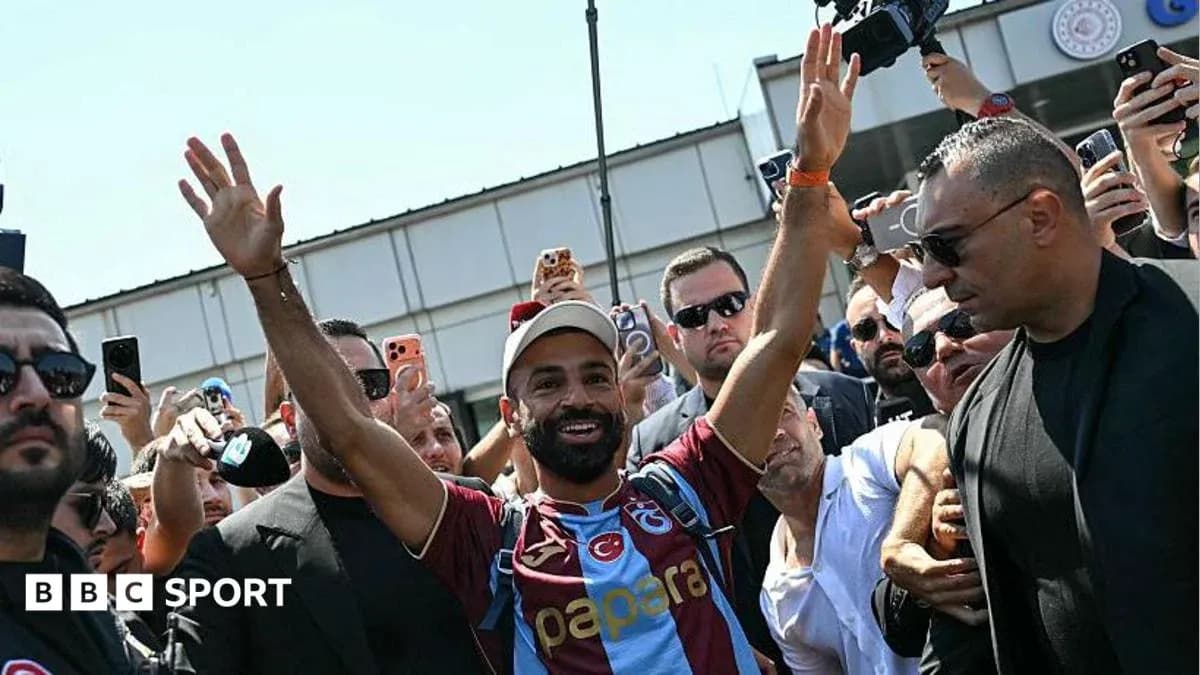
If there was any doubt about what his arrival means to Trabzon, it vanished the moment he landed. Hundreds of supporters turned out to greet him, a sea of claret and blue, flares and phone lights cutting through the night. This is a club and a city that lives its football loudly.
Former Rangers midfielder Ryan Jack, who has spent the last two seasons in Turkey, was not remotely surprised by the scenes.
He has seen it up close. The noise. The colour. The relentlessness.
“That’s one thing about Turkish football – the fans are incredibly passionate,” he told BBC Sport. “The big clubs have huge support and they really get behind their teams.”
Salah stepped straight into that culture. At his unveiling he briefly wore the number 61 shirt – Trabzon’s vehicle registration code and a badge of local pride. Supporters celebrate the 61st minute of matches; the number is woven into the city’s identity. It was a symbolic gesture, a nod of respect.
The long-term plan is different. From the 2026-27 season, Salah will wear number 10, the number he carries for Egypt. Team-mate Ernest Muci agreed to give it up, a clear sign of the status the club and dressing room are granting their new figurehead.
A league on the rise – and a strange economic edge
Salah’s move is not happening in isolation. Turkish football has been quietly repositioning itself as a destination for established names who still want intensity, atmosphere and a shot at Europe.
Victor Osimhen, Leroy Sane, Ilkay Gundogan, Nathan Ake, Leandro Trossard – the list of high-profile arrivals in the Super Lig grows longer. At Trabzonspor alone, Salah will join a squad that already includes Andre Onana, Ruslan Malinovskyi and Stefan Savic.
Last summer, the Super Lig posted the third-highest net transfer spend in world football, behind only the Premier League and the Saudi Pro League. That level of outlay speaks to ambition, but it also reflects Turkey’s unusual financial landscape.
The biggest clubs earn heavily in euros through UEFA competitions while many of their domestic costs are in Turkish lira. Years of high inflation have eroded the real weight of existing domestic debt, giving clubs more room to manoeuvre than their balance sheets might initially suggest. The result: they can offer serious wages and competitive squads to players in the latter stages of their careers, without the prestige premium required in other leagues.
Jack has felt the pull himself.
“The league is getting stronger every year and you’re seeing more and more big names joining,” he said. “Salah is probably the biggest name to move to Turkey in recent years. It shows the league is growing and it might persuade other top players to consider going there. There are great stadiums, great cities and it’s a competitive league.”
His own verdict on life there is simple: “I loved it.”
The gap to Europe’s elite
Strip away the noise and the big names and the Super Lig still sits below the game’s top tier. Opta currently ranks it as the 14th strongest domestic league in world football, trailing competitions in Denmark, Poland and even England’s Championship. That is a sobering marker.
European results back it up. Since Galatasaray’s UEFA Cup triumph in 2000, only one Turkish club has reached the semi-finals of a major UEFA competition. The country’s biggest sides have struggled to sustain deep runs, a reminder of the gulf that still exists between Turkey’s elite and the continent’s true superpowers.
Salah is not walking into a Champions League powerhouse. He is stepping into a league that is still building, still chasing, still trying to convert passion and spending into lasting continental impact.
Which is exactly what makes this move a compromise – and a challenge. He has not retreated from Europe; he has simply chosen a different vantage point from which to attack it.
What Salah gives – and what Trabzonspor gain
On the pitch, the benefits are obvious. Salah instantly becomes the most significant signing in Trabzonspor’s history. He offers goals, creativity, and an elite mentality forged in title races and Champions League campaigns. He offers standards.
Off the pitch, the effect is seismic. His name alone lifts the club’s global profile. Commercial opportunities spike. Broadcast interest rises. Social media metrics jump. For a club that has spent decades battling for recognition beyond Turkey’s borders, this is a shortcut to the global conversation.
Jack believes the impact will ripple far beyond Trabzon.
“I think Liverpool fans, and people who love watching Salah, will definitely take notice and start following the league,” he said. When he moved to Turkey, his own family and friends started watching games they had never previously considered. Salah operates on a different scale. His presence will drag new eyes to the Super Lig.
For the player, the trade-off is clear. He remains in Europe. He competes for domestic trophies and European football. He becomes the undisputed face of one of Turkey’s most storied clubs, the man everything orbits around.
No longer one star among many in a Premier League superclub. The star, in a city that will treat him like a king and demand he plays like one.
It is not the destination the football world spent years predicting. It is, instead, a bold, calculated step into a league desperate to grow and a club eager to punch above its weight again.
The question now is simple: in the claret-and-blue of Trabzon, how much more history does Mohamed Salah have left to write?