Morocco Dominates Canada in Round of 16 Clash
Under the closed roof of NRG Stadium in Houston, a Round of 16 tie that promised tactical intrigue ended in brutal clarity. Canada, so expansive and free-scoring in the group phase, were dismantled 3–0 by a Morocco side that arrived with a clear blueprint and the personnel to execute it.
This was a meeting of contrasting World Cup identities. Heading into this game, Canada had been one of the tournament’s most volatile sides: in total this campaign they had scored 9 goals and conceded 6, a goal difference of +3 built on high-risk, high-reward football. Morocco, by contrast, carried the poise of a side unbeaten in total over 5 matches, with 11 goals scored and only 4 conceded, a goal difference of +7 that spoke to balance rather than chaos.
Jesse Marsch stayed loyal to Canada’s tournament spine, rolling out the familiar 4-4-2 that had been used in all 5 of their World Cup fixtures. M. Crepeau stood behind a back four of A. Johnston, M. Bombito, L. De Fougerolles and R. Laryea. Across midfield, T. Buchanan and A. Ahmed worked the flanks, with N. Sigur and S. Eustaquio asked to stitch together transitions. Up front, J. David and T. Oluwaseyi formed a dual threat, a pairing that encapsulated Canada’s ambition to attack in waves.
Morocco’s answer was a 4-2-3-1 that has quietly become one of the most coherent structures in the tournament. Bono anchored a defence of A. Hakimi, I. Diop, R. Halhal and N. Mazraoui. In front of them, the double pivot of A. Bouaddi and N. El Aynaoui provided the platform for a gifted line of three: B. Diaz as the nominal No.10, flanked by A. Ounahi and B. El Khannouss, all servicing the movement of lone forward I. Saibari.
The first tactical void appeared even before kick-off. Canada were without I. Koné, ruled out with a lower leg fracture. His absence stripped Marsch of a midfielder who could carry the ball through pressure and break lines on the dribble, a quality that would have been invaluable against Morocco’s compact central block. Instead, the responsibility fell heavily on Eustaquio and Sigur, both more pass-oriented than Koné.
Discipline also loomed large in the pre-match narrative. Canada’s season profile showed a side that lived on the edge: in total their yellow cards were spread across the match, but with a clear spike between 31–45 minutes and 46–60 minutes, each at 27.27%. At individual level, L. De Fougerolles and C. Larin had already collected 2 yellow cards each in the competition, and both also appeared in the top red-card listings, underlining how thin Canada’s margin for error was in defensive duels. Morocco, for their part, were more controlled. Their cautions were clustered between 16–60 minutes, with each of the 16–30, 31–45 and 46–60 minute windows accounting for 33.33% of their total yellows, but with no red cards at all.
On the pitch, the “Hunter vs Shield” duel was compelling on paper. For Canada, J. David arrived as one of the World Cup’s leading marksmen: in total he had scored 3 goals, taken 12 shots with 8 on target, and even contributed defensively with 4 tackles and 1 blocked shot. He was the tip of an attack that, at home, had averaged 2.3 goals per game, and 1.8 in total across the tournament. Yet he ran into a Moroccan defensive unit that, on their travels, had conceded only 0.5 goals per match and 0.8 in total, and that had already produced 2 clean sheets.
At the heart of that shield stood I. Diop, another player high on the disciplinary charts with 2 yellow cards but also a key defensive pillar. He had blocked 4 shots and made 5 interceptions across the tournament, and here his reading of David’s movement and willingness to step into duels denied Canada’s No.10 the pockets he usually thrives in.
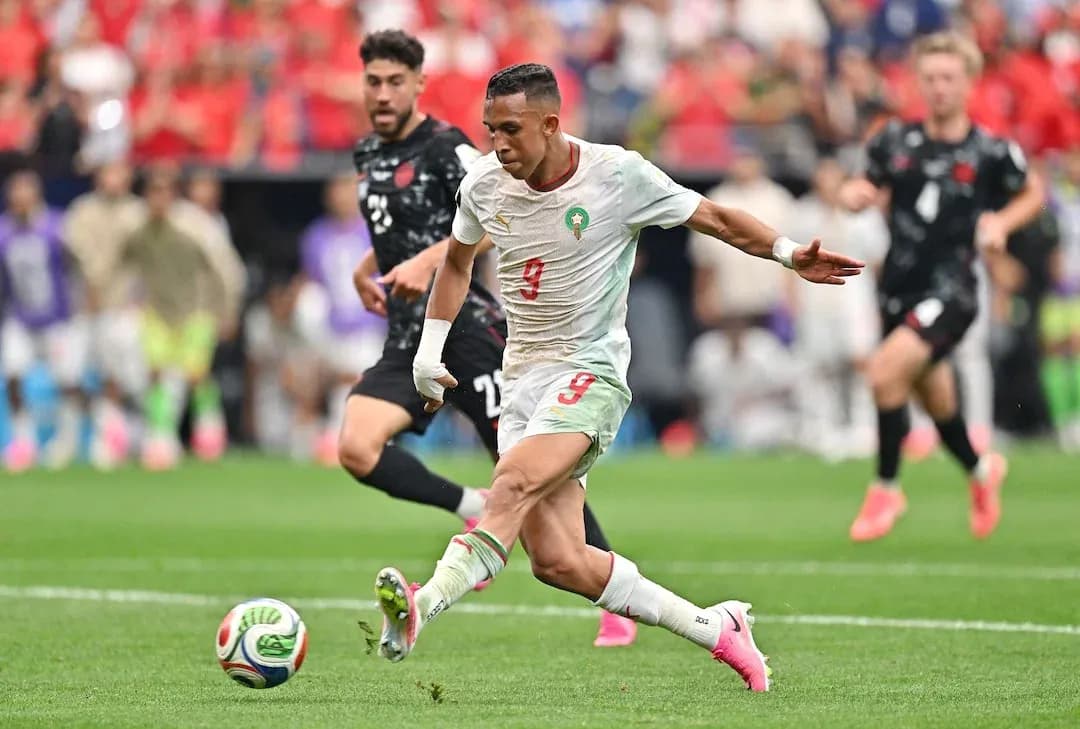
The reverse duel tilted even more heavily in Morocco’s favour. I. Saibari, also on 3 goals in total this World Cup, led their line as a modern forward: 6 shots, 3 on target, 36 duels contested with 15 won, and 7 attempted dribbles with 4 successful. He tested a Canadian back line that, at home, had been conceding 1.3 goals per match and 1.2 in total. With Canada’s full-backs pushing high, Saibari repeatedly found space in the channels, pulling De Fougerolles and Bombito into uncomfortable races back towards their own goal.
Behind him, the “Engine Room” battle was decisive. For Morocco, B. Diaz arrived as the World Cup’s second-best provider, with 4 assists in total, 8 key passes and a 90% pass accuracy. Operating between the lines, he drifted into the half-spaces behind Canada’s central midfielders, forcing Sigur and Eustaquio to turn and chase rather than dictate. On the right, A. Hakimi was a constant outlet, his 2 assists, 15 key passes and 11 tackles in total underlining how he knits both phases together. Every time Buchanan or Ahmed vacated their side to join attacks, Hakimi surged into the exposed corridor, stretching Canada’s 4-4-2 until it resembled a 4-2-4 out of possession.
Canada’s own creative fulcrum, at least in the wider tournament picture, had often been N. Saliba, with 2 assists and 1 goal in total, plus 4 key passes and 6 tackles. Starting on the bench here, he was a potential solution to Morocco’s compactness, but his impact was limited by game state; by the time his profile of progressive passing and pressing could be introduced, Morocco were in full control of the rhythm.
Statistically, the broader trends were always likely to favour Morocco. Heading into this game, Canada’s total of 9 goals for and 6 against suggested a side that opened games up, while Morocco’s 11 for and 4 against spoke of a team that could both create and control. Canada’s penalty record – 0 taken, 0 scored, 0 missed in total – meant they could not rely on set-piece windfalls, whereas Morocco had already lived the full emotional range from the spot: 5 penalties taken in total, 3 scored and 2 missed, a 60.00% conversion rate that underlined both their attacking threat and a lingering ruthlessness question. In Houston, though, they needed no such crutch.
Following this result, the narrative is of a Moroccan side whose structure and star quality aligned perfectly with the demands of knockout football. The 4-2-3-1, played in all 5 of their matches, again gave a stable platform for their main weapons: Saibari as finisher, Diaz as creator, Hakimi as the two-way force who bends the right flank to his will. Canada, whose 4-4-2 had brought 2 wins, 1 draw and 2 defeats in total, discovered its limits when denied the chaos it feeds on.
The tactical prognosis from this night is clear. Morocco’s blend of defensive solidity, elite chance creation from Diaz and Hakimi, and a confident focal point in Saibari makes them a credible threat deep into the 1/8 final phase and beyond. Canada leave with their attacking verve intact on the stat sheet but exposed in structural terms: a side that can overwhelm in groups, but which, in Houston, met a system and a squad too complete to be blown away.